
Free Safe Operating Procedure (Eye Wash Test) Template
Ensure your workplace emergency equipment is functional and ready. Download our free Safe Operating Procedure (Eye Wash Test) template to get started.
Free Safe Operating Procedure (Eye Wash Test) Template
DOCX • 126 KB + PDF
Updated Oct 2026
No signup required
Purpose of the Free Safe Operating Procedure (Eye Wash Test) Template
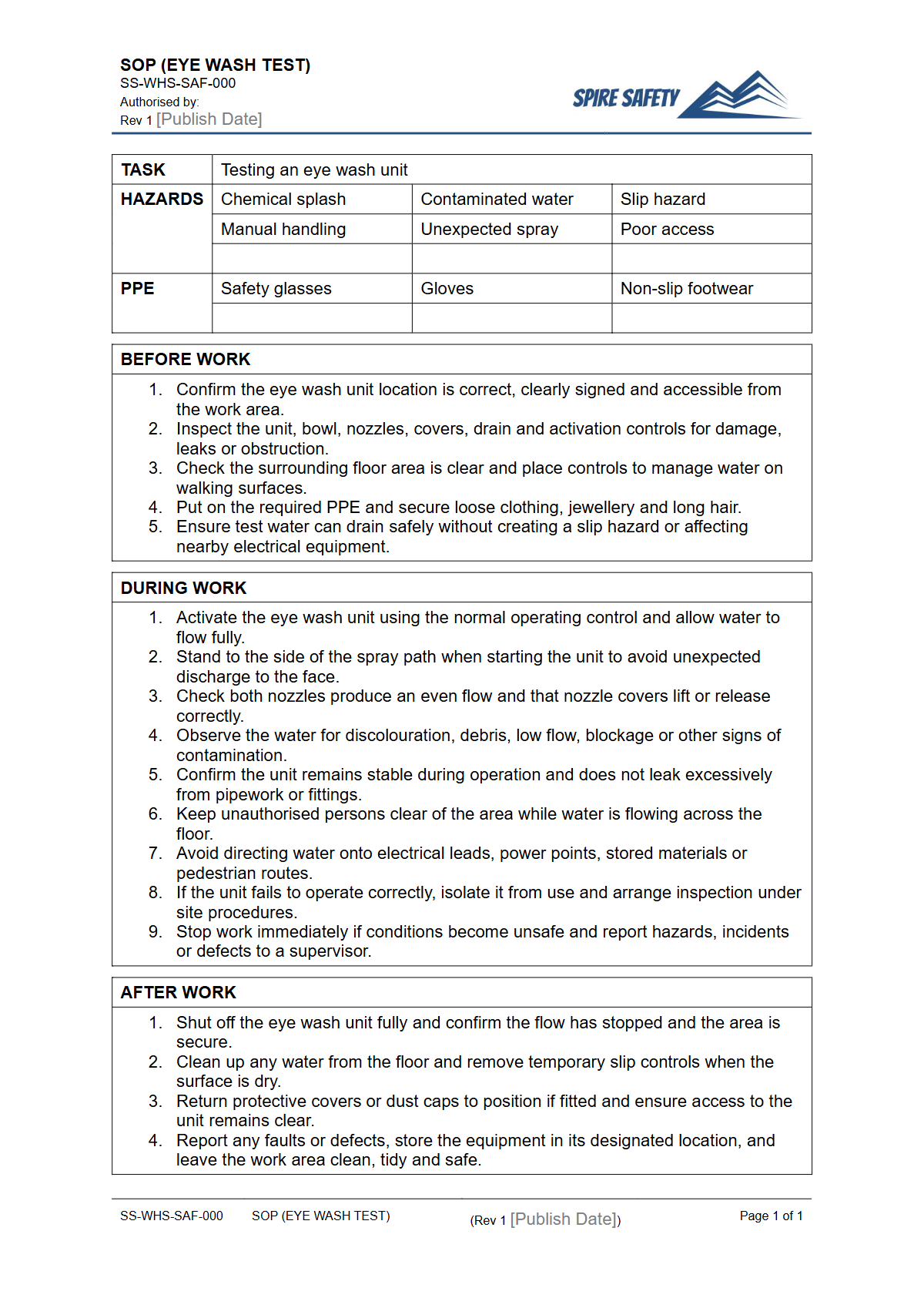
Ensuring emergency eye wash stations are functional is a critical part of any workplace safety program, especially where chemicals or fine particles pose a risk to eye health. This Free Safe Operating Procedure (Eye Wash Test) Template provides a structured framework for conducting and documenting weekly activation tests.
Following a consistent procedure helps confirm that your equipment operates as intended, delivering clean water at the correct flow rate when needed most. It standardises the testing process for all relevant personnel, ensuring no steps are missed and that clear records are maintained.
This SOP serves as a practical tool within your broader WHS management systems to demonstrate proactive risk management.
Video walkthrough
How to use the Free Safe Operating Procedure (Eye Wash Test) Template
Using this template is straightforward. First, download the file in your preferred format (DOCX for easy editing or PDF).
Next, customise the document by adding your company name, logo, site details, and the specific locations and models of your eye wash stations. The procedure outlines key steps for a weekly activation test, including checking for obstructions, activating the unit, assessing water flow and clarity, and recording the results.
While this template is aligned with Australian WHS principles, it is vital that you adapt it to your specific operational context.
Note: We have provided a comprehensive starting point based on common safety practices. However, you must customise this Safe Operating Procedure to reflect the specific eye wash equipment, potential hazards, and designated personnel at your workplace to ensure it is fit for purpose.
Tasks involving machinery, like those detailed in our free Air Compressor SOP, often require adjacent and fully functional safety equipment like eye wash stations.
When to use this Safe Operating Procedure
This Safe Operating Procedure should be used to guide the regular, scheduled testing of all plumbed and self-contained emergency eye wash units. The Australian Standard (AS 4775) recommends a weekly activation test to verify operation and flush sediment, rust, or bacteria from the lines, ensuring the water is clean and safe for use in an emergency.
This SOP should be performed at least once a week by a designated person. It is also best practice to conduct a test following any maintenance on the unit or the surrounding plumbing system, or after a period of prolonged inactivity, to confirm readiness. Using SOPs for routine checks is just as important as using them for high-risk tasks, such as those covered in our Circular Saw SOP.
Who should use this Safe Operating Procedure
This document is designed for any person responsible for workplace safety and equipment maintenance. This typically includes roles such as WHS Managers, Safety Officers, Maintenance Personnel, Site Supervisors, or designated first aid officers.
The clear, step-by-step format makes it a useful training and competency tool, ensuring that anyone tasked with performing the eye wash test does so correctly and consistently. The logging section also provides a clear record for managers and for compliance purposes, which is a key focus during any formal WHS compliance auditing. Ultimately, anyone involved in the upkeep of your site's emergency facilities can benefit from this procedure.
If your workplace uses other specialised equipment, consider implementing SOPs for those as well, like our deep fryer SOP for commercial kitchens. For a wider selection of safety documents, explore our complete free WHS resources library.
Common mistakes
Common mistakes to avoid
- Forgetting to check and clear the path to the eye wash station.
- Only 'bumping' the activator instead of running it for the recommended duration to properly flush the line.
- Failing to document the test results, creating a gap in compliance records.
- Not checking the expiry date on self-contained, portable eye wash solutions.
Legal references
Legal considerations
The following legal requirements may be relevant to this type of work.
- Work Health and Safety Act (Harmonised) — Provides the primary duties for protecting workers and other people from work health and safety risks.
- Work Health and Safety Regulations (Harmonised) — Sets out requirements supporting the management of workplace hazards and risks.
The following codes may be relevant to this type of work.
- Managing WHS Risks Code of Practice — Provides practical guidance on identifying hazards, assessing risks and applying effective controls.
- Work Health and Safety Consultation, Cooperation and Coordination Code of Practice — Provides practical guidance on consulting workers and coordinating with other duty holders.
- Managing the Work Environment and Facilities Code of Practice — Provides practical guidance on safe work environments, workplace facilities and related controls.
Did you know
The 15-Minute Rule
AS 4775 requires that eye wash stations provide a continuous flow of flushing fluid for a minimum of 15 minutes to effectively rinse contaminants from the eyes.
Location, Location, Location
Emergency eye wash stations must be located within 10 seconds of travel from a potential hazard and be on the same level, with a clear and unobstructed path.
FAQ
Frequently asked questions
01How often should an emergency eye wash station be tested in Australia?
02What should be recorded during an eye wash station test?
03Can I use this SOP template for combination shower and eye wash units?
04Why is water temperature important for an eye wash station?
Share this resource
Free Safe Operating Procedure (Eye Wash Test) Template
Browse Categories
How To Use It
- 1Download and open in Word or PDF.
- 2Replace the placeholders with your business details.
- 3Get it reviewed by a WHS specialist before rollout.
Need it customised?
Our WHS consultants can adapt this template to your site, run a gap analysis, or audit what you already have in place.
Book a Free Consultation WHS consulting servicesor call 1300 156 382
Related templates
- Free Safe Operating Procedure (Eyelet Press) Template
- Free Safe Operating Procedure (Fabric Cutter) Template
- Free Safe Operating Procedure (Facade Anchor Inspection) Template
- Free Safe Operating Procedure (Facade Glass Cleaning) Template
- Free Safe Operating Procedure (Facade Washdown) Template
- Free Safe Operating Procedure (Fall Arrest Harness) Template