
Free Safe Operating Procedure (Exhaust Removal) Template
Download our free Safe Operating Procedure (Exhaust Removal) template to manage risks from vehicle and equipment exhaust fumes. Get your DOCX and PDF now.
Free Safe Operating Procedure (Exhaust Removal) Template
DOCX • 126 KB + PDF
Updated Oct 2026
No signup required
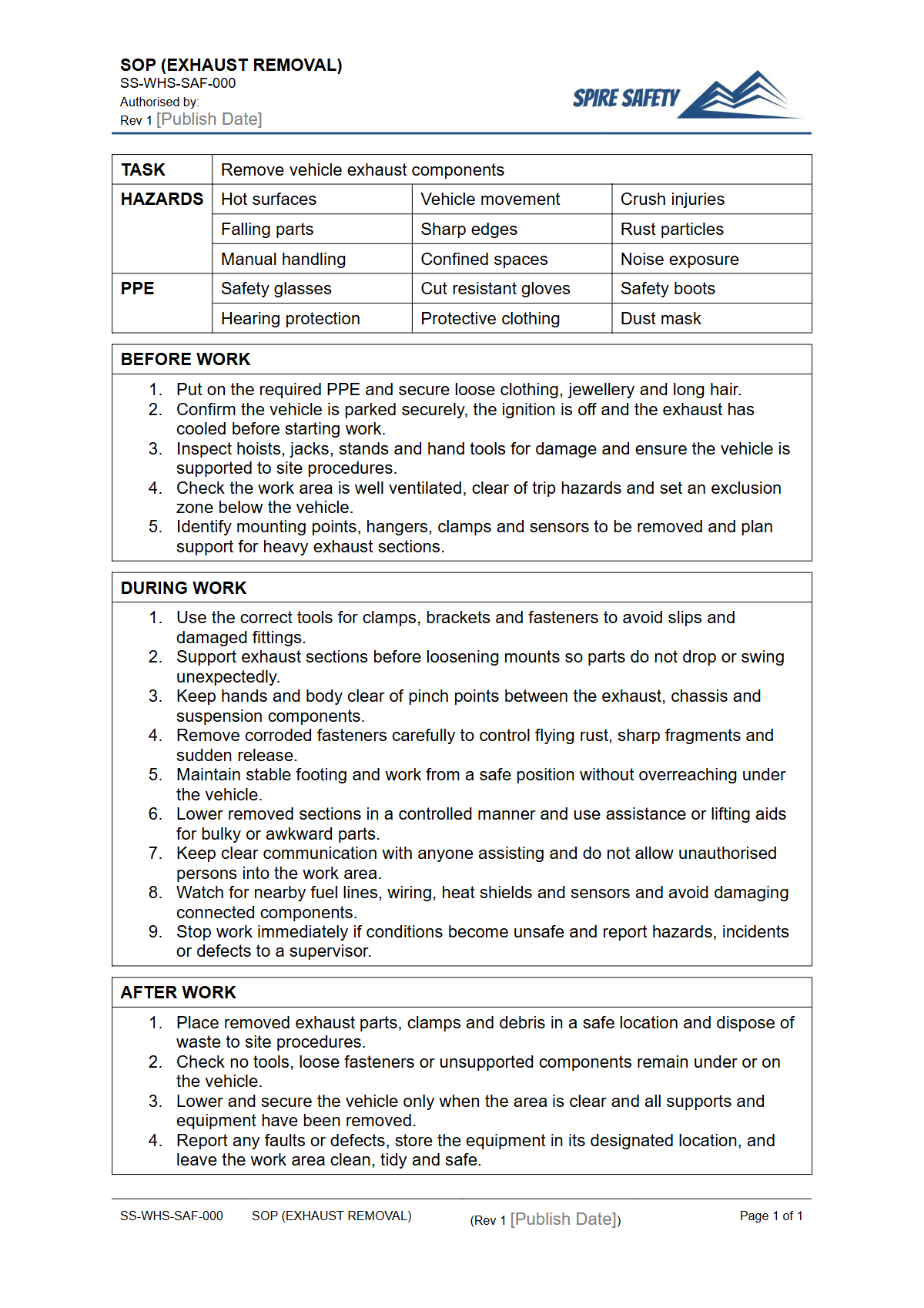
Purpose of the Free Safe Operating Procedure (Exhaust Removal) Template
Effectively managing the risks associated with vehicle and equipment exhaust is a critical WHS responsibility, particularly in enclosed or poorly ventilated areas. This free Safe Operating Procedure (Exhaust Removal) template provides a structured starting point for documenting the process of safely managing exhaust fumes.
The purpose of this Safe Operating Procedure is to help your business establish and communicate a clear, step-by-step process for controlling hazardous airborne contaminants like carbon monoxide, nitrogen oxides, and diesel particulate matter. Implementing a documented procedure helps fulfil your duty of care as a PCBU and provides a vital training tool for workers. This SOP can be integrated as a key component of your broader WHS management systems.
Video walkthrough
How to use the Free Safe Operating Procedure (Exhaust Removal) Template
This document is a customisable template designed for adaptation to your specific workplace. Upon downloading the DOCX or PDF file, you must review and modify it to align with your site's unique environment, equipment, and processes.
It is crucial to remember that this is a template, not a finished document. We have provided a structured starting point, but you must customise it to reflect the specific equipment, layout, ventilation, and work practices of your site.
Consultation with workers and relevant stakeholders is a mandatory step in this process to ensure the procedure is practical and effective. Ensure the final document is approved, communicated to all relevant personnel, and readily accessible at the point of work. This process is similar for other task-specific procedures, like our free Air Compressor SOP template.
What this Safe Operating Procedure covers
Our template provides a comprehensive framework based on Australian WHS practice, prompting you to detail key safety information including:
- Hazard Identification: Outlining specific dangers associated with exhaust fumes from petrol and diesel engines (e.g., asphyxiation, carcinogen exposure, irritation).
- Risk Assessment: A section to document the outcomes of a risk assessment for tasks involving running engines indoors or in confined spaces.
- Control Measures: Prompts to detail controls based on the hierarchy of control, such as direct source capture systems (hoses connected to tailpipes), general mechanical ventilation, specifying when doors and windows must be open, and limitations on engine idling times.
- Personal Protective Equipment (PPE): Specification of any required PPE, noting that PPE is a last resort when higher-level controls are not feasible. This may include respiratory protection in specific, assessed situations.
- Training and Competency: Requirements for worker training on the hazards of exhaust fumes and the correct use of control measures.
- Emergency Procedures: Steps to take in case of an incident, such as exposure, system failure, or activation of a carbon monoxide alarm.
When to use it
This Safe Operating Procedure is essential for any workplace where internal combustion engines are operated in a way that could expose people to harmful levels of exhaust fumes. This includes, but is not limited to:
- Vehicle and equipment maintenance workshops.
- Enclosed car parks and loading bays.
- Warehouses where forklifts, telehandlers, or other plant operate.
- Tunnelling and underground work environments.
- Any indoor or confined area where portable generators, pressure washers, or other engine-driven equipment is used.
- Facilities where plant such as that detailed in our Grader SOP might be maintained or started in an enclosed workshop.
Who should use it
This procedure is designed for use by multiple roles within an organisation. Persons Conducting a Business or Undertaking (PCBUs) and managers should use it to establish and formalise safe work practices.
Supervisors are responsible for implementing the SOP on the floor, ensuring workers follow the outlined procedures and use controls correctly. WHS officers can use the template to guide risk assessments and develop training materials.
Finally, workers who operate or work near engine-powered equipment must be trained on and follow the procedure to protect their own health and safety and that of their colleagues. Regular WHS compliance auditing can verify that these procedures are being consistently applied across the business.
By customising and implementing this procedure, you take a significant step towards managing a serious workplace health risk. For expert assistance in tailoring this or other procedures to your specific operational needs, our WHS consulting team can provide tailored support.
You can also browse our complete free WHS resources library for more templates to support your safety management system.
Common mistakes
Common mistakes to avoid
- Relying solely on opening a door or window for ventilation in enclosed spaces.
- Not maintaining the exhaust extraction system, leading to blocked filters or cracked hoses.
- Assuming outdoor or semi-enclosed areas are always safe from exhaust fume build-up, especially in calm conditions.
- Failing to train workers on the specific risks of exhaust fumes and the correct use of controls.
Legal references
Legal considerations
The following legal requirements may be relevant to this type of work.
- Work Health and Safety Act (Harmonised) — Provides the primary duties for protecting workers and other people from work health and safety risks.
- Work Health and Safety Regulations (Harmonised) — Sets out requirements supporting the management of workplace hazards and risks.
The following codes may be relevant to this type of work.
- Managing WHS Risks Code of Practice — Provides practical guidance on identifying hazards, assessing risks and applying effective controls.
- Work Health and Safety Consultation, Cooperation and Coordination Code of Practice — Provides practical guidance on consulting workers and coordinating with other duty holders.
- Managing the Work Environment and Facilities Code of Practice — Provides practical guidance on safe work environments, workplace facilities and related controls.
Did you know
Invisible Danger
Carbon monoxide (CO) is a major component of engine exhaust. It is colourless, odourless, and tasteless, and can cause incapacitation or death in minutes at high concentrations, often before the victim is aware of the danger.
Diesel Fume Classification
In 2012, the International Agency for Research on Cancer (IARC) classified diesel engine exhaust as a Group 1 carcinogen, placing it in the same category as asbestos and tobacco smoke as being known to cause cancer in humans.
FAQ
Frequently asked questions
01What are the main hazards of engine exhaust fumes in the workplace?
02Is a specific exhaust removal system required by law in Australia?
03How often should an exhaust removal SOP be reviewed?
04Can this SOP be used for both diesel and petrol engine exhaust?
Share this resource
Free Safe Operating Procedure (Exhaust Removal) Template
Browse Categories
How To Use It
- 1Download and open in Word or PDF.
- 2Replace the placeholders with your business details.
- 3Get it reviewed by a WHS specialist before rollout.
Need it customised?
Our WHS consultants can adapt this template to your site, run a gap analysis, or audit what you already have in place.
Book a Free Consultation WHS consulting servicesor call 1300 156 382
Related templates
- Free Safe Operating Procedure (Exit Sign Test) Template
- Free Safe Operating Procedure (Extensometer) Template
- Free Safe Operating Procedure (Eye Wash Test) Template
- Free Safe Operating Procedure (Eyelet Press) Template
- Free Safe Operating Procedure (Fabric Cutter) Template
- Free Safe Operating Procedure (Facade Anchor Inspection) Template