
Free Safe Operating Procedure (Excavator Tilt Bucket) Template
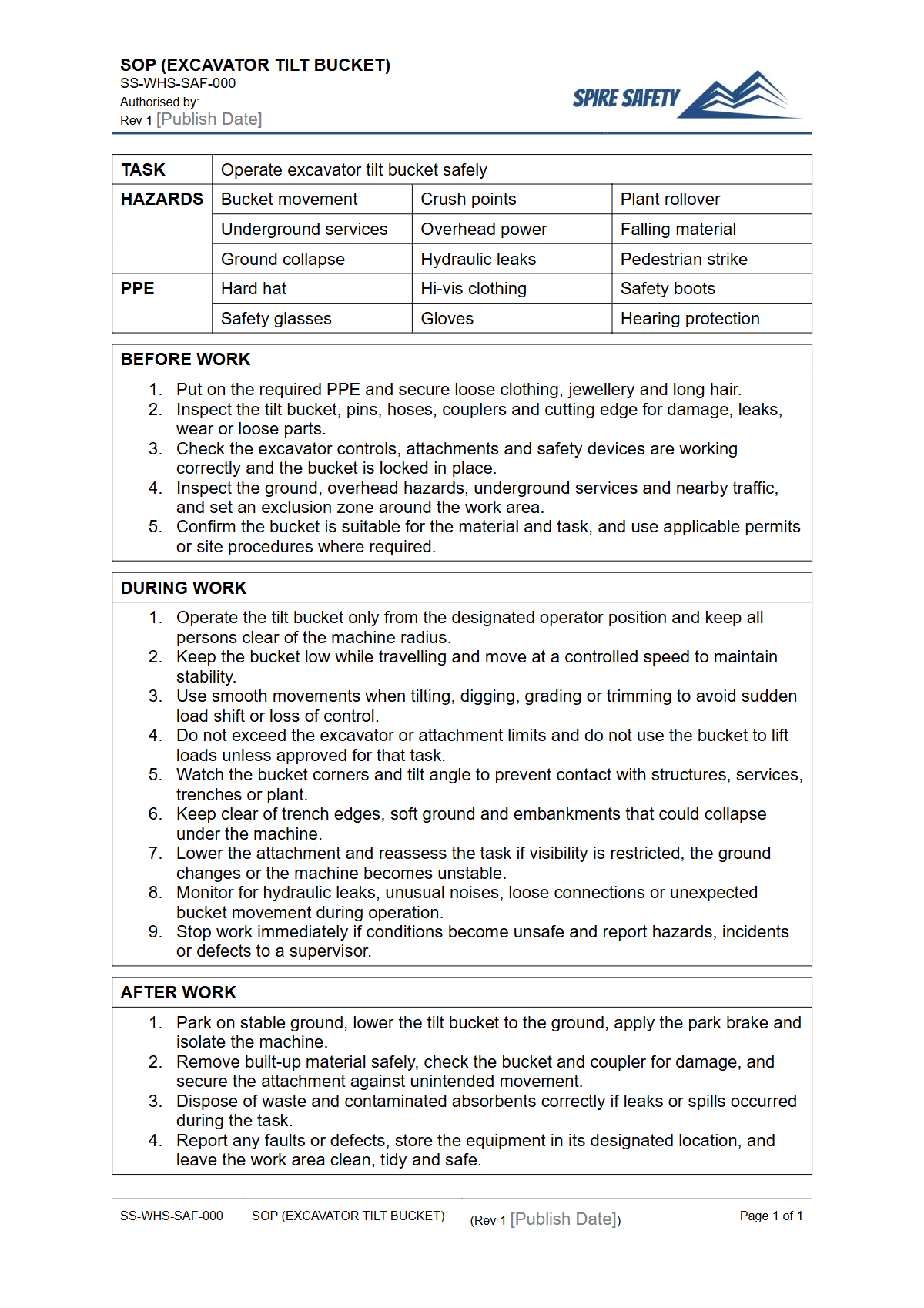
Download our free Safe Operating Procedure (Excavator Tilt Bucket) template. This customisable DOCX and PDF provides a structured starting point for your safety documents.
Free Safe Operating Procedure (Excavator Tilt Bucket) Template
DOCX • 126 KB + PDF
Updated Oct 2026
No signup required
Purpose of the Free Safe Operating Procedure (Excavator Tilt Bucket) Template
Operating heavy machinery like an excavator requires clear, documented safety protocols. The use of a tilt bucket attachment adds another layer of complexity and risk, involving articulated movements and additional hydraulic systems.
This free Safe Operating Procedure (Excavator Tilt Bucket) template provides a structured foundation for organisations to document the required steps for operating this equipment safely. A well-developed SOP is a critical tool in managing workplace health and safety, helping to minimise the risk of incidents, injuries, and damage to plant by clearly outlining pre-start checks, operational steps, and emergency responses.
This template is designed as a starting point, aligned with Australian WHS principles, to help you define and communicate safe work methods. It guides you in considering the specific hazards associated with tilt buckets, such as uncontrolled movement, hydraulic fluid injection, or striking other workers or structures due to the increased range of motion.
Video walkthrough
How to use the Free Safe Operating Procedure (Excavator Tilt Bucket) Template
To get started, simply download the template in your preferred format. The DOCX file is fully editable, allowing you to tailor every section to your specific operational needs.
The PDF version is a non-editable reference for easy printing and distribution. It is crucial to recognise that this is a template, not a finished document.
We have developed it as a starting point, and you must adapt it to reflect the specific hazards, equipment, and operating environment of your workplace.
Key Customisation Areas
- Plant Details: Specify the make, model, and year of the excavator and the tilt bucket attachment.
- Risk Control Measures: Update the risk assessment section to address hazards unique to your site, such as ground conditions, overhead powerlines, or nearby personnel.
- Personal Protective Equipment (PPE): List the mandatory PPE required for operators and any personnel working in the vicinity.
- Operating Sequence: Detail the step-by-step process for all tasks the equipment will be used for, from connecting the attachment to performing specific earthmoving activities like battering or final trim work. This section should be highly detailed and specific.
- Emergency Procedures: Outline clear instructions for responding to potential emergencies, including hydraulic hose failure, attachment malfunction, or medical emergencies.
Documenting procedures for specialised tasks is essential for safe site operations. For related excavation tasks, you might also find our FREE Trencher SOP Template a useful reference for creating consistent safety documentation.
When to use it
A Safe Operating Procedure for an excavator tilt bucket should be a core part of your daily operations and safety management. It is a 'live' document that should be used consistently during operator training and for ongoing competency verification.
It serves as a vital reference during pre-start meetings or toolbox talks to review the risks associated with a specific job. Furthermore, in the event of an incident or near-miss, the SOP provides a benchmark against which actual work practices can be reviewed and improved.
For other complex plant, having similar documents like a FREE Grader SOP (Safe Operating Procedure) Template ensures a consistent approach to safety across all equipment.
Who should use it
This template is designed for use by multiple roles within an organisation to ensure a comprehensive approach to safety. WHS Managers and Persons Conducting a Business or Undertaking (PCBUs) can use it to help fulfil their duty of care by implementing a formalised safe system of work.
A robust set of SOPs forms a cornerstone of effective WHS management systems, demonstrating proactive risk management.
Site Supervisors and Foremen should use the finalised SOP to induct and train operators, ensuring they understand the specific procedures for the equipment and the site. It also provides them with a clear standard for monitoring operator behaviour and compliance.
Operators themselves are the primary end-users, relying on the SOP for clear, unambiguous instructions on how to perform their work safely, particularly when operating less common attachments like tilt buckets. Many sites require operators to be familiar with SOPs for multiple machines, such as those detailed in our FREE Telehandler SOP Template.
Integrating SOPs into Your Safety System
A Safe Operating Procedure is most effective when it is integrated into your broader WHS framework, not used in isolation. It should directly correspond with your plant risk assessments, identifying the controls that the SOP puts into practice.
Regular reviews and updates are essential, especially after an incident, when new equipment is acquired, or when work processes change. The effectiveness of your SOPs and their practical application should be a key focus area during safety checks and formal reviews, which can be verified through a WHS compliance auditing process.
This template is one of many documents available to help you build out your safety systems. You can browse our entire collection in the free WHS resources library to find more templates and guides to support your organisation’s safety goals.
Common mistakes
Common mistakes to avoid
- Failing to customise the template for the specific make/model of excavator and tilt bucket.
- Neglecting to include site-specific hazards like overhead services, trenches, or pedestrian exclusion zones.
- Not providing practical, hands-on training to operators on the contents of the finalised SOP.
- Treating the SOP as a one-time 'tick and flick' exercise instead of a living document that requires regular review and updates.
Legal references
Legal considerations
The following legal requirements may be relevant to this type of work.
- Work Health and Safety Act (Harmonised) — Provides the primary duties for protecting workers and other people from work health and safety risks.
- Work Health and Safety Regulations (Harmonised) — Sets out requirements supporting the management of workplace hazards and risks.
The following codes may be relevant to this type of work.
- Managing WHS Risks Code of Practice — Provides practical guidance on identifying hazards, assessing risks and applying effective controls.
- Work Health and Safety Consultation, Cooperation and Coordination Code of Practice — Provides practical guidance on consulting workers and coordinating with other duty holders.
- Managing the Work Environment and Facilities Code of Practice — Provides practical guidance on safe work environments, workplace facilities and related controls.
Did you know
Hydraulic Pressure
The hydraulic systems on a modern excavator operate at immense pressures, often exceeding 3,000 PSI. A pinhole leak at this pressure can inject hydraulic fluid through the skin, causing severe chemical burns and tissue damage that requires immediate specialist medical attention.
Attachment Risks
According to safety regulators, incidents involving excavator attachments, including buckets detaching unexpectedly from quick-hitches, are a significant cause of serious injuries and fatalities on construction sites. This highlights the importance of detailed pre-start checks.
FAQ
Frequently asked questions
01What is the difference between a SWMS and an SOP for an excavator tilt bucket?
02Does this template cover all types of excavator attachments?
03Who is responsible for developing a Safe Operating Procedure?
04How often should an excavator SOP be reviewed?
Share this resource
Free Safe Operating Procedure (Excavator Tilt Bucket) Template
Browse Categories
How To Use It
- 1Download and open in Word or PDF.
- 2Replace the placeholders with your business details.
- 3Get it reviewed by a WHS specialist before rollout.
Need it customised?
Our WHS consultants can adapt this template to your site, run a gap analysis, or audit what you already have in place.
Book a Free Consultation WHS consulting servicesor call 1300 156 382
Related templates
- Free Safe Operating Procedure (Exhaust Grille Cleaning) Template
- Free Safe Operating Procedure (Exhaust Removal) Template
- Free Safe Operating Procedure (Exit Sign Test) Template
- Free Safe Operating Procedure (Extensometer) Template
- Free Safe Operating Procedure (Eye Wash Test) Template
- Free Safe Operating Procedure (Eyelet Press) Template