
Free Safe Operating Procedure (Exhaust Grille Cleaning) Template
Download our free Safe Operating Procedure for exhaust grille cleaning. This customisable template helps you document safety steps for kitchen maintenance.
Free Safe Operating Procedure (Exhaust Grille Cleaning) Template
DOCX • 126 KB + PDF
Updated Oct 2026
No signup required
Purpose of the Free Safe Operating Procedure (Exhaust Grille Cleaning) Template
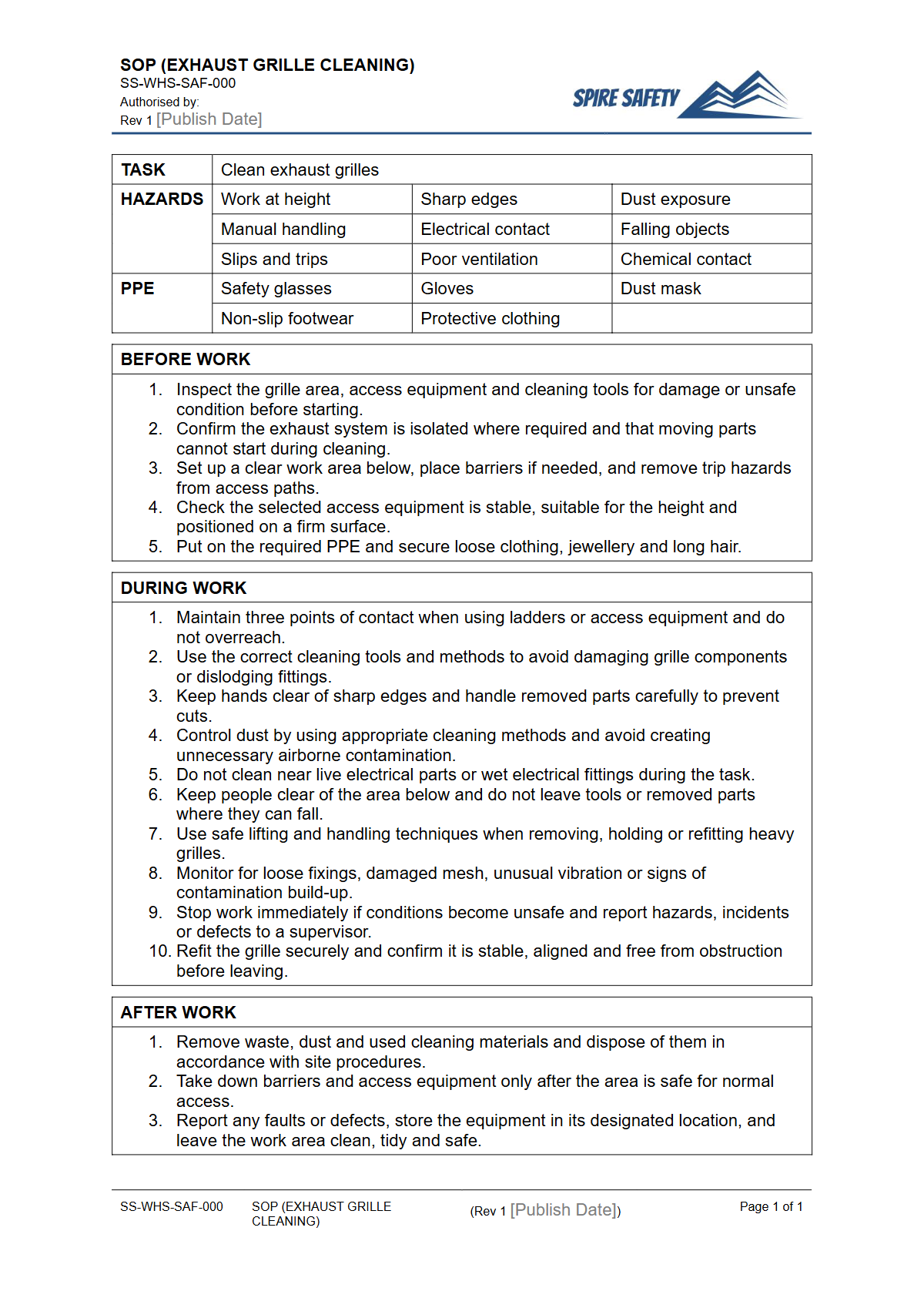
This Safe Operating Procedure (SOP) template provides a structured starting point for documenting the process of cleaning commercial exhaust grilles. Regular cleaning is critical for maintaining hygiene, ensuring efficient ventilation, and preventing fire hazards associated with grease and oil accumulation.
Documenting a safe process helps your organisation meet its duty of care under Australian WHS laws by formalising risk control measures for hazards such as hazardous chemicals, slips and falls, manual handling, and working at heights. A clear, documented procedure is a fundamental component of effective WHS management systems.
Using a standardised template ensures all necessary steps, from pre-operational checks to waste disposal, are considered and clearly communicated to workers. It helps in training staff and provides a consistent benchmark for performance and safety.
For businesses operating in hospitality or food service, this SOP complements other critical procedures, such as our free Safe Operating Procedure for deep fryer operation, creating a more comprehensive safety framework for your kitchen.
Video walkthrough
How to use the Free Safe Operating Procedure (Exhaust Grille Cleaning) Template
This template is available for download as a DOCX file for easy editing or as a PDF for straightforward printing. It is designed as a foundation that you must adapt to your specific operational context.
A generic template cannot account for the unique layout, equipment, and chemical products of your workplace. After downloading, consult with the workers who actually perform the cleaning task to ensure the procedure reflects the practical realities of the job.
Customise the document by filling in specific details, including the exact names of the cleaning chemicals used (and referencing their Safety Data Sheets), the required Personal Protective Equipment (PPE), emergency procedures, and contact persons. Once finalised, the SOP should be used to train all relevant staff.
We recommend keeping signed training records for all workers who will undertake this task. The effectiveness of these procedures can be verified through routine workplace inspections or a formal WHS compliance auditing program.
It is your responsibility as the PCBU (Person Conducting a Business or Undertaking) to ensure the information in the final document is accurate, site-specific, and effectively manages all identified risks. This document is a guide and we are not responsible for its implementation in your workplace.
When to use this Safe Operating Procedure
A Safe Operating Procedure for exhaust grille cleaning should be formally used in several key situations. It is the primary guidance document that workers must consult before commencing the cleaning task.
It serves as a critical training tool during the induction of new employees and for refresher training for existing staff, ensuring everyone follows the same safe and efficient method. The SOP should also be reviewed and potentially updated following any workplace incident or near miss related to the task, or whenever new equipment, chemicals, or processes are introduced.
Regular, scheduled reviews are also a key part of maintaining its relevance and effectiveness.
Who should use this Safe Operating Procedure
This SOP is intended for use by multiple parties within an organisation. Workers directly responsible for cleaning exhaust grilles are the primary users who must follow the procedure step-by-step.
Supervisors and managers must use the SOP to train their teams, supervise the work, and ensure all safety measures are in place. The PCBU holds the ultimate responsibility for ensuring such a procedure is developed, implemented, and maintained as part of their primary duty of care.
This document provides a practical tool to help them fulfil that obligation. For expert guidance on developing a suite of SOPs tailored to your business, consider engaging professional WHS consulting services.
A well-drafted SOP demonstrates a commitment to workplace safety and provides clear, actionable instructions that protect your people and your business. It forms just one part of a comprehensive safety management approach. For more tools and templates covering a wide range of tasks and equipment, browse our extensive library of free WHS resources.
Common mistakes
Common mistakes to avoid
- Using the template without customising it for the specific workplace, equipment, and chemicals used.
- Failing to consult with and train workers on the final, approved procedure.
- Not providing or inspecting the required Personal Protective Equipment (PPE) before work begins.
- Neglecting to review the SOP after an incident or when new equipment is introduced.
Legal references
Legal considerations
The following legal requirements may be relevant to this type of work.
- Work Health and Safety Act (Harmonised) — Provides the primary duties for protecting workers and other people from work health and safety risks.
- Work Health and Safety Regulations (Harmonised) — Sets out requirements supporting the management of workplace hazards and risks.
The following codes may be relevant to this type of work.
- Managing WHS Risks Code of Practice — Provides practical guidance on identifying hazards, assessing risks and applying effective controls.
- Work Health and Safety Consultation, Cooperation and Coordination Code of Practice — Provides practical guidance on consulting workers and coordinating with other duty holders.
- Managing the Work Environment and Facilities Code of Practice — Provides practical guidance on safe work environments, workplace facilities and related controls.
Did you know
Grease Fires
A significant percentage of commercial kitchen fires originate in the cooking appliance and spread into the exhaust system. Accumulated grease acts as a fuel source, making regular cleaning a critical fire prevention measure.
FAQ
Frequently asked questions
01Why is a specific SOP needed for just cleaning an exhaust grille?
02What other safety documents do I need for kitchen maintenance?
03How often should commercial kitchen exhaust systems be cleaned?
04Can any staff member clean the exhaust grilles?
Share this resource
Free Safe Operating Procedure (Exhaust Grille Cleaning) Template
Browse Categories
How To Use It
- 1Download and open in Word or PDF.
- 2Replace the placeholders with your business details.
- 3Get it reviewed by a WHS specialist before rollout.
Need it customised?
Our WHS consultants can adapt this template to your site, run a gap analysis, or audit what you already have in place.
Book a Free Consultation WHS consulting servicesor call 1300 156 382
Related templates
- Free Safe Operating Procedure (Exhaust Removal) Template
- Free Safe Operating Procedure (Exit Sign Test) Template
- Free Safe Operating Procedure (Extensometer) Template
- Free Safe Operating Procedure (Eye Wash Test) Template
- Free Safe Operating Procedure (Eyelet Press) Template
- Free Safe Operating Procedure (Fabric Cutter) Template