
Free Safe Operating Procedure (Excavator Grapple) Template
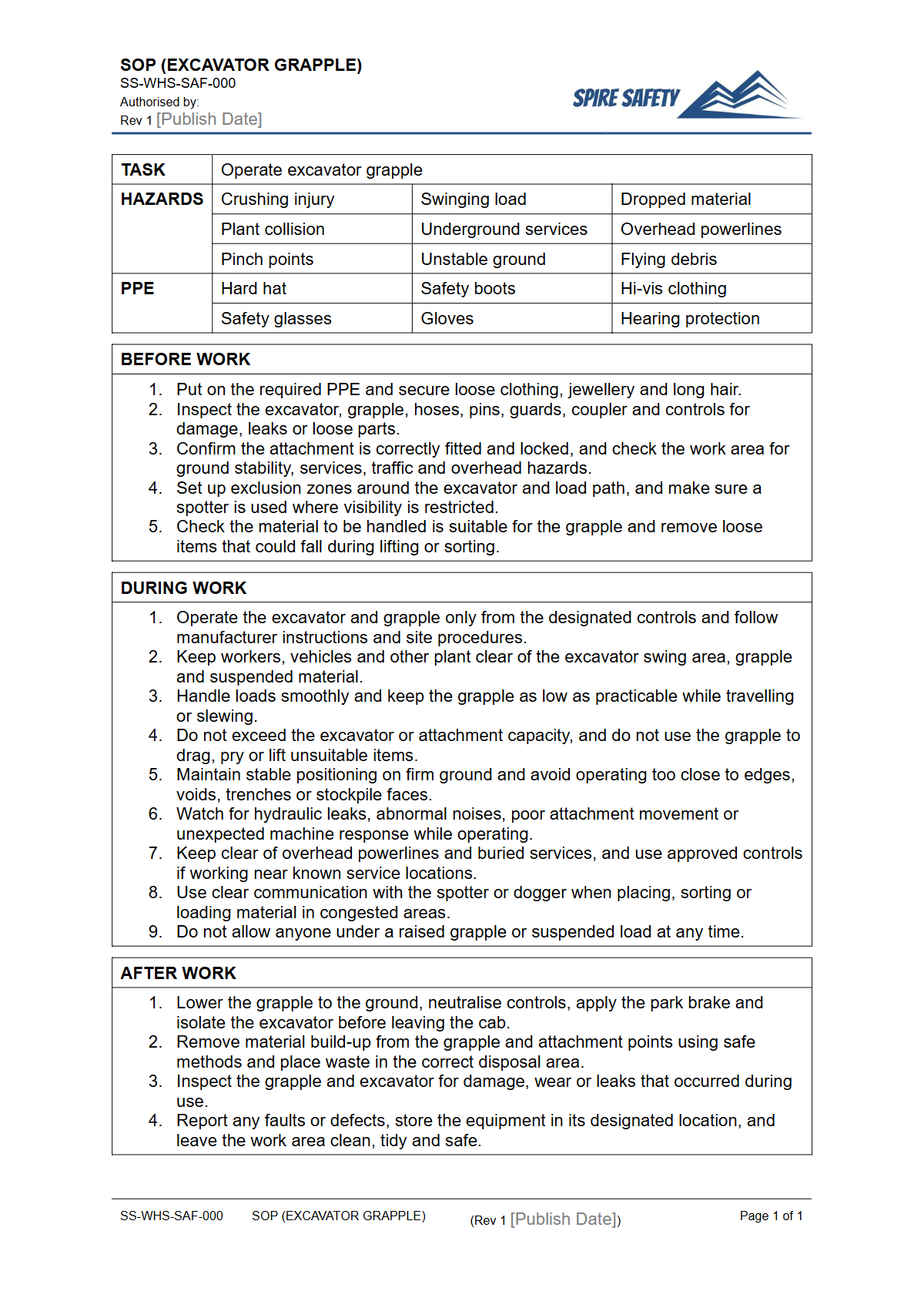
Clearly outline the safety steps for using an excavator with a grapple attachment. Download our free Safe Operating Procedure template to get started.
Free Safe Operating Procedure (Excavator Grapple) Template
DOCX • 126 KB + PDF
Updated Oct 2026
No signup required
Purpose of the Free Safe Operating Procedure (Excavator Grapple) Template
Operating an excavator fitted with a grapple attachment introduces specific risks beyond standard bucket work, including dropped loads, instability, and entanglement. This Free Safe Operating Procedure (Excavator Grapple) Template provides a structured framework for documenting the required steps to perform these tasks safely.
A documented SOP is a critical tool for ensuring all operators understand the hazards and the control measures necessary to manage them. By clearly outlining pre-start checks, operational steps, and shutdown procedures, this SOP helps organisations meet their duty of care and minimise the risk of incidents involving high-risk plant.
A well-developed SOP serves as a key training document and a reference point for workers. It formalises the expected safe work behaviour when handling materials like logs, scrap metal, or demolition debris.
Integrating this procedure into your broader safety framework is essential for consistent risk management. An effective WHS management system relies on clear, task-specific documents like this to translate safety policy into safe practice on the ground.
Video walkthrough
How to use the Free Safe Operating Procedure (Excavator Grapple) Template
This downloadable document, available in DOCX and PDF, is a comprehensive starting point. It is not a finished, ready-to-use document.
You must adapt it to reflect the unique conditions of your workplace, the specific models of excavators and grapples in use, and the types of materials being handled. The first step is to conduct a site-specific risk assessment for the task, involving the workers who will be performing it.
Use the findings from your risk assessment to add or remove steps and detail specific hazards and controls relevant to your operations.
We recommend a collaborative approach to customisation. Involve experienced operators, supervisors, and safety personnel in the review process to ensure the final SOP is practical, accurate, and effective.
Once finalised, the SOP should be used to train all relevant workers before they are authorised to operate the equipment. This process is similar for other types of heavy machinery, and it's good practice to have consistent documentation across your fleet, such as a FREE Telehandler SOP Template for your materials handlers.
Please note: We have designed this template as a starting point. You must customise it with your specific site details, machinery models, local hazards, and control measures to ensure it is effective for your workplace.
When to use it
A Safe Operating Procedure for an excavator grapple should be a living document integrated into your daily operations. It is not a 'set and forget' piece of paperwork.
Its primary use is as a direct guide for operators before and during the task. It should also be a central part of any operator training and competency verification program.
Supervisors should use it during toolbox talks to reinforce key safety points and before authorising work. Furthermore, the SOP becomes an essential reference during incident investigations to identify any deviation from established safe work methods. Regular reviews of procedures as part of your internal checks can help prevent incidents before they occur, a core principle of effective WHS compliance auditing.
Who should use it
This Safe Operating Procedure is intended for several key roles within an organisation. Primarily, excavator operators must be thoroughly familiar with it, using it as their guide for safe operation.
Supervisors and site managers are responsible for implementing the SOP, ensuring operators are trained on its contents, and monitoring compliance on site. WHS managers and safety advisors will use the template as a foundation for developing a site-specific procedure that aligns with the organisation's safety management system.
It also serves as a critical tool for trainers and assessors responsible for verifying that operators are competent to use the grapple attachment safely. Documented procedures are vital for all earthmoving equipment; a consistent approach can be applied when creating documents like a FREE Grader SOP Template as well.
If your worksite uses other specialised excavation equipment, it is important to have specific SOPs for each. For instance, the safety requirements for digging narrow channels are distinct and would be covered in a document like our FREE Trencher SOP Template. By exploring our entire free WHS resources library, you can find more templates to build out a comprehensive safety documentation system for your plant and equipment.
Common mistakes
Common mistakes to avoid
- Using a grapple attachment that is not correctly rated for the size and weight of the excavator.
- Failing to establish and enforce a clear exclusion zone around the working area to protect ground personnel.
- Attempting to lift loads that exceed the excavator's rated lifting capacity, leading to instability and tipping.
- Neglecting to inspect the grapple's hydraulic lines, pins, and structural integrity during pre-start checks.
Legal references
Legal considerations
The following legal requirements may be relevant to this type of work.
- Work Health and Safety Act (Harmonised) — Provides the primary duties for protecting workers and other people from work health and safety risks.
- Work Health and Safety Regulations (Harmonised) — Sets out requirements supporting the management of workplace hazards and risks.
The following codes may be relevant to this type of work.
- Managing WHS Risks Code of Practice — Provides practical guidance on identifying hazards, assessing risks and applying effective controls.
- Work Health and Safety Consultation, Cooperation and Coordination Code of Practice — Provides practical guidance on consulting workers and coordinating with other duty holders.
- Managing the Work Environment and Facilities Code of Practice — Provides practical guidance on safe work environments, workplace facilities and related controls.
Did you know
Hydraulic Power
The hydraulic systems that power excavator grapples can generate immense clamping forces, often exceeding 10 tonnes, making them highly effective but also introducing significant crushing hazards.
Attachment Incidents
A significant percentage of mobile plant incidents are related to attachments. The most common causes are incorrect attachment to the machine or the unexpected release of an attachment during operation.
FAQ
Frequently asked questions
01What should be included in a pre-operational check for an excavator grapple?
02Is a Safe Operating Procedure (SOP) the same as a Safe Work Method Statement (SWMS)?
03How often should an excavator grapple SOP be reviewed?
04Who is responsible for developing and implementing an SOP for an excavator grapple?
Share this resource
Free Safe Operating Procedure (Excavator Grapple) Template
Browse Categories
How To Use It
- 1Download and open in Word or PDF.
- 2Replace the placeholders with your business details.
- 3Get it reviewed by a WHS specialist before rollout.
Need it customised?
Our WHS consultants can adapt this template to your site, run a gap analysis, or audit what you already have in place.
Book a Free Consultation WHS consulting servicesor call 1300 156 382
Related templates
- Free Safe Operating Procedure (Excavator Ripper) Template
- Free Safe Operating Procedure (Excavator Tilt Bucket) Template
- Free Safe Operating Procedure (Exhaust Grille Cleaning) Template
- Free Safe Operating Procedure (Exhaust Removal) Template
- Free Safe Operating Procedure (Exit Sign Test) Template
- Free Safe Operating Procedure (Extensometer) Template