
Free Safe Operating Procedure (Event Equipment Setup) Template
Manage the risks of setting up event equipment with our customisable Safe Operating Procedure. Download your free DOCX and PDF template to get started today.
Free Safe Operating Procedure (Event Equipment Setup) Template
DOCX • 126 KB + PDF
Updated Oct 2026
No signup required
Purpose of the Free Safe Operating Procedure (Event Equipment Setup) Template
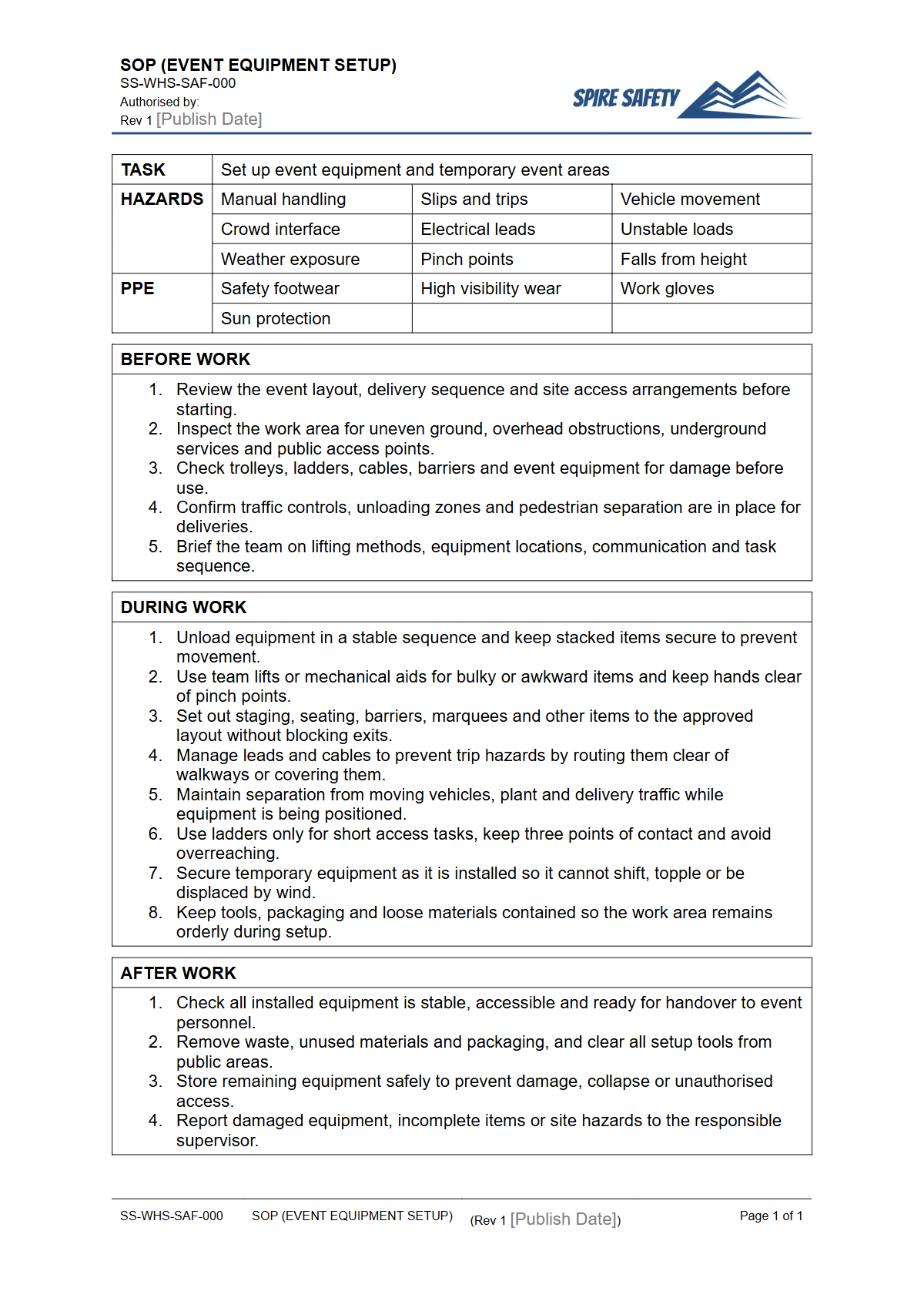
This Free Safe Operating Procedure (Event Equipment Setup) Template provides a structured framework for documenting the safety requirements and step-by-step processes for setting up equipment at events. This includes tasks associated with staging, audio-visual systems, lighting, temporary structures, and marquees.
The purpose of this Safe Operating Procedure is to help your organisation standardise its processes, control identified hazards, and provide clear instructions to workers, ensuring tasks are performed safely and consistently.
A well-documented SOP is a key component in demonstrating how a Person Conducting a Business or Undertaking (PCBU) meets their primary duty of care under WHS legislation. It serves as a critical tool for worker training, inductions, and ongoing competency management.
Implementing clear SOPs is a foundational element of robust WHS management systems, helping to formalise risk controls and promote a positive safety culture on site.
Video walkthrough
How to use the Free Safe Operating Procedure (Event Equipment Setup) Template
This template is designed to be a comprehensive starting point. To use it effectively, you must adapt it to the specific context of your workplace and the unique equipment you use.
Event setups can vary dramatically, from small corporate functions to large-scale music festivals, each with different hazards.
Follow these steps:
- Download the template in the DOCX format for easy editing.
- Conduct a thorough risk assessment for your specific event setup activities to identify all potential hazards.
- Customise the document by adding your company branding, specific site details, and the names of responsible persons.
- Detail the exact step-by-step procedures for safely setting up, operating (if applicable), and dismantling each piece of equipment. Include controls for hazards like manual handling, electrical risks, working at heights, and noise.
- Incorporate details of required Personal Protective Equipment (PPE), pre-start checks, and emergency procedures.
- Review the completed SOP with your workers to ensure it is practical, clear, and understood by everyone involved.
Note: This document is a template only. As we are not present in your workplace, we cannot know your specific site conditions, the type of equipment used, or the competency of your personnel.
You must customise this Safe Operating Procedure to reflect the actual risks and control measures relevant to your operations.
When to use this Safe Operating Procedure
A Safe Operating Procedure for event equipment setup should be integrated into your daily operations. It is not a document to be filed away; it is an active tool for managing safety.
Use it during worker training and inductions to ensure all personnel, including new hires and contractors, understand the required safety standards before commencing work.
It should be referenced during pre-start meetings and toolbox talks to refresh awareness of key hazards and controls before a setup begins. The SOP also serves as a benchmark for supervisors monitoring work practices and for incident investigations to determine if procedures were followed.
If large plant is used on site for stage construction, a separate SOP like our FREE Telehandler SOP Template will also be required for that specific machinery.
Who should use it
This SOP is intended for use by anyone involved in the management and execution of event setups. This includes:
- Event Managers and Producers: To ensure safety obligations are being met and to provide clear instructions to their teams and contractors.
- Site Supervisors and Crew Leaders: To direct work, conduct pre-start checks, and enforce safe work practices on the ground.
- Workers and Technicians: As a clear guide on how to perform their tasks safely, what PPE to wear, and what hazards to look out for.
- WHS Officers and Advisors: As part of the overall safety management system and for conducting workplace inspections and audits.
Organisations engaging contractors for event setup can also use this template as a reference to ensure the contractors' safety documentation meets a required standard. Verifying contractor compliance is a key part of supply chain safety management, a process that can be formalised through WHS compliance auditing.
For tasks in related industries, such as event catering, different procedures are necessary. For example, kitchen operations would require a document like our free Safe Operating Procedure for deep fryers to manage specific food service hazards. You can find a wide range of templates covering various tasks and equipment in our free WHS resources library.
Common mistakes
Common mistakes to avoid
- Failing to conduct a site-specific risk assessment before customising the procedure.
- Using untrained or unqualified personnel for high-risk tasks like electrical work or rigging.
- Neglecting to inspect equipment for damage, wear, or missing components before each use.
- Inadequate communication between different crews (e.g., lighting, sound, staging) working in the same area.
Legal references
Legal considerations
The following legal requirements may be relevant to this type of work.
- Work Health and Safety Act (Harmonised) — Provides the primary duties for protecting workers and other people from work health and safety risks.
- Work Health and Safety Regulations (Harmonised) — Sets out requirements supporting the management of workplace hazards and risks.
The following codes may be relevant to this type of work.
- Managing WHS Risks Code of Practice — Provides practical guidance on identifying hazards, assessing risks and applying effective controls.
- Work Health and Safety Consultation, Cooperation and Coordination Code of Practice — Provides practical guidance on consulting workers and coordinating with other duty holders.
- Managing the Work Environment and Facilities Code of Practice — Provides practical guidance on safe work environments, workplace facilities and related controls.
Did you know
A Major Cause of Injury
According to Safe Work Australia, slips, trips and falls are a leading cause of workplace injury across many industries, a risk that is heightened on busy and often temporary event sites with numerous cables and uneven surfaces.
Manual Handling Risks
Hazardous manual tasks, such as lifting heavy flight cases and stage components, are a primary source of musculoskeletal injuries in the live production and events industry. A well-designed SOP helps control these risks.
FAQ
Frequently asked questions
01What hazards should an SOP for event equipment setup cover?
02Is a Safe Operating Procedure legally required for setting up event equipment in Australia?
03How often should an SOP for event equipment be reviewed?
04Can a generic SOP be used for all types of event equipment?
Share this resource
Free Safe Operating Procedure (Event Equipment Setup) Template
Browse Categories
How To Use It
- 1Download and open in Word or PDF.
- 2Replace the placeholders with your business details.
- 3Get it reviewed by a WHS specialist before rollout.
Need it customised?
Our WHS consultants can adapt this template to your site, run a gap analysis, or audit what you already have in place.
Book a Free Consultation WHS consulting servicesor call 1300 156 382
Related templates
- Free Safe Operating Procedure (Event Floor Cleaning) Template
- Free Safe Operating Procedure (Event Signage Setup) Template
- Free Safe Operating Procedure (Event Waste Cleanup) Template
- Free Safe Operating Procedure (Excavator Grapple) Template
- Free Safe Operating Procedure (Excavator Ripper) Template
- Free Safe Operating Procedure (Excavator Tilt Bucket) Template