
Free Safe Operating Procedure (Event Chair Handling) Template
Establish clear, safe work methods for handling event chairs with our free SOP template. Download the customisable DOCX to protect your team from manual handling risks.
Free Safe Operating Procedure (Event Chair Handling) Template
DOCX • 126 KB + PDF
Updated Oct 2026
No signup required
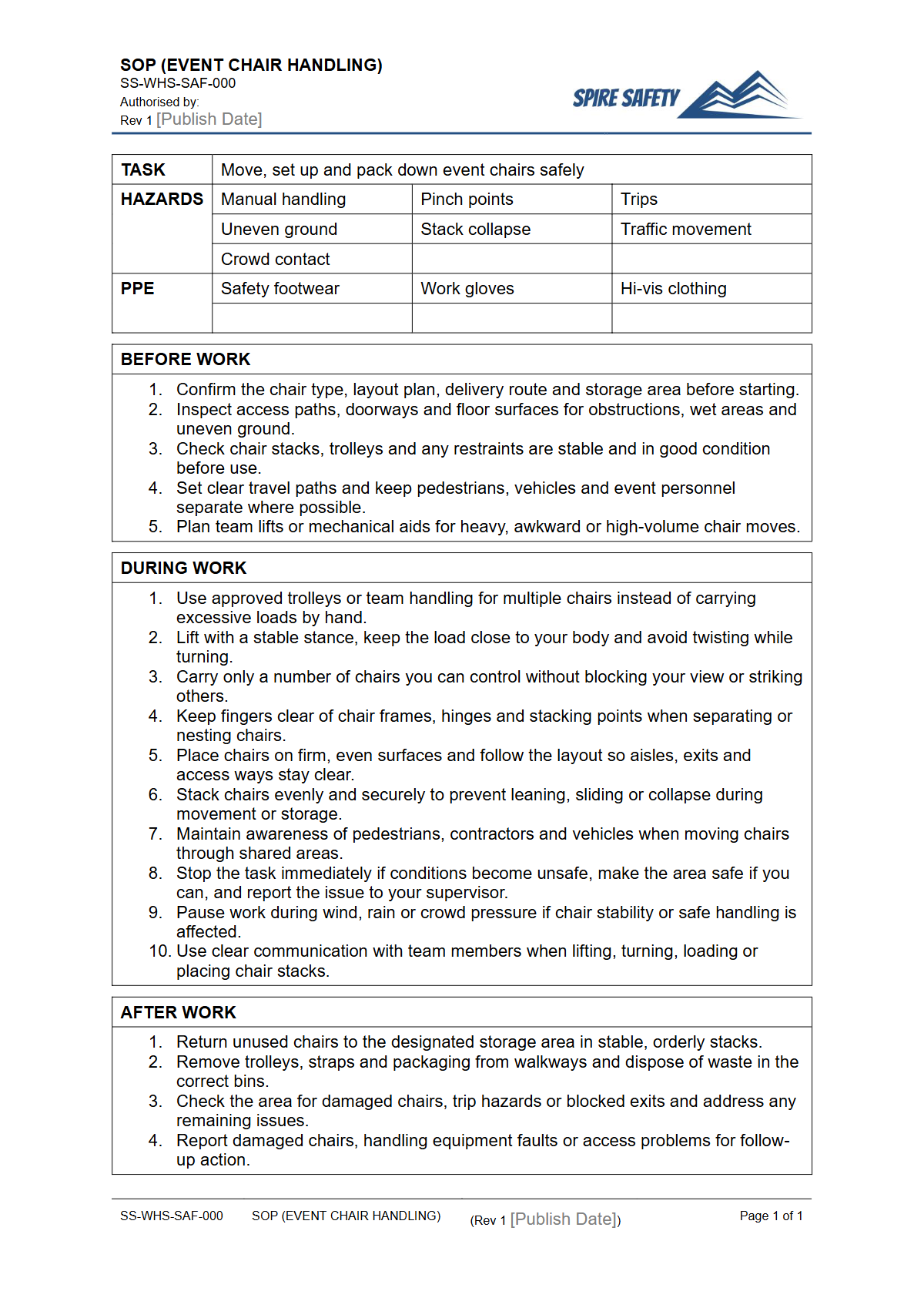
Purpose of the Free Safe Operating Procedure (Event Chair Handling) Template
Our Free Safe Operating Procedure (Event Chair Handling) Template provides a structured framework for documenting the key steps, hazards, and controls for setting up, moving, and packing down event chairs. Manual handling tasks, even those that seem simple, are a leading cause of workplace injuries like sprains, strains, and musculoskeletal disorders (MSDs).
This template helps your organisation formalise safe work practices to minimise those risks.
By implementing a clear SOP, you can standardise team behaviour, streamline worker training, and provide clear instructions to prevent injuries. Using this document helps demonstrate your commitment to safety and forms a critical part of a comprehensive WHS management system, ensuring consistent and safe work practices across all events and venues.
Video walkthrough
How to use the Free Safe Operating Procedure (Event Chair Handling) Template
This resource is available for immediate download as a customisable DOCX file and a print-ready PDF. The DOCX version is designed to be adapted to your specific operational needs.
Fill in the required fields for your company details, site information, and add any task-specific details relevant to your work environment.
It is crucial to remember that this template is a starting point. You must review, edit, and adapt it to reflect the specific types of chairs, equipment (like trolleys or dollies), venue layouts, and staffing arrangements at your workplace.
We strongly recommend a site-specific risk assessment to inform your final SOP.
For the SOP to be effective, consultation is key. Involve your workers—the people who perform the task daily—in the customisation process to ensure the procedure is practical and accurately reflects the on-the-ground realities.
If you require expert assistance to tailor this document or develop other WHS procedures, our specialist WHS consulting services can provide practical support.
When to use it
This SOP should be implemented whenever workers are required to manually handle chairs, particularly in large quantities. It is directly applicable to a range of common scenarios in the events, hospitality, and function-hire industries, including:
- Setting up seating for conferences, functions, weddings, and public gatherings.
- Clearing chairs from a venue post-event.
- Stacking and storing chairs in a warehouse or storage area.
- Transporting chairs between venues or to and from a depot.
The procedure should be a core document for inducting new event staff and for conducting refresher training on safe manual handling techniques. It serves as a constant reference point for workers and supervisors to ensure safety standards are maintained.
Who should use it
This Safe Operating Procedure is intended for use by several key roles within an organisation:
- Event Managers and Supervisors: To train staff, assign tasks, and oversee work to ensure it's performed safely.
- Workers and Event Crew: As a direct guide on how to perform their chair handling duties without injury.
- WHS/OHS Officers and Managers: To integrate into the broader safety management system and use as a basis for risk assessments and incident investigations.
Management should also use this SOP as a benchmark during workplace inspections and to guide performance reviews. Procedures must be reviewed and updated regularly, especially following an incident, a change in equipment, or as part of regular WHS compliance audits.
Event operations often involve a diverse range of tasks beyond just setting up furniture. It's vital to have documented procedures for all identified hazards, from manual handling to kitchen safety.
For example, our free Safe Operating Procedure for deep fryer operation provides a similar structured approach for managing risks in a hospitality environment.
This SOP is one of many documents that can strengthen your safety framework. You can explore a wide range of other templates and guides in our free WHS resources library to support your organisation's safety efforts.
Common mistakes
Common mistakes to avoid
- Failing to conduct a pre-task risk assessment for the specific venue and layout.
- Using poor manual handling techniques, like twisting the back while carrying a stack of chairs.
- Exceeding the safe stacking height for chairs, creating unstable towers that can fall.
- Not providing or using available mechanical aids like chair trolleys or dollies.
Legal references
Legal considerations
The following legal requirements may be relevant to this type of work.
- Work Health and Safety Act (Harmonised) — Provides the primary duties for protecting workers and other people from work health and safety risks.
- Work Health and Safety Regulations (Harmonised) — Sets out requirements supporting the management of workplace hazards and risks.
The following codes may be relevant to this type of work.
- Managing WHS Risks Code of Practice — Provides practical guidance on identifying hazards, assessing risks and applying effective controls.
- Work Health and Safety Consultation, Cooperation and Coordination Code of Practice — Provides practical guidance on consulting workers and coordinating with other duty holders.
- Managing the Work Environment and Facilities Code of Practice — Provides practical guidance on safe work environments, workplace facilities and related controls.
Did you know
A Heavy Burden
According to Safe Work Australia, manual handling injuries account for around 40% of all serious workers' compensation claims, making them the most common cause of workplace injury in the country.
Stacking Limits
Most plastic stacking chairs have a manufacturer-recommended stacking limit (e.g., 10-12 high) to ensure stability. Exceeding this limit can create a serious toppling hazard.
FAQ
Frequently asked questions
01What are the main hazards of handling event chairs?
02Is a Safe Operating Procedure for handling chairs legally required?
03How often should we train staff on this SOP?
04Can we use chair trolleys or dollies with this SOP?
Share this resource
Free Safe Operating Procedure (Event Chair Handling) Template
Browse Categories
How To Use It
- 1Download and open in Word or PDF.
- 2Replace the placeholders with your business details.
- 3Get it reviewed by a WHS specialist before rollout.
Need it customised?
Our WHS consultants can adapt this template to your site, run a gap analysis, or audit what you already have in place.
Book a Free Consultation WHS consulting servicesor call 1300 156 382
Related templates
- Free Safe Operating Procedure (Event Equipment Packdown) Template
- Free Safe Operating Procedure (Event Equipment Setup) Template
- Free Safe Operating Procedure (Event Floor Cleaning) Template
- Free Safe Operating Procedure (Event Signage Setup) Template
- Free Safe Operating Procedure (Event Waste Cleanup) Template
- Free Safe Operating Procedure (Excavator Grapple) Template