
Free Safe Operating Procedure (Event Equipment Packdown) Template
Download our Free Safe Operating Procedure for event equipment packdown, available in DOCX and PDF. This template helps you document safety steps for your team.
Free Safe Operating Procedure (Event Equipment Packdown) Template
DOCX • 126 KB + PDF
Updated Oct 2026
No signup required
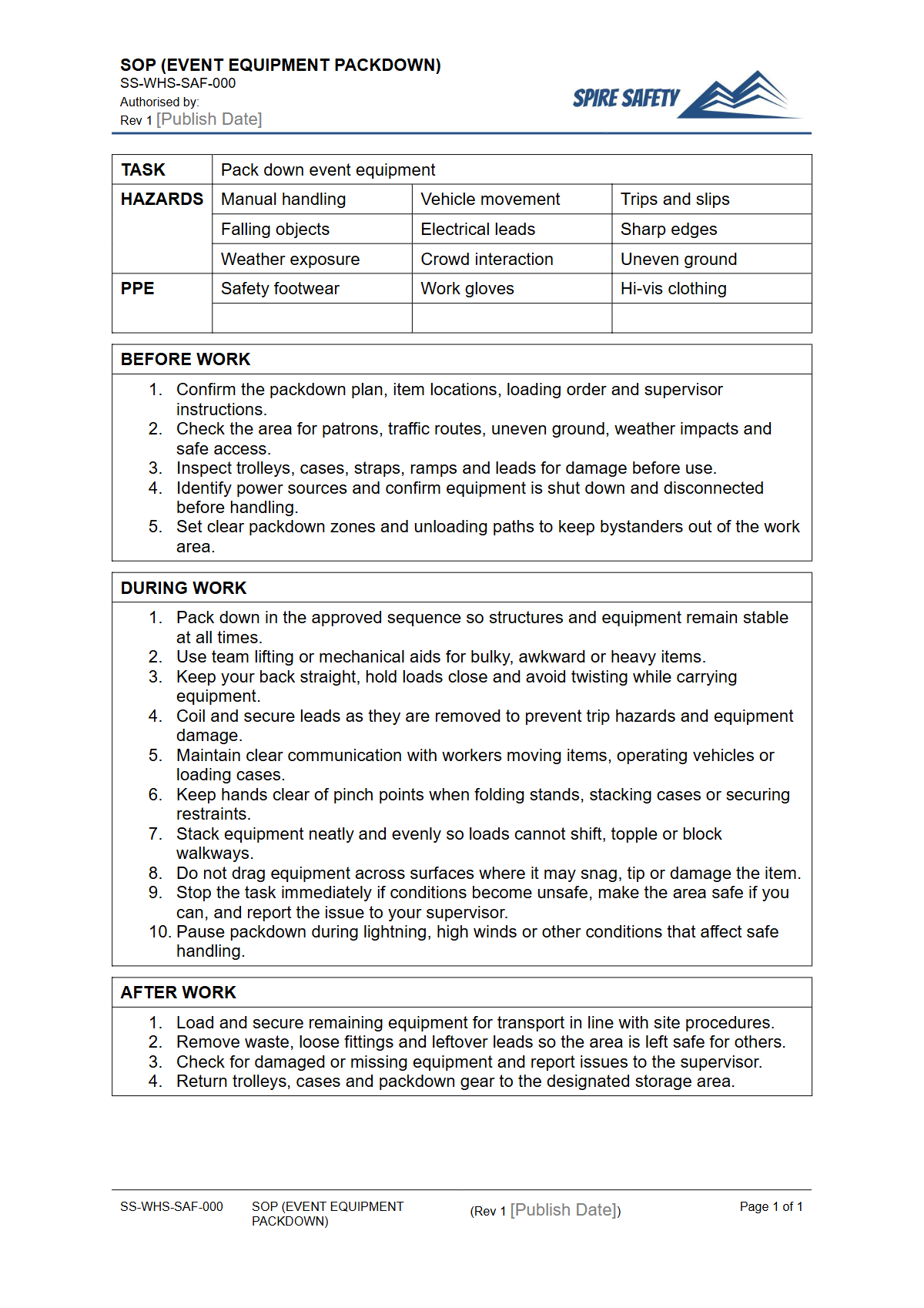
Purpose of the Free Safe Operating Procedure (Event Equipment Packdown) Template
The packdown or 'bump-out' phase of an event is a high-risk period, often performed under tight deadlines with fatigued workers. This Free Safe Operating Procedure (Event Equipment Packdown) Template provides a structured starting point for documenting the required safety controls for this critical task.
Using a standardised procedure helps your organisation manage risks associated with manual tasks, vehicle movement, electrical equipment, and potential slips, trips, and falls. It creates a consistent, repeatable process that simplifies worker training and demonstrates your commitment to health and safety management.
A well-developed Safe Operating Procedure (SOP) is a key administrative control measure. It formalises the safest way to perform a task, identifying potential hazards and outlining step-by-step instructions to minimise risk.
This is particularly important for tasks involving heavy lifting, such as moving staging, lighting trusses, or large speaker systems, where equipment like forklifts may be used. For specific high-risk plant, you should also have dedicated procedures, such as a Telehandler SOP, to supplement your general packdown plan.
What this Safe Operating Procedure covers:
- Essential pre-packdown checks and site preparation.
- Personal Protective Equipment (PPE) requirements.
- Step-by-step procedures for dismantling, sorting, and packing equipment.
- Controls for common hazards like manual handling, electrical safety, and vehicle interaction.
- Emergency procedures and post-packdown cleanup.
Video walkthrough
How to use the Free Safe Operating Procedure (Event Equipment Packdown) Template
This document is a template designed for customisation. To use it effectively, download the DOCX or PDF file and adapt it to the specific context of your workplace.
Consult directly with the event crew, supervisors, and any other workers involved in the packdown process. Their direct experience is invaluable for identifying practical hazards and effective controls.
Once customised, the SOP should be reviewed and approved by a competent person within your organisation before being used to train your team.
Important: We have created this template as a guide based on Australian WHS principles. You must adapt it to reflect the unique risks, equipment, and environment of your specific event or venue.
Integrating this SOP into your broader comprehensive WHS management systems ensures it is part of a cycle of continuous improvement, including regular reviews and updates.
When to use it
This Safe Operating Procedure should be implemented during the planning phase of any event and used actively during the packdown or bump-out. It is most critical for events involving significant infrastructure, such as concerts, festivals, exhibitions, and corporate functions with substantial audio-visual setups.
The procedure should be included in pre-start meetings before packdown begins to reinforce safety requirements, confirm responsibilities, and address any site-specific conditions that may have changed during the event.
Regularly reviewing procedures like this one is a core part of maintaining a safe workplace. If your event involves particularly complex logistics or high-risk activities, engaging specialist WHS consulting can provide expert oversight and ensure your safety documentation is robust and practical.
Who should use it
This SOP is intended for use by anyone responsible for overseeing or performing event packdown activities. This includes:
- Event Managers and Producers: To plan and resource a safe bump-out.
- Site Supervisors and Crew Chiefs: To induct, train, and directly supervise workers according to the agreed procedure.
- Technicians and Crew Members: As a reference for performing their tasks safely and consistently.
- WHS Officers and Advisors: As a tool for risk assessment, training, and incident investigation.
Ensuring workers are competent to perform tasks is crucial. This SOP can be used as a basis for training and competency assessments.
It should be supported by specific procedures for individual tools and equipment, such as a Air Compressor SOP if pneumatic tools are used for dismantling structures. You can find more examples in our free WHS resources library to build out your safety documentation.
Common mistakes
Common mistakes to avoid
- Failing to consult with the workers who actually perform the packdown tasks.
- Using a generic template without customising it for specific site conditions and equipment.
- Neglecting to provide adequate training on the finalised SOP before work begins.
- Not planning for safe interaction between pedestrians and vehicles during the busy bump-out phase.
Legal references
Legal considerations
The following legal requirements may be relevant to this type of work.
- Work Health and Safety Act (Harmonised) — Provides the primary duties for protecting workers and other people from work health and safety risks.
- Work Health and Safety Regulations (Harmonised) — Sets out requirements supporting the management of workplace hazards and risks.
The following codes may be relevant to this type of work.
- Managing WHS Risks Code of Practice — Provides practical guidance on identifying hazards, assessing risks and applying effective controls.
- Work Health and Safety Consultation, Cooperation and Coordination Code of Practice — Provides practical guidance on consulting workers and coordinating with other duty holders.
- Managing the Work Environment and Facilities Code of Practice — Provides practical guidance on safe work environments, workplace facilities and related controls.
Did you know
Manual Task Risks
The events and entertainment industry has a high rate of musculoskeletal injuries. According to Safe Work Australia, hazardous manual tasks are a leading cause of serious workers' compensation claims across all industries.
FAQ
Frequently asked questions
01What are the main hazards during an event equipment packdown?
02Is this SOP template enough to be WHS-aligned?
03Who is responsible for creating a Safe Operating Procedure?
04How often should an event packdown SOP be reviewed?
Share this resource
Free Safe Operating Procedure (Event Equipment Packdown) Template
Browse Categories
How To Use It
- 1Download and open in Word or PDF.
- 2Replace the placeholders with your business details.
- 3Get it reviewed by a WHS specialist before rollout.
Need it customised?
Our WHS consultants can adapt this template to your site, run a gap analysis, or audit what you already have in place.
Book a Free Consultation WHS consulting servicesor call 1300 156 382
Related templates
- Free Safe Operating Procedure (Event Equipment Setup) Template
- Free Safe Operating Procedure (Event Floor Cleaning) Template
- Free Safe Operating Procedure (Event Signage Setup) Template
- Free Safe Operating Procedure (Event Waste Cleanup) Template
- Free Safe Operating Procedure (Excavator Grapple) Template
- Free Safe Operating Procedure (Excavator Ripper) Template