
Free Safe Operating Procedure (Event Barrier Setup) Template
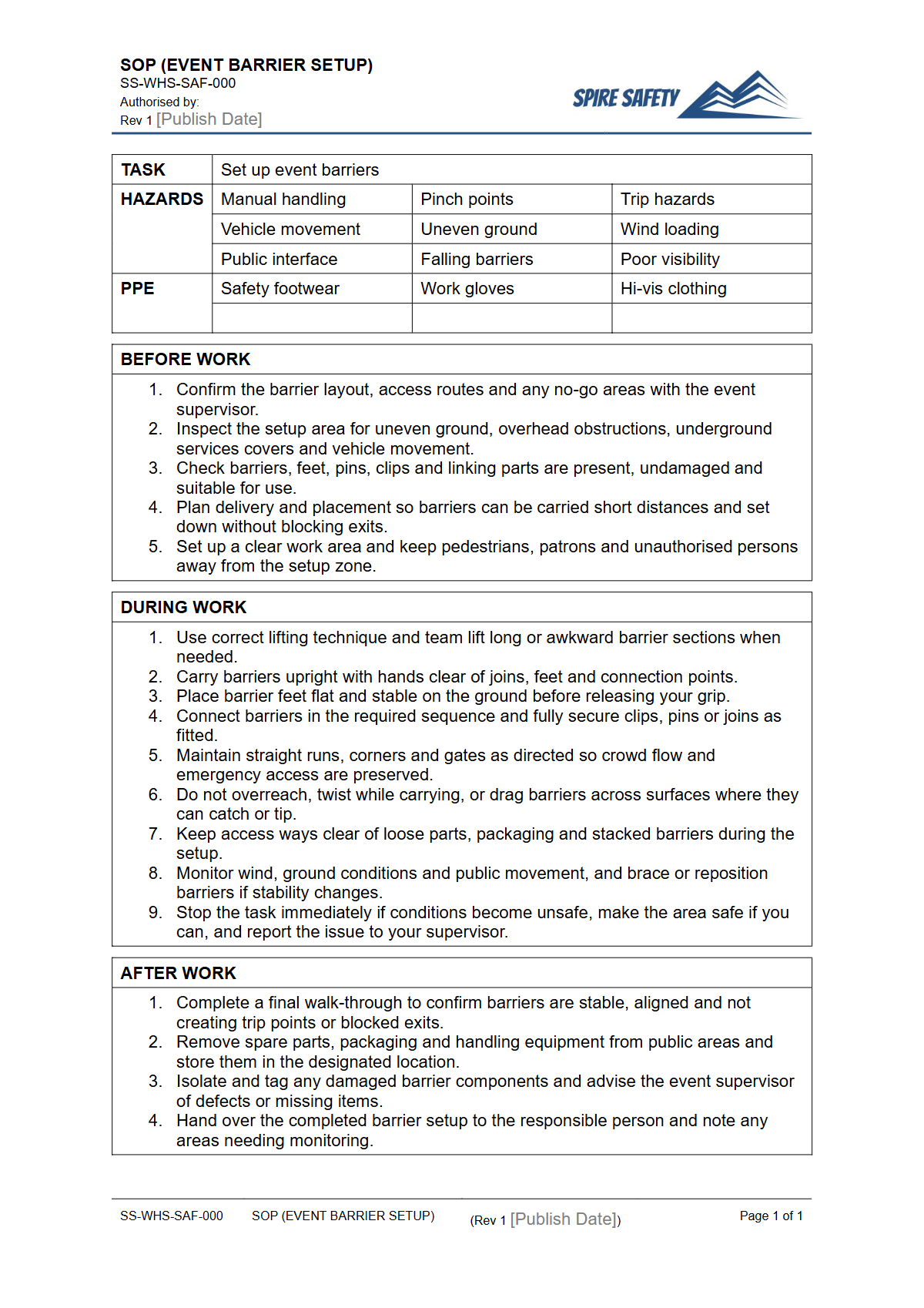
Download our free Safe Operating Procedure (Event Barrier Setup) Template to establish clear, safe steps for setting up crowd control and site barriers.
Free Safe Operating Procedure (Event Barrier Setup) Template
DOCX • 126 KB + PDF
Updated Oct 2026
No signup required
Purpose of the Free Safe Operating Procedure (Event Barrier Setup) Template
Effectively managing crowds, vehicles, and site hazards is fundamental to event and workplace safety. This free Safe Operating Procedure (Event Barrier Setup) Template provides a structured framework for documenting the required steps to safely install, position, and dismantle temporary barriers.
Using a documented SOP ensures that tasks are performed consistently and safely, reducing the risk of incidents related to crowd surges, unauthorised access, or vehicle-pedestrian interactions. It establishes clear responsibilities and safety controls, from pre-start checks to final removal.
An SOP for event barrier setup is a key operational document within broader comprehensive WHS management systems. It helps organisations demonstrate due diligence by systematically addressing risks associated with temporary demarcation and crowd control. By outlining approved methods for manual handling, barrier placement, and site assessment, this procedure helps protect workers and the public from injury.
Video walkthrough
How to use the Free Safe Operating Procedure (Event Barrier Setup) Template
This template is provided in both DOCX and PDF formats for your convenience. To use it effectively, download the DOCX file and adapt it to the unique circumstances of your workplace, event, or site.
This involves conducting a site-specific risk assessment to identify all potential hazards associated with the barrier setup task, such as uneven ground, vehicle traffic, overhead powerlines, or environmental factors like high wind.
Consultation with workers who will be performing the task is a critical step. Their direct experience is invaluable for creating a practical and effective procedure.
You must incorporate the specific types of barriers being used (e.g., water-filled, interlocking steel, concrete blocks) and refer to the manufacturer’s instructions for safe handling and installation. If you require assistance tailoring safety documentation to your operational needs, consider engaging our specialist WHS consulting services.
Important: We have provided this template as a starting point, but it is essential that you customise it to reflect the specific hazards, equipment, and controls present in your workplace. A generic procedure is not sufficient to manage your specific WHS obligations.
When to use an Event Barrier Setup SOP
A Safe Operating Procedure for setting up event barriers should be used whenever temporary barriers are required to manage people or vehicles. This applies to a wide range of situations, including:
- Public events like music festivals, markets, and sporting competitions.
- Construction sites to delineate work zones and protect the public from hazards.
- Roadworks and traffic management schemes to guide vehicles and protect workers.
- Warehouses and manufacturing facilities to create exclusion zones around machinery or moving equipment.
- Emergency situations to establish cordons and secure incident scenes.
On larger sites, ground preparation may be required before barriers can be safely placed. For tasks involving heavy earthmoving equipment, you should develop specific procedures, such as our free Grader SOP template, to ensure the work is done safely.
Who should use this Safe Operating Procedure
This SOP should be developed and implemented by those responsible for site and event safety, then used by the workers carrying out the task. Key personnel include:
- Event Managers and Site Supervisors: Responsible for ensuring that a safe system of work is in place and that workers are trained in the procedure.
- WHS Officers and Advisors: Responsible for assisting with the risk assessment process and reviewing the SOP to ensure it aligns with organisational and legislative requirements.
- Team Leaders and Forepersons: Responsible for direct supervision and ensuring the procedure is followed correctly on the ground.
- Workers and Labour Hire Staff: The individuals who must follow the documented steps to safely handle and position the barriers.
In many cases, heavy barriers are moved into position using plant and equipment. Where this occurs, workers must be trained and competent in the use of that machinery.
You can use resources like our free Telehandler SOP to document procedures for specific plant.
Key Controls for Safe Barrier Setup
A robust SOP for event barrier setup should detail specific control measures. The core of the procedure is hazard identification and risk control. Key elements to include are:
Site & Environmental Assessment
Before any work begins, the area must be assessed. Check for ground stability, slopes, proximity to traffic, and weather forecasts, particularly for high winds which can topple barrier systems.
Ensure the planned layout does not obstruct emergency exits or critical access points. The effectiveness of these controls can be verified through regular WHS compliance auditing.
Manual Handling
Barriers can be heavy and awkward. The SOP must specify correct lifting techniques, the use of team lifts, and when mechanical aids (like trolleys or forklifts) are required.
This is a critical component for preventing musculoskeletal injuries, which are a leading cause of workplace injury claims. Documenting procedures for all site equipment, such as a free Air Compressor SOP for powered tools, helps create a holistically safe environment.
Barrier Inspection and Placement
Include a pre-start checklist to inspect barriers for damage, defects, or missing components like pins or caps. The procedure should outline the correct method for interlocking barriers to ensure they form a stable, continuous line that cannot be easily breached.
For water-filled barriers, specify the fill level required for stability.
This template is one of many tools available in our free WHS resources library, designed to help Australian businesses build safer systems of work.
Common mistakes
Common mistakes to avoid
- Placing barriers on soft, unstable, or sloped ground without adequate support.
- Failing to properly interlock barriers, creating weak points that can be pushed open by crowd pressure.
- Not inspecting barriers for damage like cracks, sharp edges, or faulty connectors before use.
- Forgetting to plan for and clearly mark emergency access and egress routes within the barrier line.
Legal references
Legal considerations
The following legal requirements may be relevant to this type of work.
- Work Health and Safety Act (Harmonised) — Provides the primary duties for protecting workers and other people from work health and safety risks.
- Work Health and Safety Regulations (Harmonised) — Sets out requirements supporting the management of workplace hazards and risks.
The following codes may be relevant to this type of work.
- Managing WHS Risks Code of Practice — Provides practical guidance on identifying hazards, assessing risks and applying effective controls.
- Work Health and Safety Consultation, Cooperation and Coordination Code of Practice — Provides practical guidance on consulting workers and coordinating with other duty holders.
- Managing the Work Environment and Facilities Code of Practice — Provides practical guidance on safe work environments, workplace facilities and related controls.
Did you know
Manual Handling Risk
Musculoskeletal disorders from hazardous manual tasks are the most common type of workplace injury in Australia. A single crowd control barrier can weigh over 20 kg, making correct lifting techniques and mechanical aids essential.
Wind Loading
Wind can exert significant force on barrier lines, especially if they have signage attached. A strong gust can cause improperly secured barriers to tip over, creating a serious hazard for workers and the public.
FAQ
Frequently asked questions
01What information should be included in an SOP for event barrier setup?
02Who is responsible for creating and implementing this SOP?
03How often should a Safe Operating Procedure for barrier setup be reviewed?
04Can this template be used for all types of crowd control barriers?
Share this resource
Free Safe Operating Procedure (Event Barrier Setup) Template
Browse Categories
How To Use It
- 1Download and open in Word or PDF.
- 2Replace the placeholders with your business details.
- 3Get it reviewed by a WHS specialist before rollout.
Need it customised?
Our WHS consultants can adapt this template to your site, run a gap analysis, or audit what you already have in place.
Book a Free Consultation WHS consulting servicesor call 1300 156 382
Related templates
- Free Safe Operating Procedure (Event Cable Cover Setup) Template
- Free Safe Operating Procedure (Event Chair Handling) Template
- Free Safe Operating Procedure (Event Equipment Packdown) Template
- Free Safe Operating Procedure (Event Equipment Setup) Template
- Free Safe Operating Procedure (Event Floor Cleaning) Template
- Free Safe Operating Procedure (Event Signage Setup) Template