
Free Safe Operating Procedure (Escalator Isolation) Template
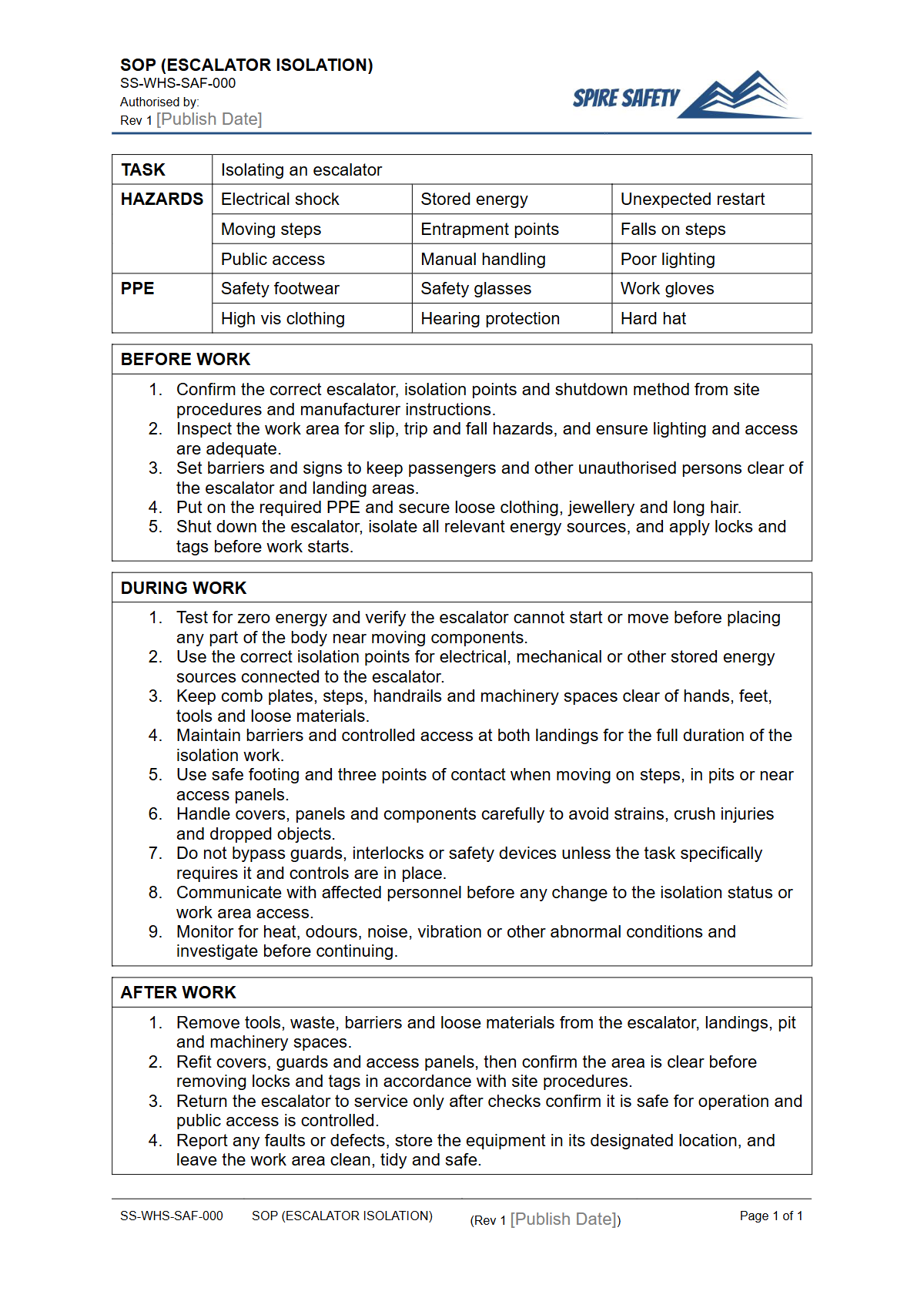
Formalise your escalator maintenance safety with our free template. Download the Safe Operating Procedure for escalator isolation to standardise your workflow.
Free Safe Operating Procedure (Escalator Isolation) Template
DOCX • 126 KB + PDF
Updated Oct 2026
No signup required
Purpose of the Free Safe Operating Procedure (Escalator Isolation) Template
Working on escalators presents significant risks, including electrical shock, entanglement, and crushing hazards from uncontrolled movement. An escalator isolation procedure is a formal, documented process designed to safely de-energise and secure the equipment before any maintenance, cleaning, or repair work begins.
This Safe Operating Procedure (SOP) template provides a structured framework for implementing a robust isolation and Lockout/Tagout (LOTO) process. Using this document helps a Person Conducting a Business or Undertaking (PCBU) meet their primary duty of care by controlling risks associated with plant maintenance.
This SOP is a critical control measure within your safety framework, ensuring that all energy sources—electrical, mechanical, and gravitational—are identified and neutralised. Formalising these steps helps prevent accidental start-up and protects workers from harm.
Integrating such procedures is a fundamental part of developing effective WHS management systems that actively manage workplace hazards.
Video walkthrough
How to use the Free Safe Operating Procedure (Escalator Isolation) Template
This document is available for immediate download in both DOCX and PDF formats. The DOCX version is fully editable, allowing you to adapt it to your specific operational needs and workplace environment.
Note: This template provides a foundation based on Australian WHS principles, but it is not a complete, out-of-the-box solution. We have designed it to be customised.
You must adapt it to reflect your specific escalator models, building layout, personnel, and internal procedures to ensure it is effective and supports your legal obligations.
When customising the template, be sure to include:
- Specific make and model of the escalator(s).
- Locations of main switches, circuit breakers, and isolation points.
- Step-by-step instructions for de-energisation, isolation, and energy dissipation.
- Procedures for testing that the isolation is effective (e.g., a 'try' or 'test for dead' step).
- Roles and responsibilities of personnel involved in the isolation process.
- Specific lockout devices and tags to be used.
- A clear process for returning the escalator to service.
The principles of isolation and lockout are applicable to a wide range of machinery. For instance, the systematic approach in this document shares a common safety philosophy with our FREE Conveyer System SOP (Safe Operating Procedure) Template, which also focuses on controlling hazards from moving parts.
When to use it
This Safe Operating Procedure should be used any time a worker needs to access any part of the escalator's mechanism for a task that could expose them to risk if the equipment were to activate. It is not intended for the general public or for routine operations like starting and stopping the escalator for passenger use with the key switch.
Specific situations requiring this SOP include:
- Performing scheduled preventative maintenance.
- Conducting repairs on the drive system, steps, handrails, or electrical components.
- Undertaking detailed inspections that require removing guards or panels.
- Cleaning the escalator pit or internal mechanisms.
Adherence to the SOP is a key performance indicator for safety. Regular reviews of its implementation can be incorporated into your organisation's audit schedule to ensure ongoing effectiveness, a process that can be supported by professional WHS compliance auditing services.
Who should use it
Use of this SOP must be restricted to personnel who are trained, competent, and explicitly authorised to perform maintenance and isolation on escalators. This is not a task for untrained staff.
A 'competent person' is someone who has acquired the knowledge and skills to carry out the task safely through training, qualification, or experience.
The primary users include:
- Authorised Technicians and Electricians: The individuals physically performing the isolation, lockout, and maintenance tasks.
- Maintenance Supervisors: Responsible for overseeing the work, issuing permits, verifying isolation, and ensuring the procedure is followed correctly.
- Safety Managers: Responsible for developing, reviewing, and auditing the procedure as part of the broader safety system.
If your organisation lacks the in-house expertise to develop or implement specialised SOPs, engaging external safety professionals can provide the necessary guidance. Spire Safety offers expert WHS consulting to help businesses establish safe systems of work tailored to their unique operational risks.
Exploring our extensive free WHS resources library can also provide valuable templates and guides for other common workplace tasks.
Common mistakes
Common mistakes to avoid
- Assuming turning the key switch provides complete and safe isolation.
- Failing to test for zero energy ('try' step) before commencing work.
- Not accounting for secondary power sources, backup generators, or stored energy.
- Poor communication between the person isolating the equipment and others in the area.
Legal references
Legal considerations
The following legal requirements may be relevant to this type of work.
- Work Health and Safety Act (Harmonised) — Provides the primary duties for protecting workers and other people from work health and safety risks.
- Work Health and Safety Regulations (Harmonised) — Sets out requirements supporting the management of workplace hazards and risks.
The following codes may be relevant to this type of work.
- Managing WHS Risks Code of Practice — Provides practical guidance on identifying hazards, assessing risks and applying effective controls.
- Work Health and Safety Consultation, Cooperation and Coordination Code of Practice — Provides practical guidance on consulting workers and coordinating with other duty holders.
- Managing the Work Environment and Facilities Code of Practice — Provides practical guidance on safe work environments, workplace facilities and related controls.
Did you know
Stored Energy Risk
Even after an escalator is switched off, it can hold stored mechanical energy in its drive system or electrical energy in its capacitors. A proper isolation procedure neutralises all energy sources, not just the main power supply.
The 'Comb Plate' Function
The comb plates at the top and bottom of an escalator are a key safety feature designed to minimise the gap where the steps enter the landing. They are also a common area for faults, requiring careful isolation for safe maintenance.
FAQ
Frequently asked questions
01What is the difference between isolation and Lockout/Tagout (LOTO)?
02Can I use this SOP for all types of escalators?
03Who is responsible for ensuring the escalator isolation SOP is followed?
04How often should an escalator isolation SOP be reviewed?
Share this resource
Free Safe Operating Procedure (Escalator Isolation) Template
Browse Categories
How To Use It
- 1Download and open in Word or PDF.
- 2Replace the placeholders with your business details.
- 3Get it reviewed by a WHS specialist before rollout.
Need it customised?
Our WHS consultants can adapt this template to your site, run a gap analysis, or audit what you already have in place.
Book a Free Consultation WHS consulting servicesor call 1300 156 382
Related templates
- Free Safe Operating Procedure (Espresso Machine Clean) Template
- Free Safe Operating Procedure (EV Charging) Template
- Free Safe Operating Procedure (Evacuation Chair Check) Template
- Free Safe Operating Procedure (Event Barrier Setup) Template
- Free Safe Operating Procedure (Event Cable Cover Setup) Template
- Free Safe Operating Procedure (Event Chair Handling) Template