
Free Safe Operating Procedure (Entry Door Cleaning) Template
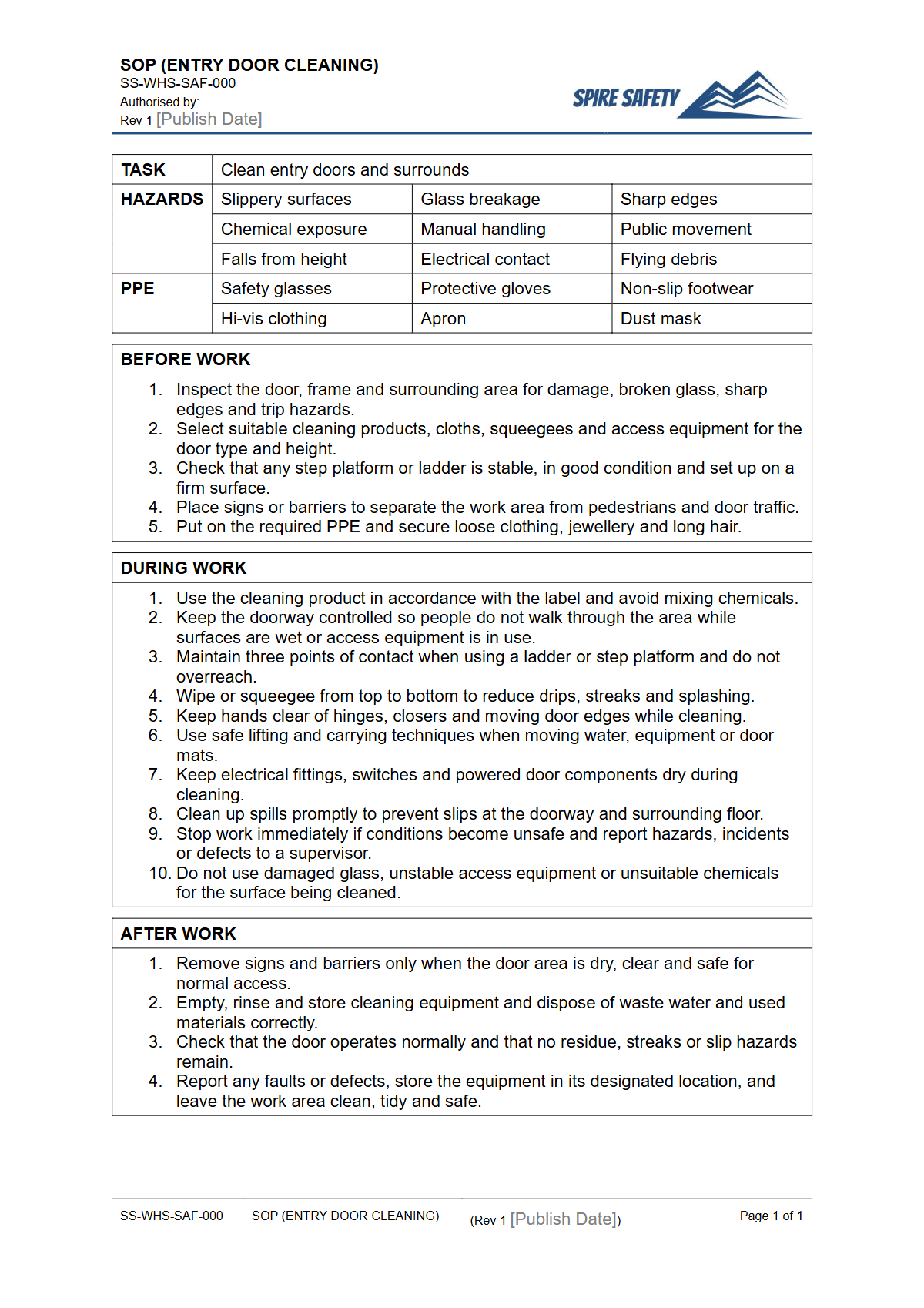
Download our free Safe Operating Procedure for entry door cleaning. This customisable template helps you document safe work methods and hazard controls.
Free Safe Operating Procedure (Entry Door Cleaning) Template
DOCX • 126 KB + PDF
Updated Oct 2026
No signup required
Purpose of the Free Safe Operating Procedure (Entry Door Cleaning) Template
Effectively managing workplace health and safety requires clear, documented processes for routine tasks. This free Safe Operating Procedure (Entry Door Cleaning) Template provides a structured starting point for organisations to formalise their cleaning protocols.
Using a standardised SOP helps ensure that all workers perform the task consistently and safely, minimising risks such as slips from wet floors, exposure to cleaning chemicals, and ergonomic injuries from awkward postures.
A well-drafted Safe Operating Procedure is a critical tool for identifying hazards before they cause harm. It acts as a training guide for new employees, a refresher for existing staff, and a reference for supervisors.
By documenting the required personal protective equipment (PPE), hazard control measures, and emergency responses, this template helps your business demonstrate its commitment to a safe system of work. It forms a key part of broader WHS management systems, linking risk assessment to practical, on-the-ground action.
Video walkthrough
How to use the Free Safe Operating Procedure (Entry Door Cleaning) Template
This resource is available for download as a DOCX file for easy editing in Microsoft Word or a PDF for straightforward printing and viewing. To get the most value from this template, you must adapt it to the unique context of your workplace.
Follow these steps:
- Review and Customise: Go through each section and replace the placeholder text with information specific to your site. This includes the exact types of doors, the specific cleaning chemicals used (and their corresponding Safety Data Sheets), the tools and equipment provided, and the environmental conditions.
- Consult Your Team: Involve the workers who actually perform the cleaning tasks. Their firsthand experience is invaluable for identifying practical hazards and effective control measures that might otherwise be overlooked.
- Seek Approval: Have the finalised SOP reviewed and approved by a supervisor, manager, or WHS representative before it is implemented.
- Train and Communicate: Ensure all relevant employees are trained on the final SOP. Keep copies readily accessible in the work area for easy reference.
Important: This is a template only. We've provided a solid framework aligned with Australian WHS practice, but you must customise it to reflect the specific hazards, equipment, chemicals, and environment of your workplace.
For complex operations, consider engaging specialist WHS consulting services to ensure your procedures are robust and effective.
Integrating the SOP into Your Safety Framework
An SOP for entry door cleaning does not exist in isolation. It should be integrated with your overall safety management system.
This means it should be referenced in your risk register, used as a basis for toolbox talks, and included in worker induction programs. The effectiveness of its implementation can be verified during regular WHS compliance auditing, which helps confirm that documented procedures are being followed correctly in practice.
Developing SOPs for Other Tasks
Once you have tailored this document, consider developing SOPs for other specific tasks in your workplace. A consistent format helps workers understand and follow procedures across different activities. For example, depending on your industry, you may also need a Safe Operating Procedure for deep fryer cleaning or instructions for other common equipment. For other machinery, such as that found in workshops or depots, you might require a Safe Operating Procedure for an air compressor to manage its specific risks. You can browse our full free WHS resources library to find other templates that may be useful for your business.
Common mistakes
Common mistakes to avoid
- Using the generic template without customising it for site-specific equipment, chemicals, and hazards.
- Failing to source and make accessible the Safety Data Sheets (SDS) for all cleaning chemicals used.
- Not training workers on the finalised SOP or verifying their understanding of the procedures.
- Forgetting to use 'wet floor' or 'cleaning in progress' signs, creating slip hazards for workers and visitors.
Legal references
Legal considerations
The following legal requirements may be relevant to this type of work.
- Work Health and Safety Act (Harmonised) — Provides the primary duties for protecting workers and other people from work health and safety risks.
- Work Health and Safety Regulations (Harmonised) — Sets out requirements supporting the management of workplace hazards and risks.
The following codes may be relevant to this type of work.
- Managing WHS Risks Code of Practice — Provides practical guidance on identifying hazards, assessing risks and applying effective controls.
- Work Health and Safety Consultation, Cooperation and Coordination Code of Practice — Provides practical guidance on consulting workers and coordinating with other duty holders.
- Managing the Work Environment and Facilities Code of Practice — Provides practical guidance on safe work environments, workplace facilities and related controls.
Did you know
Slips, Trips, and Falls
Slips, trips, and falls are one of the most common causes of workplace injuries in Australia. Inadequate signage and wet floors from cleaning activities are significant contributing factors.
Hazardous Chemicals
Even common cleaning products can be classed as hazardous chemicals. The model WHS Regulations require businesses to obtain a Safety Data Sheet (SDS) for these products and manage the risks of their use and storage.
FAQ
Frequently asked questions
01What should be included in an SOP for cleaning doors?
02How often should a Safe Operating Procedure be reviewed?
03Is this template suitable for cleaning all types of doors?
04Do I need a specific SOP for every cleaning task?
Share this resource
Free Safe Operating Procedure (Entry Door Cleaning) Template
Browse Categories
How To Use It
- 1Download and open in Word or PDF.
- 2Replace the placeholders with your business details.
- 3Get it reviewed by a WHS specialist before rollout.
Need it customised?
Our WHS consultants can adapt this template to your site, run a gap analysis, or audit what you already have in place.
Book a Free Consultation WHS consulting servicesor call 1300 156 382
Related templates
- Free Safe Operating Procedure (Epoxy Mixing) Template
- Free Safe Operating Procedure (Equipment Tag Cleaning) Template
- Free Safe Operating Procedure (Escalator Cleaning) Template
- Free Safe Operating Procedure (Escalator Isolation) Template
- Free Safe Operating Procedure (Espresso Machine Clean) Template
- Free Safe Operating Procedure (EV Charging) Template