
Free Safe Operating Procedure (Engine Oil Change) Template
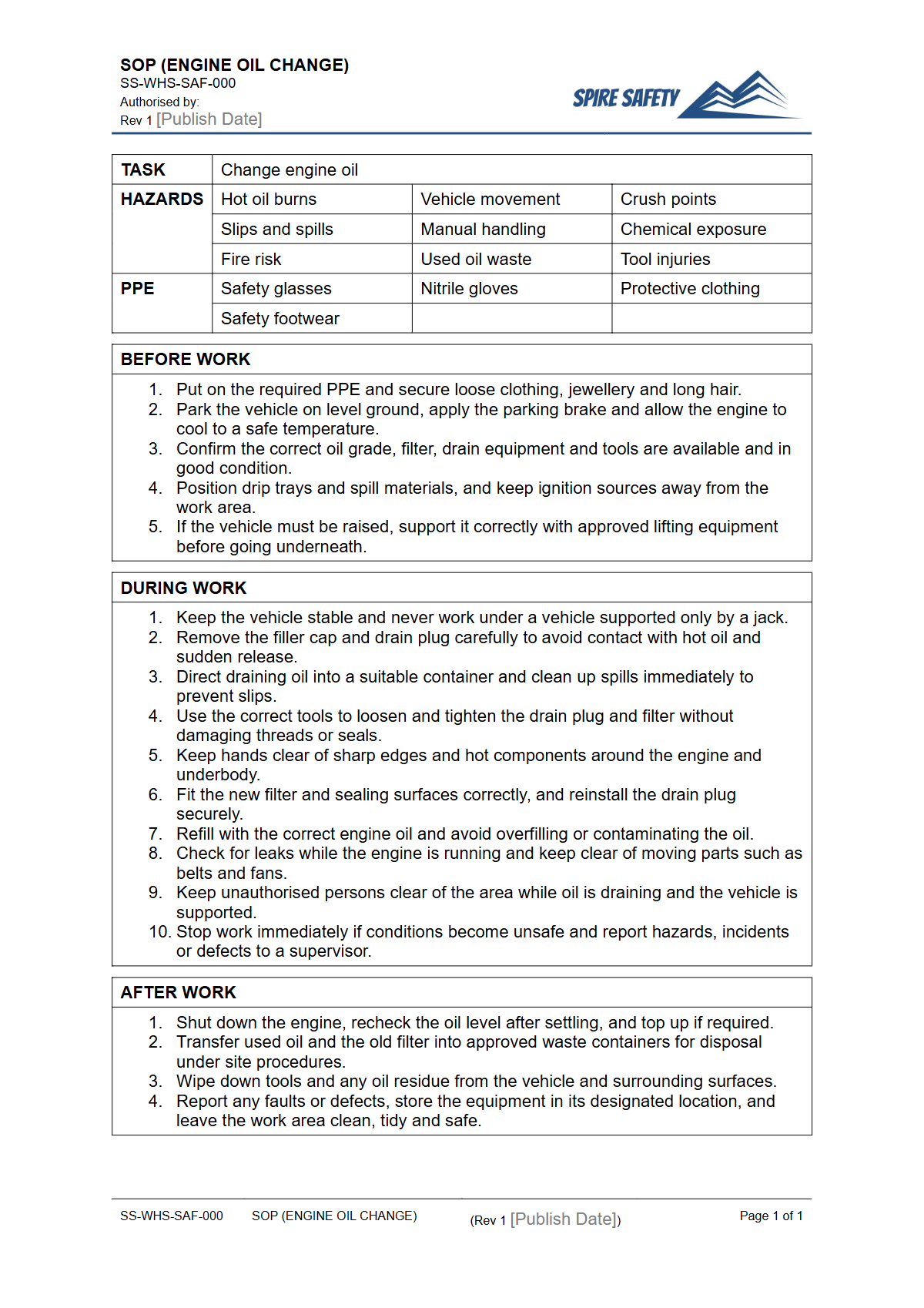
Formalise your workshop safety protocols with our free, downloadable template. This Safe Operating Procedure helps outline the risks and controls for engine oil changes.
Free Safe Operating Procedure (Engine Oil Change) Template
DOCX • 126 KB + PDF
Updated Oct 2026
No signup required
Purpose of the Free Safe Operating Procedure (Engine Oil Change) Template
Performing an engine oil change, while routine, involves multiple hazards that must be managed to prevent injury and ensure environmental compliance. This Free Safe Operating Procedure (Engine Oil Change) Template provides a structured framework for documenting the required safety controls for this common maintenance task.
It helps organisations standardise their process, meet training obligations, and demonstrate a commitment to workplace health and safety.
A documented SOP is a critical element for identifying hazards before they cause harm. The process involves risks such as burns from hot engine components and oil, musculoskeletal strain from awkward working postures, skin contact with hazardous chemicals in used oil, and crushing hazards from improperly secured vehicles.
Using this template helps formalise the risk assessment process, ensuring controls like correct PPE, vehicle support methods, and spill containment are consistently applied. Integrating such procedures is a key component of effective WHS management systems.
By implementing a clear, written procedure, you create a reliable benchmark for performance and training. It ensures every worker, from a seasoned mechanic to a new apprentice, understands the non-negotiable safety steps. This consistency is vital not just for oil changes but for all workshop tasks, such as those covered in our Free Air Compressor SOP (Safe Operating Procedure) Template.
Video walkthrough
How to use the Free Safe Operating Procedure (Engine Oil Change) Template
This resource is provided in both DOCX and PDF formats. We recommend downloading the DOCX file, which you can easily edit and customise in Microsoft Word or compatible programs.
The PDF version can be used as a printed reference in the workshop.
Important Customisation Note
This document is a template and is not a substitute for a site-specific risk assessment. We have developed it as a structured starting point, but you MUST customise it to reflect your specific vehicles, equipment (jacks, hoists, stands), chemicals (oils, degreasers), work environment, and control measures.
Always consult with the workers who perform the task to ensure the procedure is practical and reflects actual practice.
When completing the template, refer to the Safety Data Sheets (SDS) for all chemicals used, including the new oil, flushing agents, and degreasers. The SDS provides essential information on hazards, handling precautions, and required PPE. This attention to detail is crucial for all workshop procedures, including those involving equipment like saws, which you can document using our FREE Circular Saw SOP (Safe Operating Procedure) Template.
When to use it
This Safe Operating Procedure should be used as a primary reference document for several key activities in a workshop or maintenance facility. It should be readily available and referred to before any worker undertakes an engine oil change, especially if they are new or perform the task infrequently.
It also serves as a critical training document for inducting new employees and apprentices, ensuring they learn the safe and correct method from the outset.
Furthermore, the SOP should be a live document, used during toolbox talks and safety meetings to refresh knowledge and discuss any recent near-misses or incidents. It forms an essential piece of evidence during safety reviews and investigations.
Regular internal or external reviews, such as WHS compliance auditing, will often check for the presence and adequacy of such documented procedures.
Who should use it
This Safe Operating Procedure is intended for a range of personnel within an organisation. Workshop managers, supervisors, and team leaders are responsible for implementing the SOP, providing training, and ensuring it is followed correctly.
They should use the template to establish a clear and enforceable standard for their team.
Workers, mechanics, and maintenance staff who physically perform engine oil changes are the primary end-users. They must be trained on the SOP and follow its steps to protect themselves and their colleagues.
For businesses that manage a fleet of vehicles or heavy machinery, documenting procedures for each is essential, similar to how one might use a FREE Telehandler SOP (Safe Operating Procedure) Template for specific equipment.
Finally, the Person Conducting a Business or Undertaking (PCBU) holds the ultimate responsibility for providing a safe work environment. Ensuring that robust, task-specific SOPs are developed, implemented, and reviewed is a key way for them to meet their duty of care under Australian WHS law. You can find many more templates to support your safety systems in our free WHS resources library.
Common mistakes
Common mistakes to avoid
- Failing to properly support the vehicle on rated axle stands after jacking.
- Handling hot oil or engine components without appropriate thermal-resistant gloves.
- Disposing of used oil and filters in general waste instead of designated hazardous waste streams.
- Not cleaning up spills immediately, creating a serious slip and fall hazard.
Legal references
Legal considerations
The following legal requirements may be relevant to this type of work.
- Work Health and Safety Act (Harmonised) — Provides the primary duties for protecting workers and other people from work health and safety risks.
- Work Health and Safety Regulations (Harmonised) — Sets out requirements supporting the management of workplace hazards and risks.
The following codes may be relevant to this type of work.
- Managing WHS Risks Code of Practice — Provides practical guidance on identifying hazards, assessing risks and applying effective controls.
- Work Health and Safety Consultation, Cooperation and Coordination Code of Practice — Provides practical guidance on consulting workers and coordinating with other duty holders.
- Managing the Work Environment and Facilities Code of Practice — Provides practical guidance on safe work environments, workplace facilities and related controls.
Did you know
Waste Oil is a Hazard
Used engine oil contains heavy metals and toxic chemicals. A single litre of improperly disposed oil can contaminate up to one million litres of water, making correct disposal a critical environmental and safety issue.
Skin Contact Risk
Prolonged skin contact with used engine oil can lead to various skin conditions, including dermatitis and potentially skin cancer. Always wearing the correct chemical-resistant gloves is a non-negotiable control measure.
FAQ
Frequently asked questions
01What are the main hazards of changing engine oil?
02Why do I need an SOP for a simple task like an oil change?
03How often should an engine oil change SOP be reviewed?
04Who can write a Safe Operating Procedure?
Share this resource
Free Safe Operating Procedure (Engine Oil Change) Template
Browse Categories
How To Use It
- 1Download and open in Word or PDF.
- 2Replace the placeholders with your business details.
- 3Get it reviewed by a WHS specialist before rollout.
Need it customised?
Our WHS consultants can adapt this template to your site, run a gap analysis, or audit what you already have in place.
Book a Free Consultation WHS consulting servicesor call 1300 156 382
Related templates
- Free Safe Operating Procedure (Engine Stand) Template
- Free Safe Operating Procedure (Entry Door Cleaning) Template
- Free Safe Operating Procedure (Epoxy Mixing) Template
- Free Safe Operating Procedure (Equipment Tag Cleaning) Template
- Free Safe Operating Procedure (Escalator Cleaning) Template
- Free Safe Operating Procedure (Escalator Isolation) Template