
Free Safe Operating Procedure (Engine Stand) Template
Download our free Safe Operating Procedure (Engine Stand) template to establish clear, safe work instructions for your mechanics and workshop staff.
Free Safe Operating Procedure (Engine Stand) Template
DOCX • 126 KB + PDF
Updated Oct 2026
No signup required
Purpose of the Free Safe Operating Procedure (Engine Stand) Template
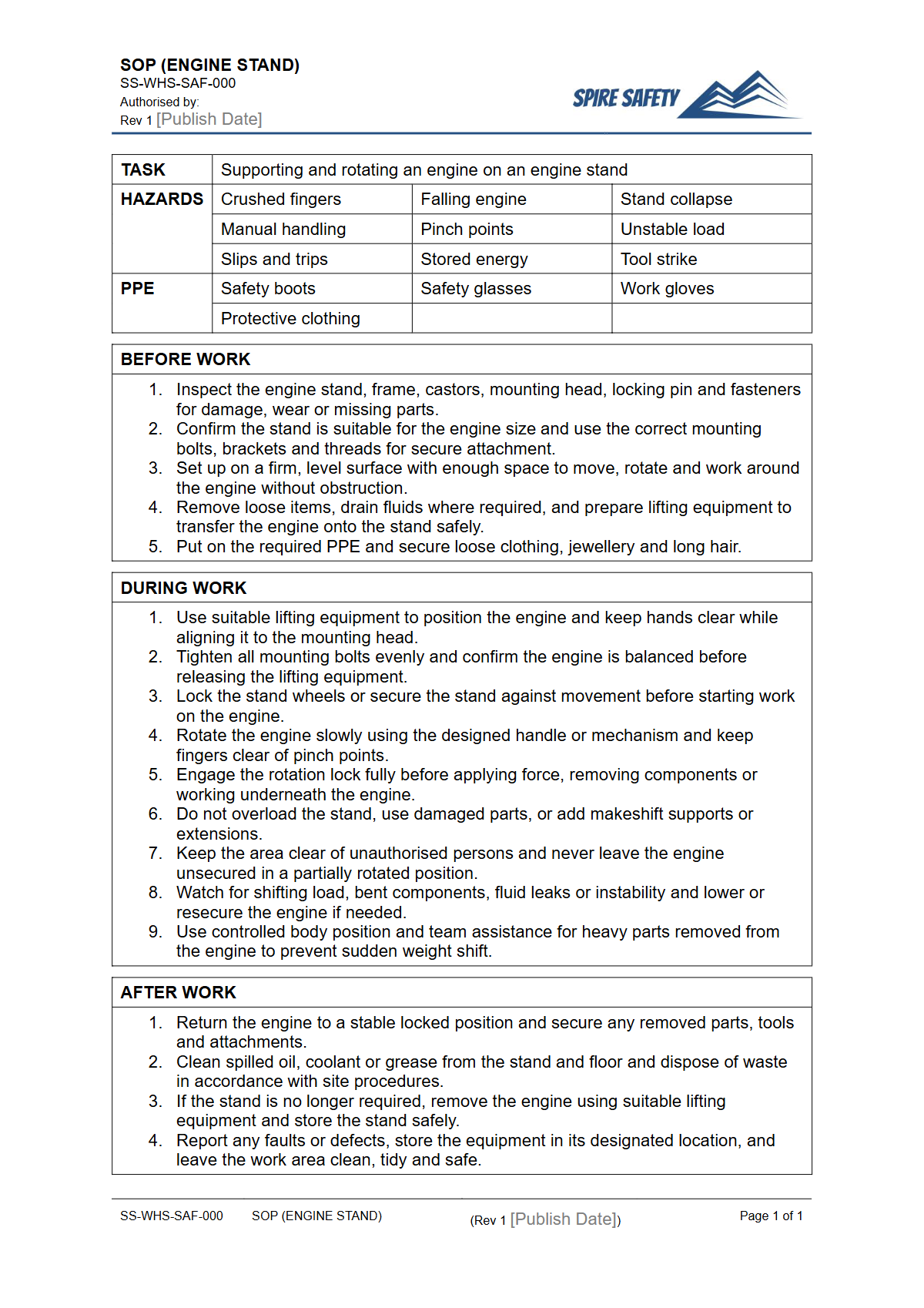
Using an engine stand involves significant risks, including crushing injuries from a dropped engine, musculoskeletal disorders from awkward postures, and injuries from unexpected movement. This Free Safe Operating Procedure (Engine Stand) Template provides a structured framework for documenting the required steps to perform this task safely.
By clearly outlining pre-operational checks, mounting procedures, and safe work practices, a SOP helps your organisation standardise its approach to workshop safety. It serves as a vital tool for worker training and competency verification, ensuring everyone understands the hazards and control measures associated with using this equipment.
Implementing documented procedures like this is a cornerstone of effective WHS management systems, demonstrating a proactive commitment to risk management.
Video walkthrough
How to use the Free Safe Operating Procedure (Engine Stand) Template
This resource is available as a fully editable DOCX file, allowing you to tailor it precisely to your operational needs. A PDF version is also provided for easy printing and distribution.
It is crucial to adapt this template to your specific context.
Important: This document is a template and must be customised to your workplace. You must conduct your own risk assessment and ensure the procedure reflects the specific models of engine stands you use, the types of engines being worked on, your unique site conditions, and your internal safety protocols.
We provide this as a starting point, but responsibility for its correct and safe implementation lies with the user.
A well-defined SOP for one piece of workshop equipment should be consistent with others. For example, the structure used here can be adapted for developing an air compressor SOP or procedures for other common tools.
Key Elements of a Safe Operating Procedure
A comprehensive SOP for an engine stand should detail the entire work cycle. Our template prompts you to consider the following key stages:
- Pre-Operational Checks: A checklist for inspecting the stand before use. This includes checking for cracked welds, bent frames, functioning castors and brakes, and the integrity of the locking pin and rotation mechanism.
- Mounting the Engine: Step-by-step instructions for safely lifting the engine (e.g., using a crane or hoist), selecting the correct grade and size of mounting bolts, and ensuring the engine is properly balanced on the stand's mounting head.
- Working on the Engine: Rules for safe conduct while the engine is mounted. This covers ensuring the rotation handle is secure or removed, the locking pin is fully engaged before applying force, and the work area around the stand remains clear of trip hazards.
- Dismounting and Storage: The procedure for safely removing the engine from the stand and instructions for cleaning and storing the equipment to prevent damage or corrosion.
Documenting processes for all workshop tools is a key safety practice. You can apply similar principles when creating an SOP for other equipment, such as our free Circular Saw SOP.
When to use a Safe Operating Procedure
A Safe Operating Procedure for engine stands should be used as a primary reference document in several situations. It is essential for inducting new mechanics or apprentices, providing them with a clear, authoritative guide on how to perform the task safely.
It also serves as an excellent tool for refresher training for experienced workers to prevent complacency. The SOP should be readily available in the work area and consulted before starting any job involving an engine stand, particularly if the task is non-routine.
Furthermore, it is a foundational document used when conducting a Job Safety Analysis (JSA) or risk assessment for engine removal and overhaul tasks.
Who should use this Safe Operating Procedure
This template is designed for a range of personnel within a mechanical workshop or vehicle servicing environment. It should be used by:
- Mechanics and Technicians: As a direct guide for their day-to-day work.
- Apprentices and Trainees: As a core training document to build safe work habits from the start of their careers.
- Workshop Managers and Supervisors: To enforce safety standards, conduct training, and investigate incidents.
- WHS Officers and Advisors: To develop and integrate into the broader workplace safety management system.
For organisations needing assistance in rolling out SOPs and embedding them into their safety culture, engaging specialist WHS consulting can provide valuable guidance and support. A consultant can help ensure your procedures are practical, understood by workers, and meet regulatory expectations.
Integrating SOPs into Your Safety System
An SOP does not exist in isolation. It is most effective when it is part of a holistic safety framework.
This means linking the procedure to your training records, conducting regular reviews to ensure it remains current, and using it as a benchmark during workplace inspections. Periodic WHS compliance auditing can help verify that the procedures documented in your SOP are actually being followed on the workshop floor.
Keeping your safety documentation organised and up-to-date is a continuous process that protects both your workers and your business. For more tools to support your safety system, explore our comprehensive library of free WHS resources.
Common mistakes
Common mistakes to avoid
- Using incorrect bolts or not enough bolts to mount the engine.
- Failing to confirm the engine's weight against the stand's rated capacity (SWL).
- Attempting to move a loaded engine stand across cluttered or uneven floors.
- Neglecting to engage the rotation locking pin securely before applying torque to engine components.
Legal references
Legal considerations
The following legal requirements may be relevant to this type of work.
- Work Health and Safety Act (Harmonised) — Provides the primary duties for protecting workers and other people from work health and safety risks.
- Work Health and Safety Regulations (Harmonised) — Sets out requirements supporting the management of workplace hazards and risks.
The following codes may be relevant to this type of work.
- Managing WHS Risks Code of Practice — Provides practical guidance on identifying hazards, assessing risks and applying effective controls.
- Work Health and Safety Consultation, Cooperation and Coordination Code of Practice — Provides practical guidance on consulting workers and coordinating with other duty holders.
- Managing the Work Environment and Facilities Code of Practice — Provides practical guidance on safe work environments, workplace facilities and related controls.
Did you know
Bolt Grade Matters
The bolts used to attach an engine to the stand are critical. Using standard hardware-store bolts instead of high-tensile (e.g., Grade 8.8 or higher) bolts can lead to shear failure and a dropped engine.
FAQ
Frequently asked questions
01Is an engine stand considered 'plant' under Australian WHS law?
02Do I need to train my workers on how to use the engine stand SOP?
03What is the maximum weight my engine stand can hold?
04How often should I review my Safe Operating Procedure for an engine stand?
Share this resource
Free Safe Operating Procedure (Engine Stand) Template
Browse Categories
How To Use It
- 1Download and open in Word or PDF.
- 2Replace the placeholders with your business details.
- 3Get it reviewed by a WHS specialist before rollout.
Need it customised?
Our WHS consultants can adapt this template to your site, run a gap analysis, or audit what you already have in place.
Book a Free Consultation WHS consulting servicesor call 1300 156 382
Related templates
- Free Safe Operating Procedure (Entry Door Cleaning) Template
- Free Safe Operating Procedure (Epoxy Mixing) Template
- Free Safe Operating Procedure (Equipment Tag Cleaning) Template
- Free Safe Operating Procedure (Escalator Cleaning) Template
- Free Safe Operating Procedure (Escalator Isolation) Template
- Free Safe Operating Procedure (Espresso Machine Clean) Template