
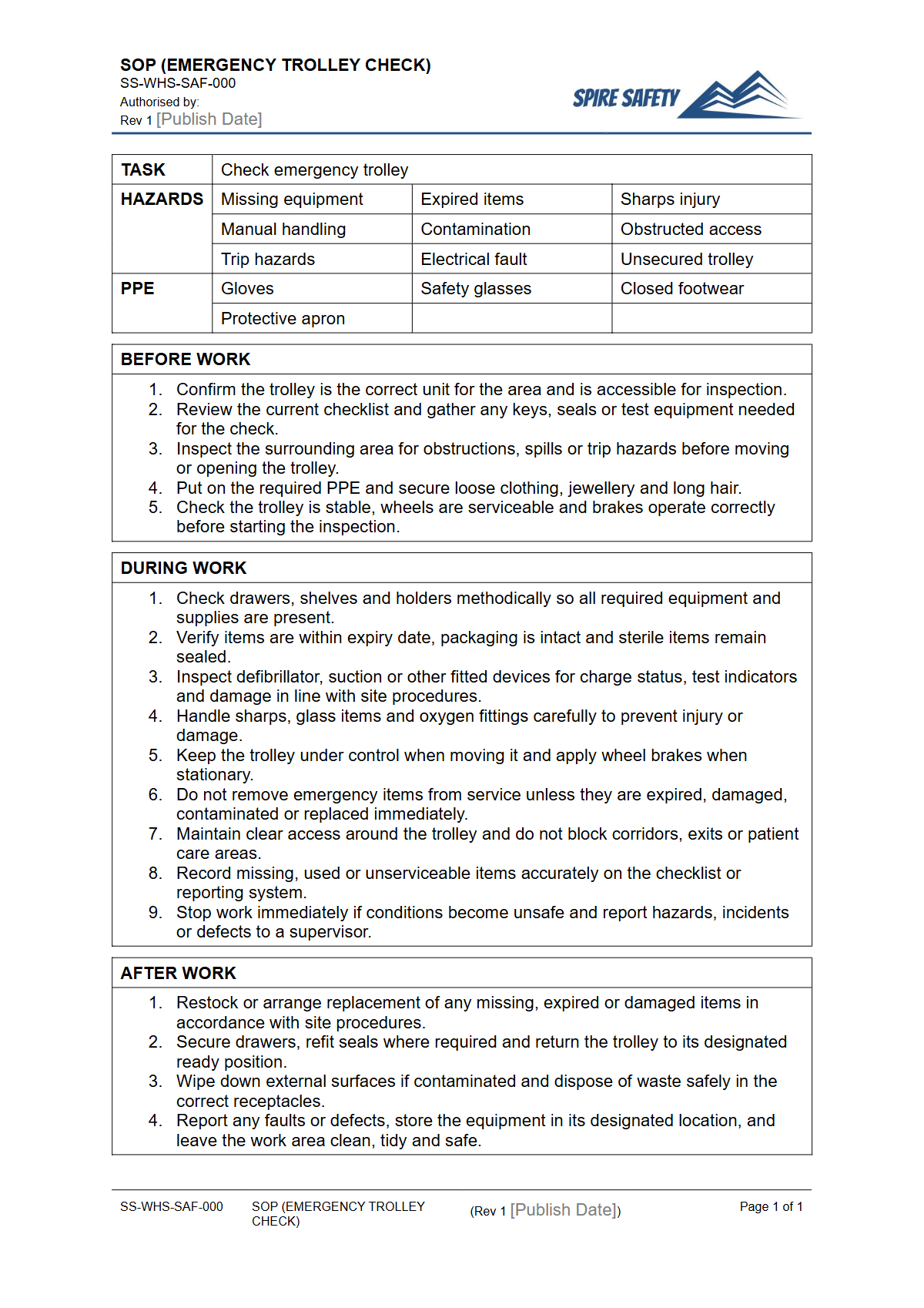
Free Safe Operating Procedure (Emergency Trolley Check) Template
Ensure your emergency trolley is always ready for response. Download our free Safe Operating Procedure template to formalise your check process and improve safety.
Free Safe Operating Procedure (Emergency Trolley Check) Template
DOCX • 126 KB + PDF
Updated Oct 2026
No signup required
Purpose of the Free Safe Operating Procedure (Emergency Trolley Check) Template
In any workplace, a fully stocked and functional emergency trolley is a critical asset for responding to incidents, from first aid events to chemical spills. This Free Safe Operating Procedure (Emergency Trolley Check) Template provides a structured framework for ensuring your trolley is consistently maintained and ready for immediate use.
It formalises the checking process, turning an ad-hoc task into a documented, repeatable system of work. Using an SOP helps demonstrate due diligence by creating a clear record of inspection, stock levels, and expiry dates, proving that equipment is being actively managed.
Implementing documented procedures like this one is a cornerstone of proactive safety management. By standardising routine but critical tasks, organisations can significantly reduce the risk of equipment failure during an emergency.
This SOP is a fundamental building block that integrates seamlessly into broader WHS management systems, reinforcing a culture of preparedness and accountability across the business.
Video walkthrough
How to use the Free Safe Operating Procedure (Emergency Trolley Check) Template
Our template is available as a DOCX file for easy customisation and a PDF for quick reference. The goal is to provide a comprehensive starting point aligned with Australian WHS principles, which you can then tailor to your specific operational needs.
A generic procedure is not effective; customisation is essential for creating a document that genuinely reflects your workplace risks and resources.
Important: This is a template, not a finished document. To use it effectively, you must customise it to suit your specific workplace, equipment, and legislative requirements.
Your customisation should include adding your company name and logo, detailing the exact location of the emergency trolley, listing all specific items the trolley must contain (e.g., specific bandages, chemical neutralisers, PPE), and defining the inspection frequency based on your own risk assessment. Similar to how you would detail the specific steps in an Air Compressor SOP template, this document requires your specific operational details to be effective.
When to use it
This Safe Operating Procedure should be integrated into your regular safety and maintenance schedule. The frequency of checks—whether daily, weekly, or monthly—should be determined by a risk assessment.
Factors to consider include the level of risk in the work area, the rate at which supplies are used or expire, and any specific site or regulatory requirements. The SOP should be used to conduct these routine checks to ensure nothing is missed.
Additionally, the procedure must be followed immediately after any incident where the emergency trolley was used, to ensure it is fully restocked and prepared for the next potential event.
Regular verification is key to ensuring these procedures are not just paperwork. A documented SOP provides a clear benchmark for internal and external safety reviews, with specialist WHS compliance auditing services able to use it to confirm that procedures are being correctly implemented and records are properly maintained.
Who should use it
This SOP is designed for use by any person or persons responsible for workplace safety and emergency preparedness. This typically includes WHS Officers, Safety Managers, First Aid Officers, Emergency Wardens, or a designated team member or supervisor.
The SOP format helps ensure that the check is performed consistently, regardless of who is conducting it. By clearly assigning responsibility within the document, it eliminates ambiguity and fosters ownership of the task.
The person responsible should be competent, meaning they are trained to understand the purpose and function of each item on the trolley. For example, the person checking a trolley for chemical spills should understand the different types of absorbents, just as a person following a deep fryer operation SOP needs to understand the risks of hot oil.
By clearly defining roles and procedures, you ensure the right person performs the right task correctly every time.
This template is just one of many procedural documents available to help you build a safer workplace. Explore our complete free WHS resources library for more templates, checklists, and guides to support your safety management system.
Common mistakes
Common mistakes to avoid
- Forgetting to immediately replace items used during a minor incident or drill.
- Not checking expiry dates on sterile supplies, batteries, or chemical agents.
- Storing the trolley in an inaccessible location or blocking it with other items.
- Failing to train all staff on the location of the trolley and who is authorised to use it.
Legal references
Legal considerations
The following legal requirements may be relevant to this type of work.
- Work Health and Safety Act (Harmonised) — Provides the primary duties for protecting workers and other people from work health and safety risks.
- Work Health and Safety Regulations (Harmonised) — Sets out requirements supporting the management of workplace hazards and risks.
The following codes may be relevant to this type of work.
- Managing WHS Risks Code of Practice — Provides practical guidance on identifying hazards, assessing risks and applying effective controls.
- Work Health and Safety Consultation, Cooperation and Coordination Code of Practice — Provides practical guidance on consulting workers and coordinating with other duty holders.
- Managing the Work Environment and Facilities Code of Practice — Provides practical guidance on safe work environments, workplace facilities and related controls.
Did you know
Also Known As
In medical settings, emergency trolleys are often called 'crash carts' and are a standardised element of rapid response protocols for events like cardiac arrests.
Context is Key
The contents of an emergency trolley are highly specific. A trolley in a chemical laboratory will look very different from one in a food processing plant or a construction site, each tailored to manage the most likely incidents.
FAQ
Frequently asked questions
01What should be included in an emergency trolley checklist?
02How often should an emergency trolley be checked in Australia?
03Who is responsible for checking the emergency trolley?
04Why is a Safe Operating Procedure better than just a checklist?
Share this resource
Free Safe Operating Procedure (Emergency Trolley Check) Template
Browse Categories
How To Use It
- 1Download and open in Word or PDF.
- 2Replace the placeholders with your business details.
- 3Get it reviewed by a WHS specialist before rollout.
Need it customised?
Our WHS consultants can adapt this template to your site, run a gap analysis, or audit what you already have in place.
Book a Free Consultation WHS consulting servicesor call 1300 156 382
Related templates
- Free Safe Operating Procedure (Engine Crane) Template
- Free Safe Operating Procedure (Engine Oil Change) Template
- Free Safe Operating Procedure (Engine Stand) Template
- Free Safe Operating Procedure (Entry Door Cleaning) Template
- Free Safe Operating Procedure (Epoxy Mixing) Template
- Free Safe Operating Procedure (Equipment Tag Cleaning) Template