
Free Safe Operating Procedure (Emergency Light Test) Template
Establish a clear process for maintaining workplace safety with our Safe Operating Procedure for emergency light testing. Download your free template today.
Free Safe Operating Procedure (Emergency Light Test) Template
DOCX • 126 KB + PDF
Updated Oct 2026
No signup required
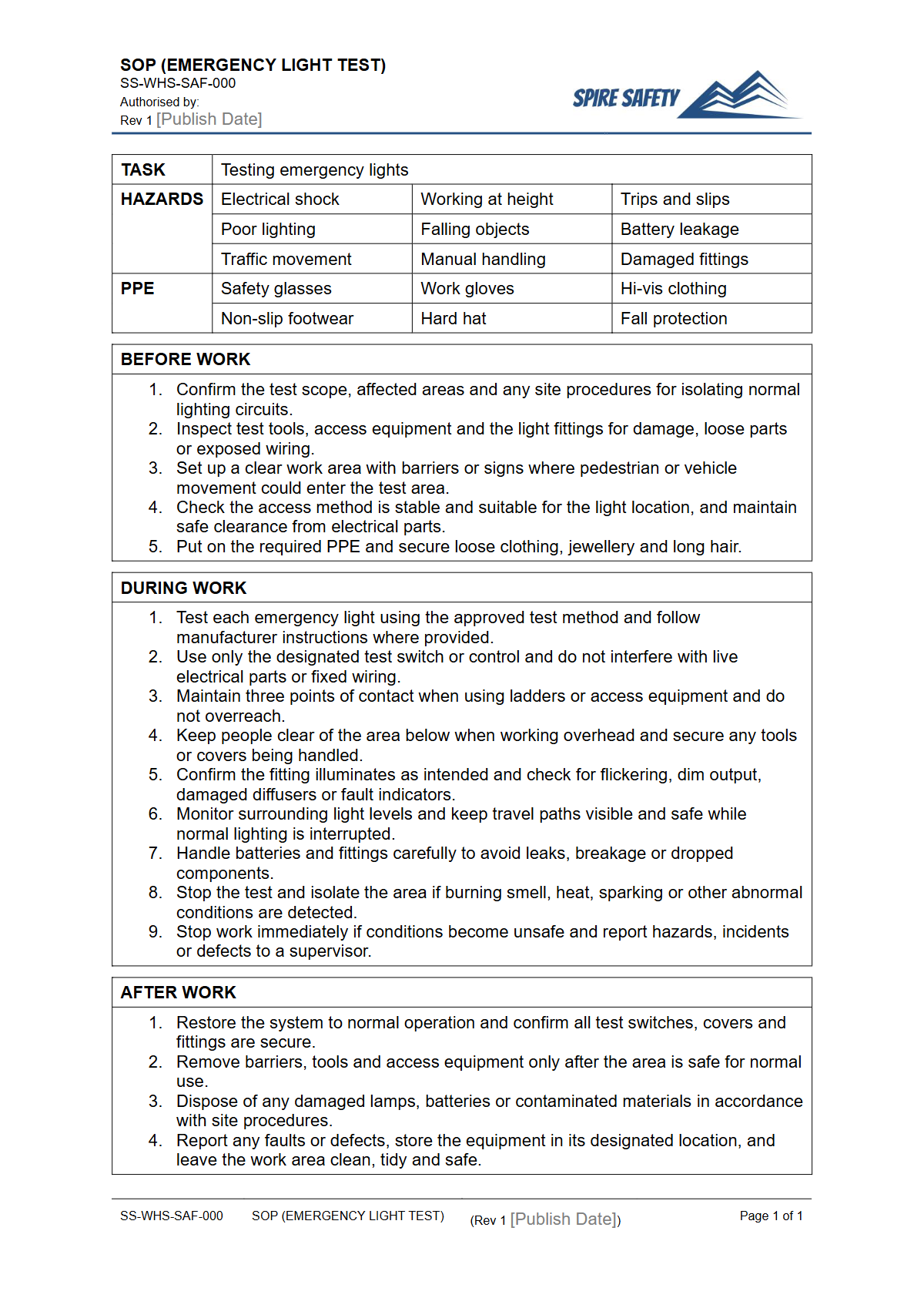
Purpose of the Free Safe Operating Procedure (Emergency Light Test) Template
Ensuring emergency and exit lights function correctly is a critical safety requirement for any Australian workplace. This Free Safe Operating Procedure (Emergency Light Test) Template provides a structured framework for documenting the process of routinely inspecting, testing, and maintaining these essential systems.
Using a documented SOP helps demonstrate due diligence, standardises procedures for all staff involved, and ensures that lighting systems will perform as required during a power failure or other emergency. This procedure is a fundamental component of your organisation's overall safety management program, helping to facilitate safe egress from the building at all times.
Implementing clear, documented procedures is a cornerstone of effective safety management. This SOP helps formalise your testing protocols, making them easier to audit, train staff on, and consistently apply.
Formalising such processes is a key activity in building robust WHS management systems that protect workers and ensure operational continuity.
Video walkthrough
How to use the Free Safe Operating Procedure (Emergency Light Test) Template
This template is provided in both DOCX and PDF formats for your convenience. To use it effectively, download the DOCX version and adapt it to the specific requirements of your facility.
This includes identifying the types of emergency lights installed, the location of circuit breakers or test switches, and assigning specific responsibilities to personnel. You should also detail your organisation's specific recording and reporting requirements, such as the format and location of the test logbook.
Important Note: This document is a template and must be customised to your specific workplace. We are not WHS consultants for your business just by you downloading this template.
You must ensure the content is tailored to your unique operational risks, equipment, and legal obligations. For other common equipment, you might find our Free Safe Operating Procedure (Deep Fryer) template a useful reference for structuring similar documents.
What is included in the template?
Our SOP template provides a clear, logical structure for you to build upon. It includes sections for:
- Defining the purpose and scope of the procedure.
- Outlining roles and responsibilities.
- Listing necessary personal protective equipment (PPE).
- Detailing the step-by-step testing procedure, including pre-operational checks, the testing process, and post-test actions.
- Guidance on recording results and managing non-conformances.
- Emergency procedures relevant to the task.
When to test emergency lighting
Regular testing is mandated by Australian Standards to ensure reliability. The frequency and type of tests vary.
A quick function test (typically by pressing a 'push-to-test' button) should be conducted every 6 months to ensure the lamps illuminate. A more comprehensive 90-minute discharge test, which simulates a power outage and tests battery endurance, must be performed annually.
This template is designed to accommodate both types of tests, providing a consistent procedure for whichever is scheduled. It is important to integrate these recurring tasks into your broader maintenance schedule, just as you would for other facility equipment. Similar principles of routine checks apply to various workplace assets, as detailed in resources like our Free Air Compressor SOP.
Who should conduct emergency light tests?
Emergency light testing must be performed by a competent person. This could be a trained internal staff member, such as a maintenance officer or facilities manager, or an external contractor specialising in electrical or fire safety services.
The key requirement is that the individual has the necessary knowledge, training, and experience to safely perform the test, correctly interpret the results, and identify any faults. They must understand the electrical risks involved and be capable of isolating power where necessary.
Using a documented SOP ensures that anyone assigned the task follows the same safe and effective method. The records produced from these tests are often reviewed as part of routine safety checks and formal WHS compliance auditing.
The principles of electrical safety are paramount, whether dealing with fixed installations or portable equipment. For guidance on procedures involving handheld tools, our FREE Circular Saw SOP (Safe Operating Procedure) Template provides another example of documenting safe work practices.
While the equipment differs, the focus on hazard identification and control remains constant. For more templates covering a wide range of tasks and equipment, browse our complete free WHS resources library.
Common mistakes
Common mistakes to avoid
- Only performing the 'push-to-test' and neglecting the mandatory 90-minute discharge test.
- Failing to maintain a detailed and up-to-date logbook of all tests and repairs.
- Not replacing faulty batteries or failed lamps promptly after a test identifies them.
- Assuming an 'off-the-shelf' procedure is sufficient without customising it for the building's specific layout and system.
Legal references
Legal considerations
The following legal requirements may be relevant to this type of work.
- Work Health and Safety Act (Harmonised) — Provides the primary duties for protecting workers and other people from work health and safety risks.
- Work Health and Safety Regulations (Harmonised) — Sets out requirements supporting the management of workplace hazards and risks.
The following codes may be relevant to this type of work.
- Managing WHS Risks Code of Practice — Provides practical guidance on identifying hazards, assessing risks and applying effective controls.
- Work Health and Safety Consultation, Cooperation and Coordination Code of Practice — Provides practical guidance on consulting workers and coordinating with other duty holders.
- Managing the Work Environment and Facilities Code of Practice — Provides practical guidance on safe work environments, workplace facilities and related controls.
Did you know
Battery Life
The 90-minute discharge test is designed to ensure emergency lighting can operate for the duration required for a complete building evacuation, even after years of service.
LED Advantage
Modern emergency lights increasingly use LED technology, which offers lower power consumption, longer lamp life, and greater reliability compared to older fluorescent or incandescent types.
FAQ
Frequently asked questions
01What is the Australian Standard for emergency lighting tests?
02How often should emergency lights be tested in Australia?
03What records need to be kept for emergency light testing?
04Can any staff member test emergency and exit lights?
Share this resource
Free Safe Operating Procedure (Emergency Light Test) Template
Browse Categories
How To Use It
- 1Download and open in Word or PDF.
- 2Replace the placeholders with your business details.
- 3Get it reviewed by a WHS specialist before rollout.
Need it customised?
Our WHS consultants can adapt this template to your site, run a gap analysis, or audit what you already have in place.
Book a Free Consultation WHS consulting servicesor call 1300 156 382
Related templates
- Free Safe Operating Procedure (Emergency Shower Test) Template
- Free Safe Operating Procedure (Emergency Stop Test) Template
- Free Safe Operating Procedure (Emergency Trolley Check) Template
- Free Safe Operating Procedure (Engine Crane) Template
- Free Safe Operating Procedure (Engine Oil Change) Template
- Free Safe Operating Procedure (Engine Stand) Template