
Free Safe Operating Procedure (Emergency Shower Test) Template
Ensure your emergency showers are functional and compliant with our free template. Download this Safe Operating Procedure for testing emergency showers today.
Free Safe Operating Procedure (Emergency Shower Test) Template
DOCX • 126 KB + PDF
Updated Oct 2026
No signup required
Purpose of the Free Safe Operating Procedure (Emergency Shower Test) Template
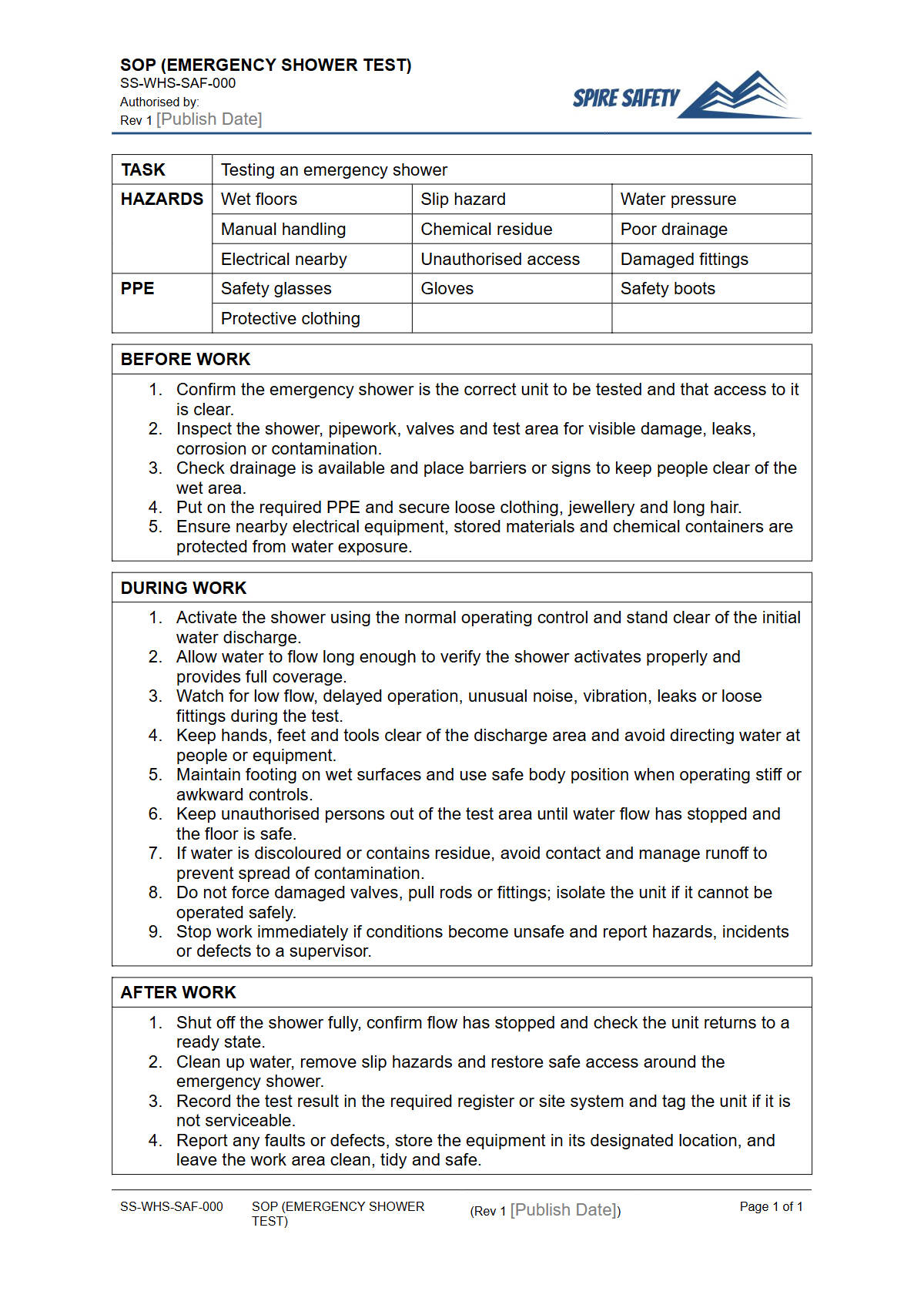
This Free Safe Operating Procedure (Emergency Shower Test) Template provides a structured framework for workplaces to document and standardise the process of inspecting, testing, and maintaining emergency shower and eyewash equipment. Regular testing is a critical control measure in any environment where employees are at risk of exposure to hazardous substances.
Functional emergency equipment can significantly reduce the severity of injuries from chemical splashes or other contaminants.
Using this template helps a Person Conducting a Business or Undertaking (PCBU) demonstrate due diligence in meeting their primary duty of care under WHS legislation. It establishes a clear, repeatable process for verification, ensuring the equipment operates correctly when needed most.
This SOP forms a vital component of your broader WHS management systems, integrating emergency preparedness into daily operational safety.
What is this Safe Operating Procedure for?
This Safe Operating Procedure (SOP) outlines the step-by-step requirements for both weekly activation tests (or 'bump tests') and more comprehensive annual flow rate and performance tests. It is designed to be adapted to any workplace with plumbed or self-contained emergency shower and eyewash stations, including laboratories, manufacturing plants, workshops, and agricultural facilities.
The document serves as a guide for competent personnel and a record for compliance purposes.
Video walkthrough
How to use the Free Safe Operating Procedure (Emergency Shower Test) Template
To effectively implement this SOP, you must adapt it to the specific context of your organisation and the equipment you use. A generic document is not sufficient for compliance; customisation is essential.
- Step 1: Download and Customise. Download the DOCX version to edit the content. Fill in your company name, the specific locations and identification numbers of each emergency shower unit, and the details of the responsible personnel.
- Step 2: Review and Adapt Procedures. The steps provided are based on the Australian Standard AS 4775. You must review these against your equipment's manufacturer instructions and your site's specific risks. Adjust the procedure for weekly and annual tests as required.
- Step 3: Consult and Train. Consult with your Health and Safety Representatives (HSRs) and the workers who will be performing the tests. Ensure they are trained and deemed competent in the procedure, understand the risks, and know how to use the associated log sheets. A structured SOP is also crucial for other specific tasks, as seen in our free Deep Fryer SOP.
- Step 4: Formalise and Implement. Once finalised, have the SOP approved by the relevant manager or PCBU. Make it readily accessible to all relevant staff and integrate it into your safety induction and ongoing training programs.
Note: This document is a template only. It is not a substitute for professional WHS advice.
You must customise this Safe Operating Procedure to suit the specific equipment, hazards, and operational environment of your workplace. We are not liable for any action or inaction you take in reliance on this document without customisation.
When to Test Emergency Showers and Eyewash Stations
A consistent testing schedule is non-negotiable for ensuring equipment reliability. This SOP should be used as part of a regular maintenance and inspection program. According to Australian Standard AS 4775, emergency equipment requires two main types of tests:
- Weekly Activation: All emergency showers and eyewash units should be activated weekly. This 'bump test' is brief but essential. It ensures water is flowing, clears any sediment from the line, and verifies that the unit is functional. The test should be long enough to ensure flushing fluid is supplied.
- Annual Performance Test: A more comprehensive inspection and test must be conducted at least once a year to ensure the equipment meets all performance requirements of AS 4775, including flow rate, water pattern, and temperature. Documenting these procedures is as important as for other equipment, for which you might use our Free Air Compressor SOP Template.
Regularly scheduled WHS compliance auditing can help verify that these testing schedules are being followed correctly and that your records are up to date.
Who Should Conduct the Tests
The responsibility for testing emergency showers should be assigned to personnel who are competent and have received specific training on the procedure. This may include:
- Maintenance Staff or Technicians
- Designated Safety Officers or Advisors
- Department Supervisors
- Other workers specifically trained and authorised for the task
The person conducting the test must understand how the equipment works, the potential faults to look for, and the correct record-keeping process. They must also be aware of the safety protocols for conducting the test itself, such as managing water spillage to prevent slip hazards.
If your team lacks the internal expertise to manage these processes confidently, engaging external support through WHS consulting can provide the necessary guidance and assurance. You can find many other useful documents in our free WHS resources library to support your team.
Common mistakes
Common mistakes to avoid
- Forgetting to perform and log weekly 'bump tests', leading to sediment build-up.
- Failing to ensure the pathway to the shower is always clear of obstructions.
- Not keeping accurate and up-to-date maintenance and testing logs for auditing purposes.
- Testing only the shower function on a combination unit and neglecting the eyewash.
Legal references
Legal considerations
The following legal requirements may be relevant to this type of work.
- Work Health and Safety Act (Harmonised) — Provides the primary duties for protecting workers and other people from work health and safety risks.
- Work Health and Safety Regulations (Harmonised) — Sets out requirements supporting the management of workplace hazards and risks.
The following codes may be relevant to this type of work.
- Managing WHS Risks Code of Practice — Provides practical guidance on identifying hazards, assessing risks and applying effective controls.
- Work Health and Safety Consultation, Cooperation and Coordination Code of Practice — Provides practical guidance on consulting workers and coordinating with other duty holders.
- Managing the Work Environment and Facilities Code of Practice — Provides practical guidance on safe work environments, workplace facilities and related controls.
Did you know
The 10-Second Rule
An emergency shower or eyewash station must be located within 10 seconds of travel time from the hazard. The path must be well-lit and free of any obstructions.
Flow Rate Requirements
AS 4775 requires emergency showers to maintain a minimum flow rate of 75.7 litres per minute for a full 15 minutes to be considered effective.
FAQ
Frequently asked questions
01How often should emergency showers and eyewash stations be tested in Australia?
02What is the required water temperature for an emergency shower?
03What records need to be kept for emergency shower testing?
04Can this SOP template be used for combination shower and eyewash stations?
Share this resource
Free Safe Operating Procedure (Emergency Shower Test) Template
Browse Categories
How To Use It
- 1Download and open in Word or PDF.
- 2Replace the placeholders with your business details.
- 3Get it reviewed by a WHS specialist before rollout.
Need it customised?
Our WHS consultants can adapt this template to your site, run a gap analysis, or audit what you already have in place.
Book a Free Consultation WHS consulting servicesor call 1300 156 382
Related templates
- Free Safe Operating Procedure (Emergency Stop Test) Template
- Free Safe Operating Procedure (Emergency Trolley Check) Template
- Free Safe Operating Procedure (Engine Crane) Template
- Free Safe Operating Procedure (Engine Oil Change) Template
- Free Safe Operating Procedure (Engine Stand) Template
- Free Safe Operating Procedure (Entry Door Cleaning) Template