
Free Safe Operating Procedure (Emergency Stop Test) Template
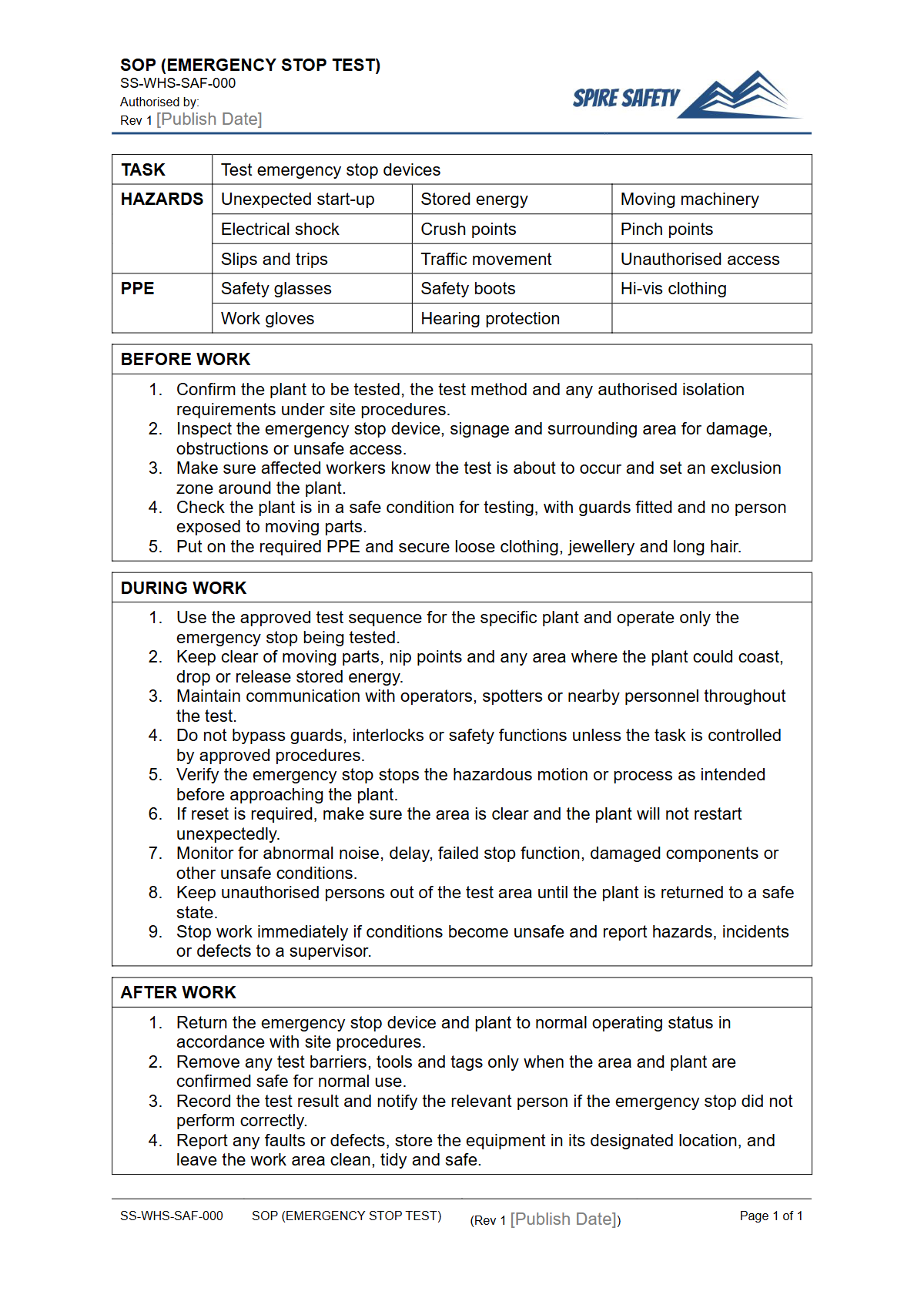
Ensure your emergency stops are regularly tested and verified. Our free SOP provides a structured format for this critical task.
Free Safe Operating Procedure (Emergency Stop Test) Template
DOCX • 126 KB + PDF
Updated Oct 2026
No signup required
Purpose of the Free Safe Operating Procedure (Emergency Stop Test) Template
Ensuring that emergency stops on plant and equipment function correctly is a non-negotiable part of any workplace safety program. This Free Safe Operating Procedure (Emergency Stop Test) Template provides a structured framework to guide your team through the process of regularly testing and verifying these critical safety devices.
Using a standardised procedure helps to eliminate guesswork, ensure consistency across all shifts and operators, and create a clear record of due diligence. An effective SOP demonstrates that your organisation is proactive in managing risks associated with machinery, forming a key part of your overall safety management system.
A well-documented testing regime is essential for training new employees and for refresher training for existing staff. It clarifies responsibilities, outlines the exact steps to be taken, and specifies the expected outcomes of a successful test.
This document serves as a foundational tool for creating a safer work environment by systematically proving the integrity of your most important backup safety controls. For machinery-specific guidance, you might also find our FREE Conveyer System SOP useful, as they frequently feature multiple emergency stop controls.
Video walkthrough
How to use the Free Safe Operating Procedure (Emergency Stop Test) Template
This template is designed for immediate use and is available in both DOCX and PDF formats for your convenience. Simply download the file and adapt it to the specific needs of your workplace.
While the procedure is based on established Australian WHS principles for plant safety, it is crucial to tailor it to your operational context. This is more than just adding a company logo; it involves a detailed review to ensure the steps are relevant and effective for your specific equipment.
- Customise: Update the document to include details of the specific machinery being tested, its location, any unique hazards, and the personal protective equipment (PPE) required.
- Review: Have a competent person, such as a maintenance supervisor or equipment specialist, review and approve the customised procedure.
- Train: Use the finalised SOP to train all relevant personnel on how to perform the test safely and correctly.
Important Note: This document provides a structured starting point. As every worksite is different, we cannot guarantee that this template covers every possible hazard or legislative requirement for your specific situation.
You must customise this document to reflect the machinery, environment, and organisational procedures in your workplace. Integrating this SOP into your broader WHS management systems ensures it becomes part of your organisation's standard practice.
When to use this Safe Operating Procedure
An emergency stop test SOP should be integrated into your regular maintenance and operational schedules. It is not a one-off task but a recurring verification activity. Key times to perform an emergency stop test include:
- Pre-operational Checks: For critical machinery, a quick function test can be incorporated into daily pre-start checklists.
- Scheduled Maintenance: Include the test as a mandatory step in your preventative maintenance program, with frequency determined by a risk assessment (e.g., weekly, monthly, or quarterly).
- After Repairs or Modification: Always test the emergency stop function after any maintenance, repairs, or alterations have been made to the machine or its control system.
- Following an Incident: If an incident or near-miss occurs, re-testing all safety controls is a crucial part of the investigation and corrective action process.
Consistent testing and record-keeping are vital components reviewed during a WHS compliance auditing process, providing tangible evidence of your safety commitments.
Who should use it
The responsibility for using this SOP and performing the test should be assigned to individuals who have the appropriate training and competence. This typically includes:
- Competent Operators: Trained and authorised operators of the specific plant or machinery are often best placed to conduct routine tests as part of their pre-start duties.
- Maintenance Personnel: Fitters, electricians, and technicians should use this procedure during scheduled maintenance activities and after completing repairs. SOPs for complex equipment, like our FREE Telehandler SOP, highlight the importance of operator competency.
- Supervisors and Team Leaders: Supervisors are responsible for ensuring that tests are being completed as required and that records are maintained. They may also use the SOP to conduct spot-checks or verification activities.
Ultimately, anyone tasked with verifying the functionality of safety equipment can benefit from this structured procedure. If you require expert assistance in developing and implementing SOPs tailored to your unique risks, our WHS consulting team can provide specialised support. For other equipment-specific procedures, feel free to browse our free WHS resources library, which includes documents like a Free Air Compressor SOP.
Common mistakes
Common mistakes to avoid
- Using the emergency stop as a convenient, routine way to shut down machinery.
- Failing to record the date, time, and outcome of each test, creating a gap in safety records.
- Only testing the physical button without confirming it actually stopped the hazardous motion.
- Forgetting to safely reset the machine and the emergency stop device after a successful test.
Legal references
Legal considerations
The following legal requirements may be relevant to this type of work.
- Work Health and Safety Act (Harmonised) — Provides the primary duties for protecting workers and other people from work health and safety risks.
- Work Health and Safety Regulations (Harmonised) — Sets out requirements supporting the management of workplace hazards and risks.
The following codes may be relevant to this type of work.
- Managing WHS Risks Code of Practice — Provides practical guidance on identifying hazards, assessing risks and applying effective controls.
- Work Health and Safety Consultation, Cooperation and Coordination Code of Practice — Provides practical guidance on consulting workers and coordinating with other duty holders.
- Managing the Work Environment and Facilities Code of Practice — Provides practical guidance on safe work environments, workplace facilities and related controls.
Did you know
Design Standards
The Australian Standard AS 4024.1604 specifies that emergency stop actuators (like buttons or pull-cords) must be coloured red. If there is a background behind the actuator, it must be coloured yellow.
Not for Routine Stops
Using an emergency stop for routine shutdowns can cause unnecessary wear and tear on the machine's components, potentially leading to premature failure of the safety system itself.
FAQ
Frequently asked questions
01What is the difference between an emergency stop and a normal stop?
02How often should we test emergency stops?
03Is this SOP template suitable for all types of machinery?
04Who is considered a 'competent person' to perform these tests?
Share this resource
Free Safe Operating Procedure (Emergency Stop Test) Template
Browse Categories
How To Use It
- 1Download and open in Word or PDF.
- 2Replace the placeholders with your business details.
- 3Get it reviewed by a WHS specialist before rollout.
Need it customised?
Our WHS consultants can adapt this template to your site, run a gap analysis, or audit what you already have in place.
Book a Free Consultation WHS consulting servicesor call 1300 156 382
Related templates
- Free Safe Operating Procedure (Emergency Trolley Check) Template
- Free Safe Operating Procedure (Engine Crane) Template
- Free Safe Operating Procedure (Engine Oil Change) Template
- Free Safe Operating Procedure (Engine Stand) Template
- Free Safe Operating Procedure (Entry Door Cleaning) Template
- Free Safe Operating Procedure (Epoxy Mixing) Template