
Free Safe Operating Procedure (Emergency Beacon) Template
Formalise safety protocols for emergency communication devices with our free Safe Operating Procedure (Emergency Beacon) template.
Free Safe Operating Procedure (Emergency Beacon) Template
DOCX • 126 KB + PDF
Updated Oct 2026
No signup required
Purpose of the Free Safe Operating Procedure (Emergency Beacon) Template
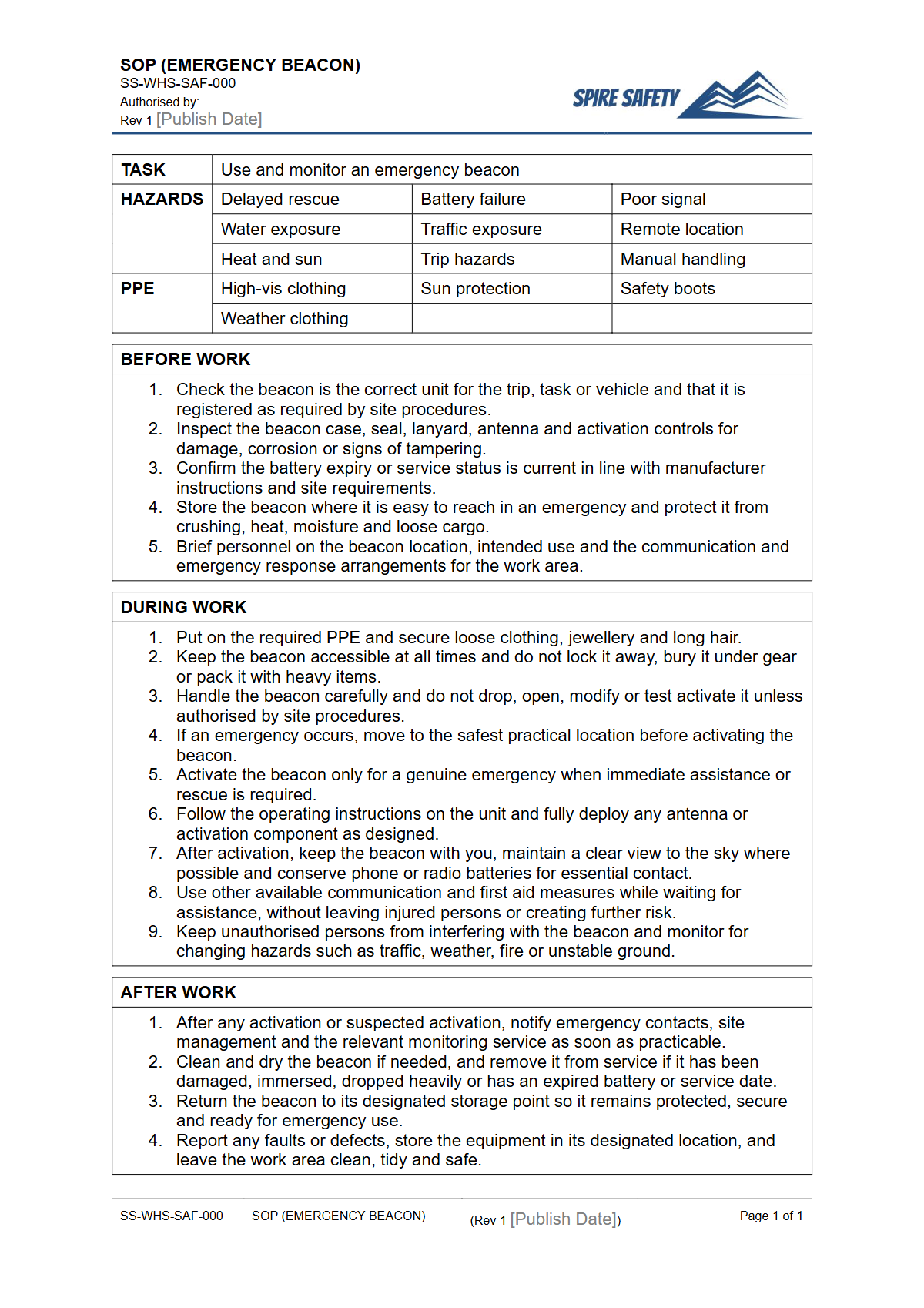
This Free Safe Operating Procedure (Emergency Beacon) Template provides a structured framework for documenting the safe use, maintenance, and activation of emergency beacons in your workplace. Establishing clear procedures is vital for managing the risks associated with remote or isolated work, ensuring workers have a reliable means of signalling for help when other communication methods fail.
The primary purpose of this Free Safe Operating Procedure (Emergency Beacon) Template is to help you fulfil your duty of care by establishing a formal system for managing these critical safety devices. It guides you in detailing pre-operational checks, correct carrying and storage, activation criteria, and post-incident procedures.
Integrating this SOP into your broader comprehensive WHS management systems ensures that emergency preparedness is a documented and repeatable part of your safety culture.
Video walkthrough
How to use the Free Safe Operating Procedure (Emergency Beacon) Template
This template is provided in both DOCX and PDF formats for your convenience. The DOCX file is fully editable, allowing you to add your company branding and tailor the content to your specific needs.
You should detail the exact make and model of the beacons you use, the names and contact details for your emergency contacts, and the specific activation triggers relevant to your work environments.
IMPORTANT: This document is a starting-point template. You are responsible for customising it to reflect the specific types of beacons used, your company's emergency response plan, and the unique risks of your worksites.
We accept no liability for incidents arising from the use of this un-customised template. You must consult the manufacturer’s instructions for your specific device and conduct a site-specific risk assessment.
When to use it
An SOP for emergency beacons is essential for any task where a worker may be isolated or unable to summon help through conventional means. This is common in industries like agriculture, mining, civil construction, and environmental services where work is conducted far from assistance or outside mobile phone coverage.
For example, operators working alone on large sites using heavy equipment, as detailed in our free Grader SOP, should be equipped with a beacon and trained on its use. Similarly, remote civil projects involving equipment like trenchers present significant risks that a beacon can help mitigate, making a procedure like our Trencher SOP template even more robust when paired with this emergency plan.
Who should use it
This Safe Operating Procedure should be used by several key personnel within an organisation. WHS managers and supervisors are responsible for developing, implementing, and reviewing the procedure.
They must ensure it is site-specific and that adequate resources (like beacon testing and maintenance schedules) are allocated.
Workers assigned to remote or isolated tasks are the primary end-users; they must be trained in the SOP to ensure they are competent in checking and operating the beacon correctly. If you need assistance defining roles and implementing effective safety procedures, our expert WHS consulting services can provide tailored support.
A well-drafted SOP is more than just a document; it's a critical tool for training, risk management, and demonstrating due diligence. Regularly review and update it to reflect changes in equipment, personnel, or work environments.
You can find many other useful templates and guides in our free WHS resources library to help build out your safety documentation.
Common mistakes
Common mistakes to avoid
- Failing to register the beacon with AMSA or keep registration details current.
- Neglecting regular battery checks and replacement as per manufacturer guidelines.
- Storing the beacon in an inaccessible location or separate from the worker it's assigned to.
- Lack of practical training on how and when to activate the device in a simulated emergency.
Legal references
Legal considerations
The following legal requirements may be relevant to this type of work.
- Work Health and Safety Act (Harmonised) — Provides the primary duties for protecting workers and other people from work health and safety risks.
- Work Health and Safety Regulations (Harmonised) — Sets out requirements supporting the management of workplace hazards and risks.
The following codes may be relevant to this type of work.
- Managing WHS Risks Code of Practice — Provides practical guidance on identifying hazards, assessing risks and applying effective controls.
- Work Health and Safety Consultation, Cooperation and Coordination Code of Practice — Provides practical guidance on consulting workers and coordinating with other duty holders.
- Managing the Work Environment and Facilities Code of Practice — Provides practical guidance on safe work environments, workplace facilities and related controls.
Did you know
Registration is Key
In Australia, it is a legal requirement to register your 406 MHz emergency beacon with the Australian Maritime Safety Authority (AMSA). This registration is free and ensures rescue authorities have your correct details.
406 MHz Beacons
Modern emergency beacons transmit on the 406 MHz satellite frequency, which is monitored by the Cospas-Sarsat international satellite system. This system can detect and locate distress signals from anywhere on Earth.
FAQ
Frequently asked questions
01What is a Safe Operating Procedure for an emergency beacon?
02Is using an emergency beacon SOP a legal requirement in Australia?
03How often should emergency beacons be tested?
04Who is responsible for maintaining the emergency beacon SOP?
Share this resource
Free Safe Operating Procedure (Emergency Beacon) Template
Browse Categories
How To Use It
- 1Download and open in Word or PDF.
- 2Replace the placeholders with your business details.
- 3Get it reviewed by a WHS specialist before rollout.
Need it customised?
Our WHS consultants can adapt this template to your site, run a gap analysis, or audit what you already have in place.
Book a Free Consultation WHS consulting servicesor call 1300 156 382
Related templates
- Free Safe Operating Procedure (Emergency Exit Check) Template
- Free Safe Operating Procedure (Emergency Light Test) Template
- Free Safe Operating Procedure (Emergency Shower Test) Template
- Free Safe Operating Procedure (Emergency Stop Test) Template
- Free Safe Operating Procedure (Emergency Trolley Check) Template
- Free Safe Operating Procedure (Engine Crane) Template