
Free Safe Operating Procedure (Electrical Test Bench) Template
Manage electrical hazards effectively with our Free Safe Operating Procedure (Electrical Test Bench) Template. Download your customisable DOCX to get started.
Free Safe Operating Procedure (Electrical Test Bench) Template
DOCX • 126 KB + PDF
Updated Oct 2026
No signup required
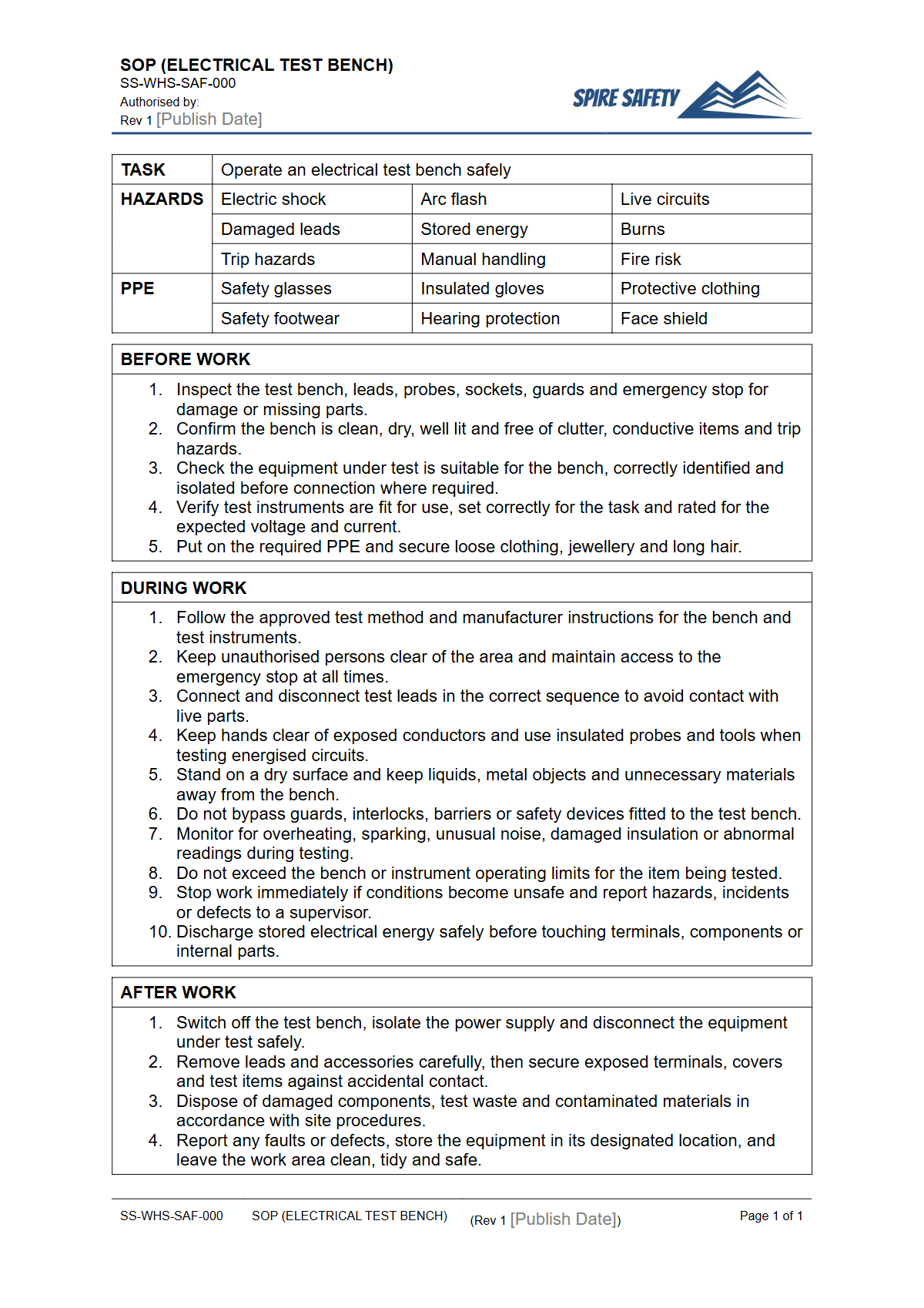
Purpose of the Free Safe Operating Procedure (Electrical Test Bench) Template
Working with electricity presents significant risks, including electric shock, arc flash, burns, and potential fatalities. This Free Safe Operating Procedure (Electrical Test Bench) Template provides a structured framework to help your organisation document and standardise the process for safely using an electrical test bench.
A formal SOP is a critical tool for risk management, ensuring that all workers follow a consistent, pre-approved method for testing, diagnosing, and repairing electrical equipment. It formalises pre-start checks, operational steps, and shutdown procedures to minimise the risk of injury and equipment damage.
Implementing this procedure helps demonstrate your commitment to electrical safety and forms a vital component of comprehensive WHS management systems. By clearly defining safe work methods, you provide workers with the guidance they need to perform their tasks competently and safely, reducing ambiguity and the likelihood of human error in a high-risk environment.
What is an Electrical Test Bench Safe Operating Procedure?
A Safe Operating Procedure (SOP) for an electrical test bench is a set of written, step-by-step instructions that guide a worker through a specific task from start to finish. It details the required safety precautions, personal protective equipment (PPE), and emergency responses associated with the task.
The SOP serves as both a training document for new personnel and a reference guide for experienced technicians, promoting consistent and safe work practices across the organisation.
Video walkthrough
How to use the Free Safe Operating Procedure (Electrical Test Bench) Template
This template is provided as a starting point and is aligned with Australian WHS best practices. It is available for download in both DOCX and PDF formats.
The DOCX version is fully editable, allowing you to adapt the content to the specific requirements of your workplace.
Important: You must customise this template to reflect your specific electrical test bench, the types of equipment tested, the tools used, and the unique environmental conditions of your workshop or laboratory. We strongly recommend a consultation process involving the workers who will use the SOP, their supervisors, and a WHS representative to ensure the final document is practical, accurate, and effective.
After customisation, the SOP should be formally approved, and all relevant personnel should be trained in its use.
For more customisable documents and checklists, you can browse our complete free WHS resources library.
When to use an Electrical Test Bench SOP
An SOP for an electrical test bench should be used consistently whenever the equipment is operated. It is not just a document for new starters; it is a live operational tool. Key times to refer to and use the SOP include:
- During the training and induction of new electricians, technicians, or apprentices.
- Before commencing any testing or diagnostic work as a pre-start checklist reminder.
- When conducting periodic risk assessments for electrical work.
- As a standard to measure against during workplace inspections and WHS compliance audits.
- As a key document in an incident investigation should a near-miss or injury occur.
Who should use this Safe Operating Procedure
This Safe Operating Procedure should be used by any person required to operate an electrical test bench. This typically includes:
- Qualified and competent electricians.
- Electrical engineers and technicians.
- Apprentices under the direct supervision of a competent person.
- Maintenance personnel with appropriate electrical training and licensing.
Supervisors and managers are responsible for ensuring that workers are trained on the SOP and that its procedures are being followed correctly. Like other workshop tasks, using an electrical test bench requires specific competency, just as operating machinery does, which is why we also provide resources like our free Bench Grinder SOP to cover various workshop risks.
The SOP clearly outlines the necessary pre-operational safety checks. These steps include inspecting the test bench for damage, ensuring test leads and probes are in good condition, verifying the functionality of residual current devices (RCDs), and confirming the correct personal protective equipment (PPE) is available and worn. This process is similar to pre-start checks on other workshop equipment, such as those detailed in an Air Compressor SOP.
Your customised SOP must also include clear emergency procedures. This section should detail steps for responding to an electric shock incident, including how to safely rescue a person from a live conductor, the location of emergency stop buttons and power isolation points, first aid measures for burns, and CPR instructions. Documenting these steps ensures a swift and organised response in a crisis, which is a critical part of any procedure involving high-risk equipment, similar in importance to having a documented process for using a circular saw SOP.
Common mistakes
Common mistakes to avoid
- Assuming the test bench is de-energised without following Lockout/Tagout (LOTO) procedures.
- Using damaged or uncalibrated test leads and probes, leading to inaccurate readings or electrical shock.
- Failing to wear appropriate electrically-rated gloves and other personal protective equipment (PPE).
- Working alone on energised equipment without adequate supervision or an established emergency communication plan.
Legal references
Legal considerations
The following legal requirements may be relevant to this type of work.
- Work Health and Safety Act (Harmonised) — Provides the primary duties for protecting workers and other people from work health and safety risks.
- Work Health and Safety Regulations (Harmonised) — Sets out requirements supporting the management of workplace hazards and risks.
The following codes may be relevant to this type of work.
- Managing WHS Risks Code of Practice — Provides practical guidance on identifying hazards, assessing risks and applying effective controls.
- Work Health and Safety Consultation, Cooperation and Coordination Code of Practice — Provides practical guidance on consulting workers and coordinating with other duty holders.
- Managing the Work Environment and Facilities Code of Practice — Provides practical guidance on safe work environments, workplace facilities and related controls.
Did you know
A Silent Hazard
In Australia, contact with electricity is one of the top five causes of traumatic workplace fatalities. Most of these incidents are preventable through robust risk management, including the use of detailed Safe Operating Procedures.
Testing and Tagging
The Australian Standard AS/NZS 3760 specifies procedures for the in-service safety inspection and testing of electrical equipment. An electrical test bench is often used to perform these critical safety checks on portable appliances.
FAQ
Frequently asked questions
01What is an electrical test bench SOP?
02Who is a 'competent person' to use an electrical test bench?
03How often should an SOP for an electrical test bench be reviewed?
04Does this template cover arc flash procedures?
Share this resource
Free Safe Operating Procedure (Electrical Test Bench) Template
Browse Categories
How To Use It
- 1Download and open in Word or PDF.
- 2Replace the placeholders with your business details.
- 3Get it reviewed by a WHS specialist before rollout.
Need it customised?
Our WHS consultants can adapt this template to your site, run a gap analysis, or audit what you already have in place.
Book a Free Consultation WHS consulting servicesor call 1300 156 382
Related templates
- Free Safe Operating Procedure (Electrode Oven) Template
- Free Safe Operating Procedure (Electroplating) Template
- Free Safe Operating Procedure (Embroidery Machine) Template
- Free Safe Operating Procedure (Emergency Beacon) Template
- Free Safe Operating Procedure (Emergency Exit Check) Template
- Free Safe Operating Procedure (Emergency Light Test) Template