
Free Safe Operating Procedure (Electric Shears) Template
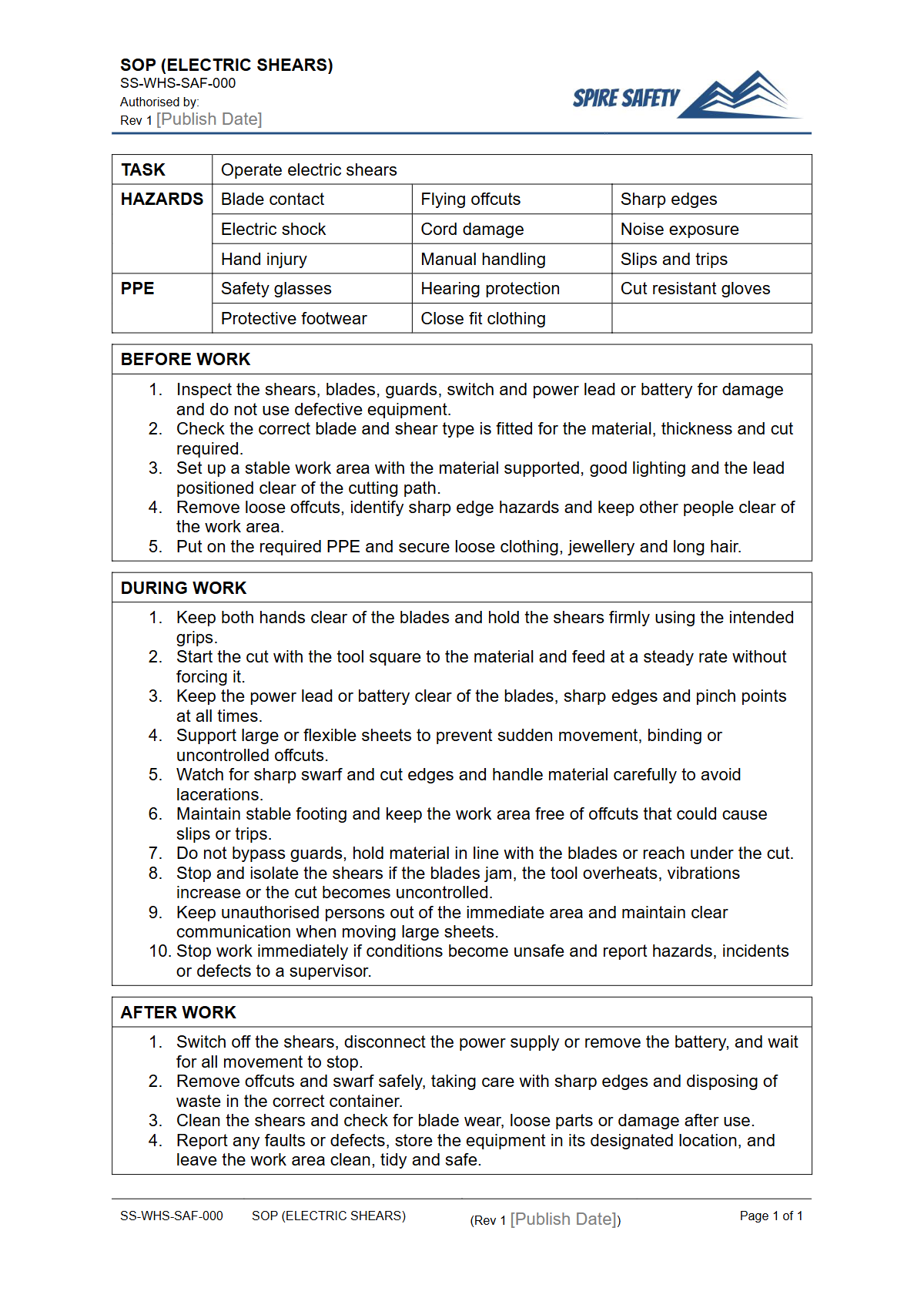
Download our free Safe Operating Procedure (Electric Shears) template. This document helps you outline clear safety steps for using electric shears at your workplace.
Free Safe Operating Procedure (Electric Shears) Template
DOCX • 126 KB + PDF
Updated Oct 2026
No signup required
Purpose of the Free Safe Operating Procedure (Electric Shears) Template
Operating powered hand tools like electric shears introduces significant workplace hazards. This free Safe Operating Procedure (Electric Shears) template provides a structured framework for documenting the safest way to perform this task.
An SOP standardises your process, ensuring every worker understands the required steps, potential hazards, and essential control measures. It is a critical tool for managing risks such as cuts, lacerations, electric shock, entanglement, and ergonomic strain.
By clearly defining pre-start checks, operational steps, and post-use procedures, this SOP helps you meet your WHS duties to provide a safe system of work.
Implementing documented procedures is a fundamental part of creating robust WHS management systems. A well-written SOP serves as a key reference for worker training, competency assessments, and incident investigations, promoting a consistent and safety-conscious approach to using equipment.
Video walkthrough
How to use the Free Safe Operating Procedure (Electric Shears) Template
This Safe Operating Procedure for electric shears is designed for ease of use. Simply download the template in your preferred format (DOCX for easy editing or PDF for straightforward printing) and begin adapting it to your operational context.
The document is logically structured with sections for PPE, hazards, pre-operational checks, operating steps, and emergency procedures. You must fill in the details specific to your business and the exact model of electric shears used by your team.
Important: We provide this document as a comprehensive starting point, not a finished product. To be effective, you must customise this template with your specific site details, equipment models, risk assessment outcomes, and internal procedures.
This ensures the final SOP accurately reflects the realities of your work environment.
When to use a Safe Operating Procedure
An SOP for electric shears should be integrated into your daily operations. It is not a document to be filed away and forgotten.
It should be used during initial worker inductions and as the basis for task-specific training. It serves as an essential refresher tool before a worker who operates the equipment infrequently performs the task.
Furthermore, the SOP must be reviewed and referenced following any incident or near-miss involving electric shears, or whenever a new model or type of shear is introduced to the workplace. Regular reviews are also a key focus during a WHS compliance auditing process to verify that procedures remain current and effective.
Who should use this SOP
This procedure is intended for use by multiple roles within an organisation. Workers and operators are the primary users, consulting the SOP to ensure they follow safe work practices every time they use the equipment.
Supervisors and managers use the template to conduct training, verify competency, and supervise work to ensure it aligns with the documented procedure. WHS personnel and management will use this SOP as a critical component of the organisation's overall safety framework, demonstrating that risks associated with power tools have been systematically addressed.
Key Hazards and Risks
Using electric shears presents several potential hazards that must be managed. The most obvious is the risk of severe cuts or amputation from contact with the moving blades. Other significant risks include:
- Electric Shock: Caused by damaged cords, plugs, or internal faults, particularly in damp conditions.
- Entanglement: Loose clothing, long hair, or jewellery can be caught in the moving parts of the tool.
- Projectiles: Metal fragments or off-cuts can be ejected at high speed, posing a risk to the operator and others nearby.
- Noise and Vibration: Prolonged use can contribute to hearing loss and musculoskeletal disorders like Hand-Arm Vibration Syndrome (HAVS).
These hazards are common across many powered cutting tools. The control measures outlined in our circular saw SOP also emphasise the importance of guarding, pre-start checks, and appropriate PPE to mitigate similar risks.
Developing Effective Control Measures
Your customised SOP must detail the specific controls your workplace has implemented. This begins with pre-operational checks, including inspecting the tool body for damage, ensuring the power cord is intact, and verifying that the blades are sharp and secure.
It should specify the mandatory Personal Protective Equipment (PPE), such as safety glasses, cut-resistant gloves, and appropriate footwear. For complex environments or unique applications, engaging in professional WHS consulting can provide expert guidance on conducting a thorough risk assessment to identify the most effective controls.
You can browse our complete free WHS resources library for more templates and guides to help you build out your safety management system and address other common workplace hazards.
Common mistakes
Common mistakes to avoid
- Using a generic SOP without customising it for the specific workplace and shear model.
- Failing to conduct and document pre-start inspections of the tool, blades, and power cord.
- Wearing loose clothing, gloves, or jewellery that can become entangled in the tool's moving parts.
- Neglecting to provide specific training on the SOP, assuming workers will read it on their own.
Legal references
Legal considerations
The following legal requirements may be relevant to this type of work.
- Work Health and Safety Act (Harmonised) — Provides the primary duties for protecting workers and other people from work health and safety risks.
- Work Health and Safety Regulations (Harmonised) — Sets out requirements supporting the management of workplace hazards and risks.
The following codes may be relevant to this type of work.
- Managing WHS Risks Code of Practice — Provides practical guidance on identifying hazards, assessing risks and applying effective controls.
- Work Health and Safety Consultation, Cooperation and Coordination Code of Practice — Provides practical guidance on consulting workers and coordinating with other duty holders.
- Managing the Work Environment and Facilities Code of Practice — Provides practical guidance on safe work environments, workplace facilities and related controls.
Did you know
RCD Protection
Using a portable residual current device (RCD) is a critical safety measure when operating corded electric tools. An RCD can shut off the power in milliseconds if it detects a fault, significantly reducing the risk of a fatal electric shock.
Blade Maintenance
A sharp blade is a safe blade. Dull or damaged blades require more force to cut, increasing the risk of operator fatigue, tool kickback, and poor-quality work.
FAQ
Frequently asked questions
01What is the difference between an SOP and a SWMS for electric shears?
02Is this template suitable for all types of electric shears?
03How often should our Electric Shears SOP be reviewed?
04Who is responsible for training workers on this SOP?
Share this resource
Free Safe Operating Procedure (Electric Shears) Template
Browse Categories
How To Use It
- 1Download and open in Word or PDF.
- 2Replace the placeholders with your business details.
- 3Get it reviewed by a WHS specialist before rollout.
Need it customised?
Our WHS consultants can adapt this template to your site, run a gap analysis, or audit what you already have in place.
Book a Free Consultation WHS consulting servicesor call 1300 156 382
Related templates
- Free Safe Operating Procedure (Electric Stapler) Template
- Free Safe Operating Procedure (Electric Tug) Template
- Free Safe Operating Procedure (Electrical Isolation) Template
- Free Safe Operating Procedure (Electrical Test Bench) Template
- Free Safe Operating Procedure (Electrode Oven) Template
- Free Safe Operating Procedure (Electroplating) Template