
Free Safe Operating Procedure (Electric Stapler) Template
Download our free Safe Operating Procedure (Electric Stapler) template to establish and document safe work practices. Get started with our customisable DOCX.
Free Safe Operating Procedure (Electric Stapler) Template
DOCX • 126 KB + PDF
Updated Oct 2026
No signup required
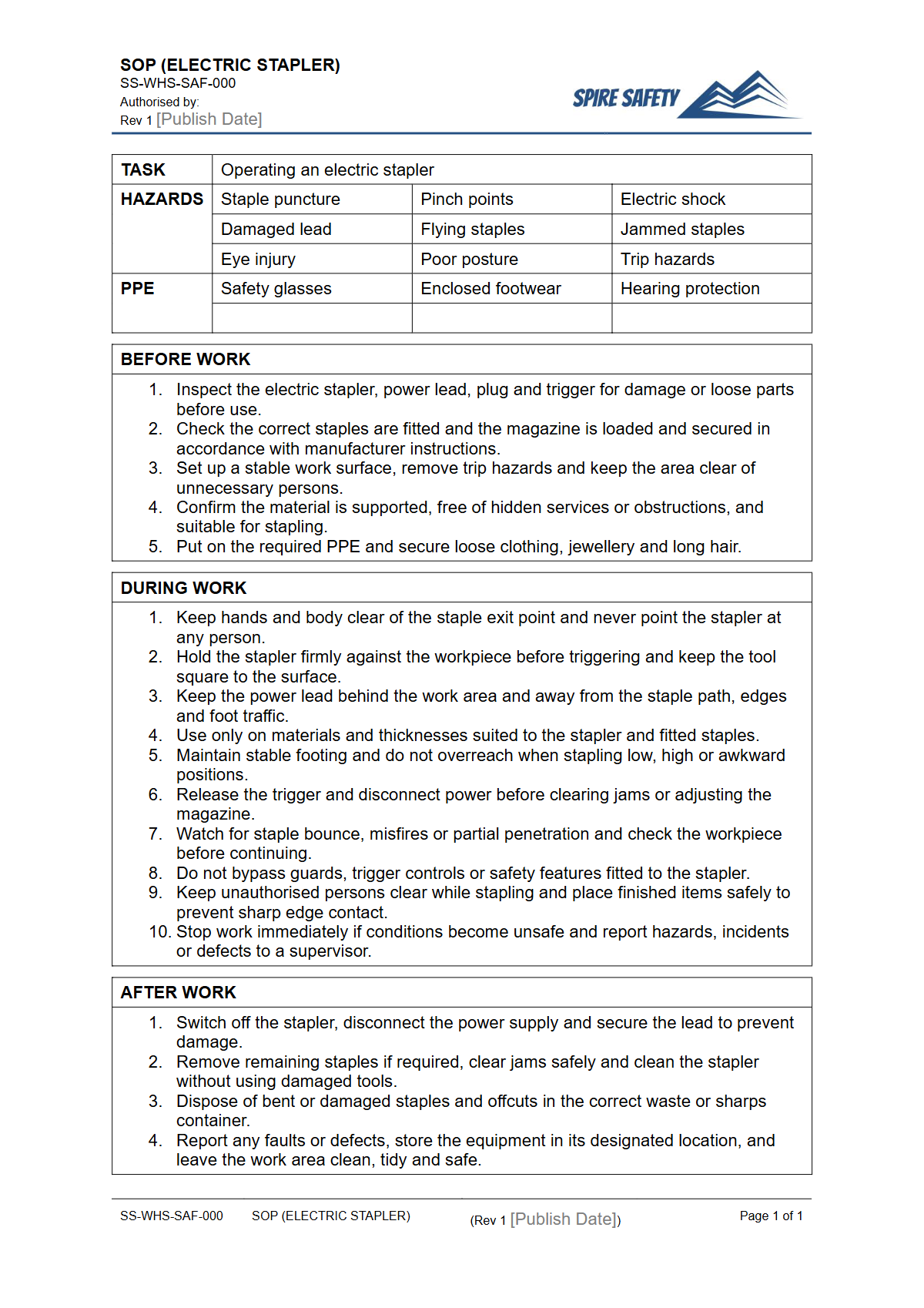
Purpose of the Free Safe Operating Procedure (Electric Stapler) Template
An electric stapler, while a common office and workshop tool, poses several health and safety risks if not used correctly. This Free Safe Operating Procedure (Electric Stapler) Template provides a structured starting point for your organisation to document the approved, step-by-step process for safely operating this equipment.
Its purpose is to control hazards and minimise the risk of injury to workers. Implementing a formal SOP helps standardise user training, reinforces safe behaviour, and demonstrates a commitment to workplace safety.
Key Hazard Identification
Using an electric stapler can expose operators to a range of hazards. This SOP template guides you in identifying and controlling risks specific to your workplace, which may include:
- Puncture Wounds: Accidental firing of a staple into hands, fingers, or other body parts.
- Electrical Hazards: Risk of electric shock from frayed cords, faulty wiring, or use near liquids.
- Projectile Injuries: Staples being ejected at high speed, particularly if a jam is cleared improperly, posing a risk to eyes.
- Entanglement: Loose clothing, jewellery, or long hair getting caught in the stapler's mechanism.
- Ergonomic Strain: Repetitive use or awkward postures can lead to musculoskeletal disorders.
Video walkthrough
How to use the Free Safe Operating Procedure (Electric Stapler) Template
This document is a template and must be adapted to your specific operational needs. To use it effectively, download the DOCX file and work through each section.
You should replace the placeholder text with details relevant to your specific make and model of electric stapler, the tasks it's used for, and your unique work environment. Ensure you consult with the workers who actually use the equipment, as they provide invaluable insight into the practical realities of the task.
Important Note: This is a generic template provided as a guide only. It is the responsibility of the user to ensure it is customised to reflect the specific hazards and control measures relevant to their workplace.
We cannot guarantee that this document will meet all your legislative requirements; it is your responsibility to supports your compliance efforts.
The principles of identifying hazards and documenting safe steps are transferable to other powered hand tools. For instance, our circular saw SOP template follows a similar structure for managing higher-risk equipment.
When to use a Safe Operating Procedure
A Safe Operating Procedure for an electric stapler should be a central part of your safety framework. It is used as a primary training document for new workers or those unfamiliar with a specific model.
It also serves as a critical pre-task reference, allowing operators to refresh their knowledge of safety checks and correct operation before they begin work. Furthermore, SOPs are vital reference documents during safety talks, incident investigations, and performance reviews.
They form a key component of a safe system of work, which is fundamental to developing WHS management systems that are both practical and effective.
For machinery with more complex energy sources, such as compressed air, a dedicated procedure is also essential. You can review our Free Air Compressor SOP to see how controls differ for pneumatic equipment.
Who should use this Safe Operating Procedure
This SOP is designed for several key roles within an organisation. Primarily, it is for the workers who will operate the electric stapler.
It provides them with clear, unambiguous instructions to perform their tasks safely. Supervisors and line managers should use the SOP to train their teams, monitor for correct usage, and enforce safety standards on the floor.
Finally, WHS managers and safety officers will use this template as a foundational document to build, review, and integrate into the broader workplace health and safety program. Regular reviews ensure the SOP remains current, a process that can be verified through formal WHS compliance auditing.
Documenting procedures for all types of workplace equipment, no matter how simple they seem, is a hallmark of a mature safety culture. Even machinery like conveyors requires a formal process, as outlined in our Conveyer System SOP.
This electric stapler procedure is just one of many documents available to help you build out your safety systems. You can browse our complete free WHS resources library for more templates, checklists, and guides.
Common mistakes
Common mistakes to avoid
- Using the template without customising it for the specific model and work environment.
- Failing to train workers on the SOP and confirm their understanding before use.
- Neglecting pre-use inspections to check for damaged cords or faulty safety features.
- Attempting to clear jams or perform maintenance without first disconnecting the power source.
Legal references
Legal considerations
The following legal requirements may be relevant to this type of work.
- Work Health and Safety Act (Harmonised) — Provides the primary duties for protecting workers and other people from work health and safety risks.
- Work Health and Safety Regulations (Harmonised) — Sets out requirements supporting the management of workplace hazards and risks.
The following codes may be relevant to this type of work.
- Managing WHS Risks Code of Practice — Provides practical guidance on identifying hazards, assessing risks and applying effective controls.
- Work Health and Safety Consultation, Cooperation and Coordination Code of Practice — Provides practical guidance on consulting workers and coordinating with other duty holders.
- Managing the Work Environment and Facilities Code of Practice — Provides practical guidance on safe work environments, workplace facilities and related controls.
Did you know
Ergonomic Risk
Repetitive use of any stapler, including electric models, can contribute to musculoskeletal disorders (MSDs) if posture and workstation setup are not optimised.
Duty of Care
Under Australian WHS law, a Person Conducting a Business or Undertaking (PCBU) has a primary duty of care to ensure the health and safety of workers, which includes providing safe plant and equipment.
FAQ
Frequently asked questions
01What hazards are associated with using an electric stapler?
02Is a Safe Operating Procedure legally required for an electric stapler in Australia?
03How often should an electric stapler SOP be reviewed?
04Can I use this template for a pneumatic stapler?
Share this resource
Free Safe Operating Procedure (Electric Stapler) Template
Browse Categories
How To Use It
- 1Download and open in Word or PDF.
- 2Replace the placeholders with your business details.
- 3Get it reviewed by a WHS specialist before rollout.
Need it customised?
Our WHS consultants can adapt this template to your site, run a gap analysis, or audit what you already have in place.
Book a Free Consultation WHS consulting servicesor call 1300 156 382
Related templates
- Free Safe Operating Procedure (Electric Tug) Template
- Free Safe Operating Procedure (Electrical Isolation) Template
- Free Safe Operating Procedure (Electrical Test Bench) Template
- Free Safe Operating Procedure (Electrode Oven) Template
- Free Safe Operating Procedure (Electroplating) Template
- Free Safe Operating Procedure (Embroidery Machine) Template