
Free Safe Operating Procedure (Electric Bed Adjustment) Template
Properly adjusting electric beds requires clear, safe instructions to prevent injury. Download our free Safe Operating Procedure template to get started.
Free Safe Operating Procedure (Electric Bed Adjustment) Template
DOCX • 126 KB + PDF
Updated Oct 2026
No signup required
Purpose of the Free Safe Operating Procedure (Electric Bed Adjustment) Template
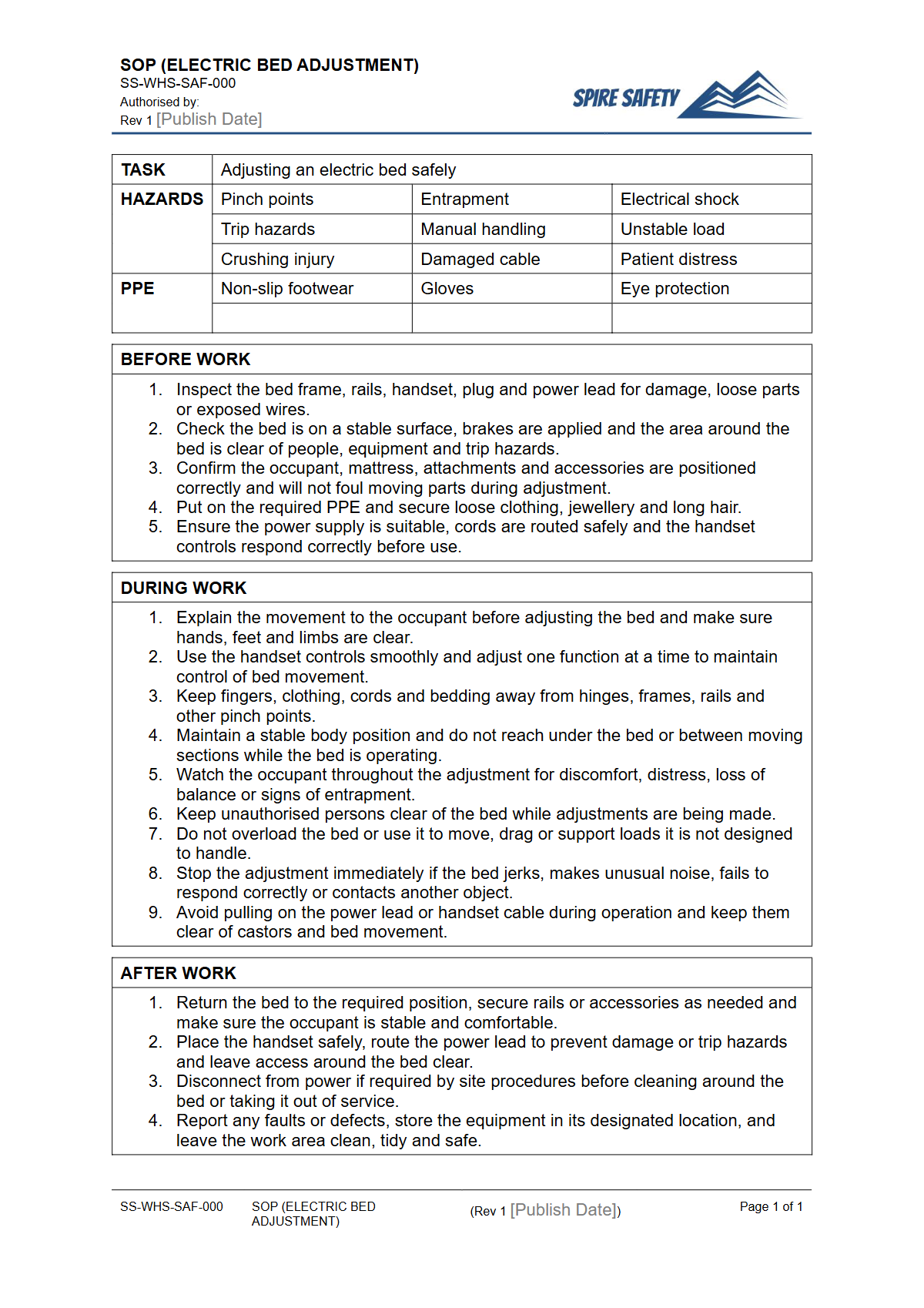
This Free Safe Operating Procedure (Electric Bed Adjustment) Template provides a structured framework for businesses to document the safe use of electric beds in healthcare, aged care, and support environments. The primary purpose of this SOP is to minimise health and safety risks to both workers and patients.
Key hazards include musculoskeletal injuries for staff from poor posture or over-exertion, crush or entrapment injuries from moving parts, and patient falls from beds left at an unsafe height.
Implementing a clear, standardised procedure ensures that all workers, regardless of experience level, follow the same safe, pre-approved method for adjusting bed height, backrests, and leg rests. This document is a fundamental component within a comprehensive WHS management system, helping to standardise training, demonstrate due diligence in managing workplace risks, and foster a proactive safety culture.
Video walkthrough
How to use the Free Safe Operating Procedure (Electric Bed Adjustment) Template
Begin by downloading the template in the format that best suits your needs. The DOCX file is fully editable, allowing for extensive customisation, while the PDF version is a static reference for printing or digital distribution.
Once downloaded, you must review and adapt the content to your specific operational context.
Important: This template is a starting point, not a finished, document. You must adapt it to reflect the specific models of electric beds used in your facility, the environment they are in, and the findings of your own site-specific risk assessment.
We provide this resource to assist your safety process, but responsibility for creating a safe system of work remains with the PCBU (Person Conducting a Business or Undertaking).
A critical step in finalising your SOP is to ensure it aligns with your other safety documentation and processes. The periodic review of these documents is a key safety activity, which can form part of a broader WHS compliance audit to verify the effectiveness of your safety systems.
When to use it
A Safe Operating Procedure for electric bed adjustment should be used as a primary reference document in several key situations. It forms the basis of initial training and induction for new staff members, ensuring they learn the correct procedure from day one.
It should also be used during periodic refresher training to maintain competency and address any procedural drift.
The SOP should be readily accessible to staff in work areas as a quick reference guide. It is particularly important to consult before performing unfamiliar adjustments or when using a new model of bed.
Furthermore, this document becomes a vital tool for review and analysis during an incident investigation should a near miss or injury occur involving this equipment.
Who should use it
This SOP is intended for a range of personnel. The primary users are direct care staff who operate electric beds daily, including nurses, personal care assistants, and disability support workers.
It is also a critical resource for WHS managers and supervisors who are responsible for providing training, assessing worker competency, and overseeing safe work practices.
Maintenance and technical staff who are required to service, test, or repair electric beds should also be familiar with the operational SOP to understand how the equipment is used in practice. Creating consistent procedures for all equipment within a facility, from patient care devices to kitchen appliances detailed in a deep fryer standard operation SOP, helps to establish a robust and predictable safety environment for everyone.
Key Elements of an Electric Bed SOP
A thorough SOP for electric bed adjustment covers several distinct phases of the task. Our template guides you through documenting:
- Pre-operational Checks: Steps to take before using the bed, such as inspecting the power cord and handset for damage, ensuring castors move freely, and testing that brakes lock effectively.
- Personal Protective Equipment (PPE): Identification of any required PPE, such as non-slip, enclosed footwear.
- Step-by-Step Operating Procedure: A logical sequence for making adjustments, including communicating with the patient, using controls to move the bed to the correct working height, adjusting patient position, and returning the bed to a safe, low position.
- Post-operational Tasks: Actions to complete after the task, such as ensuring brakes are engaged, side rails are positioned according to the patient's care plan, and the handset is stored securely.
- Emergency Procedures: Instructions on how to use manual over-rides or emergency lowering functions, if available on your model.
Integrating with Other Safety Procedures
An SOP does not exist in isolation. It is most effective when integrated into a broader safety framework.
This procedure should be directly linked to your worker induction program, practical training sessions, and competency assessment records. It should also be supported by a regular equipment maintenance and inspection schedule, with clear records kept for each bed.
For facilities with diverse plant and equipment, such as maintenance workshops, standardising your documentation using templates like our Free Air Compressor SOP Template ensures consistency and ease of use for workers.
Developing and implementing a single SOP is a great first step. Building out this system to cover all hazardous tasks and plant requires a strategic approach.
For expert guidance on integrating this procedure or developing a more comprehensive safety framework tailored to your needs, our WHS consulting team can provide assistance. Feel free to browse our complete free WHS resources library for more templates and safety guides to support your organisation.
Common mistakes
Common mistakes to avoid
- Forgetting to apply brakes before and after adjustment.
- Leaving the bed in a raised position after providing care.
- Failing to check for obstructions under or around the bed before moving it.
- Operating controls without communicating with the patient or occupant.
Legal references
Legal considerations
The following legal requirements may be relevant to this type of work.
- Work Health and Safety Act (Harmonised) — Provides the primary duties for protecting workers and other people from work health and safety risks.
- Work Health and Safety Regulations (Harmonised) — Sets out requirements supporting the management of workplace hazards and risks.
The following codes may be relevant to this type of work.
- Managing WHS Risks Code of Practice — Provides practical guidance on identifying hazards, assessing risks and applying effective controls.
- Work Health and Safety Consultation, Cooperation and Coordination Code of Practice — Provides practical guidance on consulting workers and coordinating with other duty holders.
- Managing the Work Environment and Facilities Code of Practice — Provides practical guidance on safe work environments, workplace facilities and related controls.
Did you know
MSDs in Healthcare
The healthcare and social assistance industry has one of the highest rates of serious workers' compensation claims in Australia, with body stressing and manual handling being primary causes.
Patient Safety
Incorrect bed height is a significant contributing factor to patient falls in hospitals and aged care facilities. A standardised procedure helps mitigate this risk.
FAQ
Frequently asked questions
01What risks are associated with adjusting electric beds?
02Is a Safe Operating Procedure a legal requirement in Australia?
03How often should an SOP for electric bed adjustment be reviewed?
04Can I use this template for any brand of electric bed?
Share this resource
Free Safe Operating Procedure (Electric Bed Adjustment) Template
Browse Categories
How To Use It
- 1Download and open in Word or PDF.
- 2Replace the placeholders with your business details.
- 3Get it reviewed by a WHS specialist before rollout.
Need it customised?
Our WHS consultants can adapt this template to your site, run a gap analysis, or audit what you already have in place.
Book a Free Consultation WHS consulting servicesor call 1300 156 382
Related templates
- Free Safe Operating Procedure (Electric Planer) Template
- Free Safe Operating Procedure (Electric Screwdriver) Template
- Free Safe Operating Procedure (Electric Shears) Template
- Free Safe Operating Procedure (Electric Stapler) Template
- Free Safe Operating Procedure (Electric Tug) Template
- Free Safe Operating Procedure (Electrical Isolation) Template