
Free Safe Operating Procedure (Electric Screwdriver) Template
Effectively manage hazards associated with electric screwdrivers with our structured template. Download your free, customisable Safe Operating Procedure today.
Free Safe Operating Procedure (Electric Screwdriver) Template
DOCX • 126 KB + PDF
Updated Oct 2026
No signup required
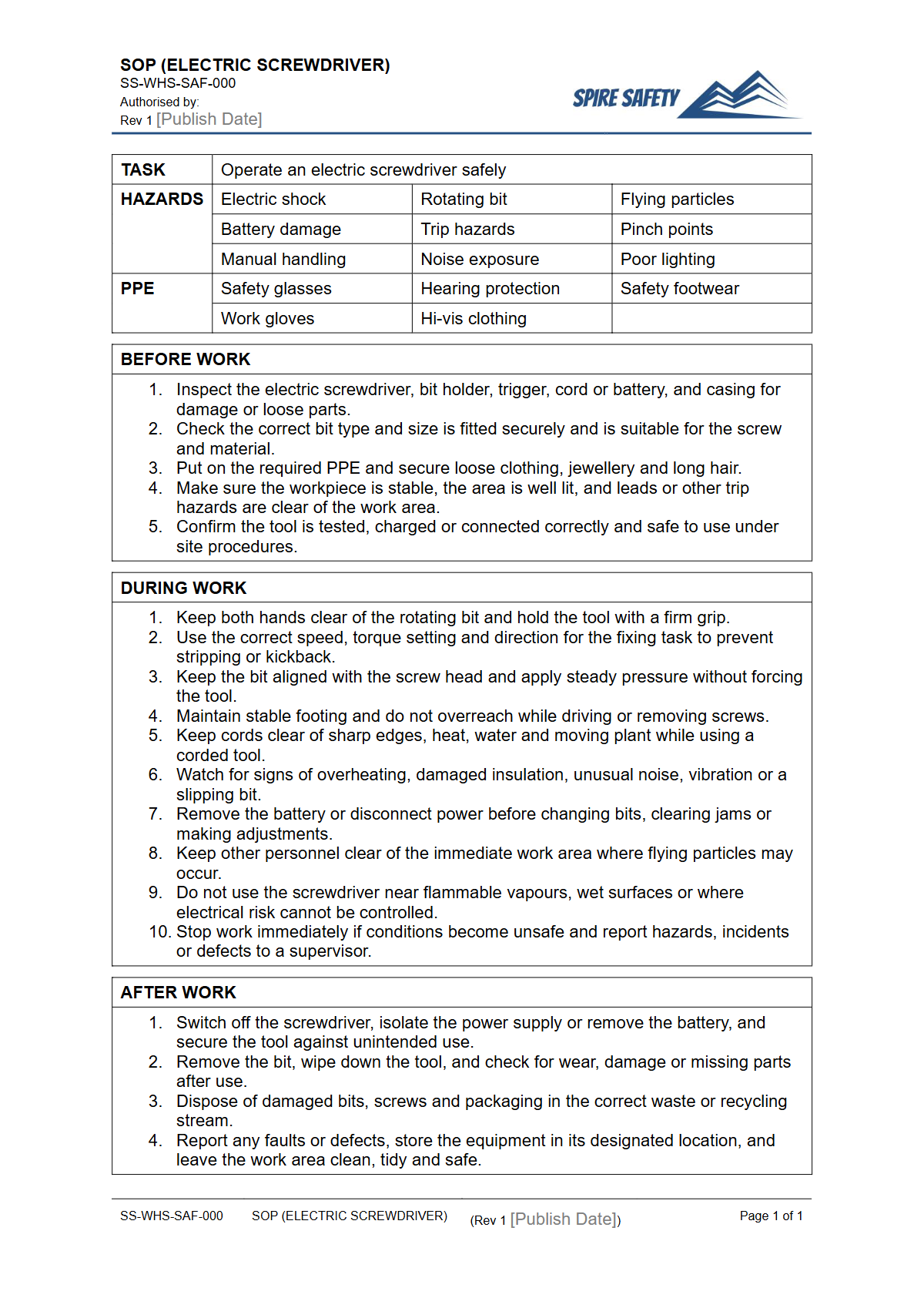
Streamline your safety documentation with our Free Safe Operating Procedure (Electric Screwdriver) Template. Designed for Australian workplaces, this resource provides a structured framework for outlining the step-by-step process for the safe use of electric screwdrivers. By documenting your procedures, you create a clear, consistent guide for workers, helping to minimise risks and ensure tasks are completed safely.
This template is available as a fully editable DOCX file, allowing for easy customisation to suit your specific equipment and operational context.
Video walkthrough
Purpose of the Free Safe Operating Procedure (Electric Screwdriver) Template
A Safe Operating Procedure (SOP) is a foundational document in any workplace safety system. The primary purpose of this template is to help your organisation document and standardise the safe use of electric screwdrivers.
It formalises the expected behaviours and steps workers must follow before, during, and after operation. This includes pre-start checks, identifying required Personal Protective Equipment (PPE), detailing the correct operating technique, and outlining shutdown and cleaning procedures.
Implementing a clear SOP helps reduce the risk of common injuries such as electric shock from damaged cords, repetitive strain injuries from improper handling, or eye injuries from flying debris. For a holistic approach, these documents should be integrated into your broader WHS management systems.
How to use the Free Safe Operating Procedure (Electric Screwdriver) Template
This document serves as a comprehensive starting point, not a final, document. It is crucial that you customise it to reflect the specific hazards and controls within your workplace. Follow these steps:
- Download: Choose either the DOCX for easy editing or the PDF for reference.
- Review and Customise: We strongly advise that you conduct a risk assessment on the use of your specific electric screwdriver models. Incorporate your findings, including brand-specific controls, workplace conditions, and the types of materials being worked on.
- Consult: Involve workers who use the equipment in the review process. Their practical experience is invaluable for creating a procedure that is both safe and workable.
- Approve and Train: Once finalised, have the SOP approved by a competent person. Use it as a central tool for training new employees and for conducting refresher training with existing staff.
When to use this Safe Operating Procedure
An SOP for an electric screwdriver should be used consistently as part of your daily operational safety practices. It is a critical training document for any new worker before they are authorised to use the tool.
It should also be referenced during toolbox talks or safety briefings, especially if a task is non-routine or involves heightened risk. Furthermore, the SOP serves as a benchmark during safety observations or performance reviews.
If you are developing procedures for other common workshop equipment, our free Air Compressor SOP offers a similar structured approach for a different hazard profile.
Who should use this Safe Operating Procedure
This SOP is intended for a range of personnel within an organisation. Workers and operators use it as a direct guide for performing their tasks safely.
Supervisors and Team Leaders use it to induct new team members, enforce safety standards, and investigate any incidents or near misses. WHS Managers and Advisors use it as a component of the overall safety management system, ensuring that documented procedures are in place for workplace plant and equipment.
Procedures like this are often reviewed during a formal WHS compliance auditing process to verify that controls are documented and implemented.
Integrating SOPs into your Safety Framework
A single SOP is a great start, but its effectiveness is magnified when it's part of a broader system. Ensure your workers understand the hierarchy of control and the importance of risk assessment.
SOPs are an administrative control, which should be supported by higher-level controls like engineering solutions (e.g., using low-vibration tools) and robust PPE programs. For businesses needing expert guidance on developing these comprehensive systems, our general WHS consulting services can provide tailored support.
Documenting procedures for all high-risk equipment is essential. For instance, tasks involving other powerful handheld tools require their own specific instructions, which is why we also provide resources like a free Circular Saw SOP. By building a complete library of procedures, you create a safer and more predictable work environment. You can explore our full range of templates in our free WHS resources library.
Common mistakes
Common mistakes to avoid
- Using the wrong size or type of bit for the screw head, leading to slippage and hand injuries.
- Failing to inspect the power cord and plug for damage before use, creating an electrical hazard.
- Applying excessive body force instead of letting the tool's motor do the work.
- Neglecting to secure the workpiece, allowing it to spin or move unexpectedly during operation.
Legal references
Legal considerations
The following legal requirements may be relevant to this type of work.
- Work Health and Safety Act (Harmonised) — Provides the primary duties for protecting workers and other people from work health and safety risks.
- Work Health and Safety Regulations (Harmonised) — Sets out requirements supporting the management of workplace hazards and risks.
The following codes may be relevant to this type of work.
- Managing WHS Risks Code of Practice — Provides practical guidance on identifying hazards, assessing risks and applying effective controls.
- Work Health and Safety Consultation, Cooperation and Coordination Code of Practice — Provides practical guidance on consulting workers and coordinating with other duty holders.
- Managing the Work Environment and Facilities Code of Practice — Provides practical guidance on safe work environments, workplace facilities and related controls.
Did you know
Ergonomic Advantage
While electric screwdrivers significantly reduce the wrist strain associated with manual tools, prolonged or awkward use can still lead to Repetitive Strain Injuries (RSIs). Ergonomic design and regular breaks are key.
Torque Control
Modern electric screwdrivers feature an adjustable clutch that controls torque. This prevents over-tightening fasteners, which can damage the workpiece or strip screw heads, a common quality and safety issue.
FAQ
Frequently asked questions
01What should be included in a Safe Operating Procedure for an electric screwdriver?
02Is this SOP template compliant with Australian WHS laws?
03How often should an SOP be reviewed?
04Can I use this SOP for a cordless screwdriver too?
Share this resource
Free Safe Operating Procedure (Electric Screwdriver) Template
Browse Categories
How To Use It
- 1Download and open in Word or PDF.
- 2Replace the placeholders with your business details.
- 3Get it reviewed by a WHS specialist before rollout.
Need it customised?
Our WHS consultants can adapt this template to your site, run a gap analysis, or audit what you already have in place.
Book a Free Consultation WHS consulting servicesor call 1300 156 382
Related templates
- Free Safe Operating Procedure (Electric Shears) Template
- Free Safe Operating Procedure (Electric Stapler) Template
- Free Safe Operating Procedure (Electric Tug) Template
- Free Safe Operating Procedure (Electrical Isolation) Template
- Free Safe Operating Procedure (Electrical Test Bench) Template
- Free Safe Operating Procedure (Electrode Oven) Template