
Free Safe Operating Procedure (Electric Planer) Template
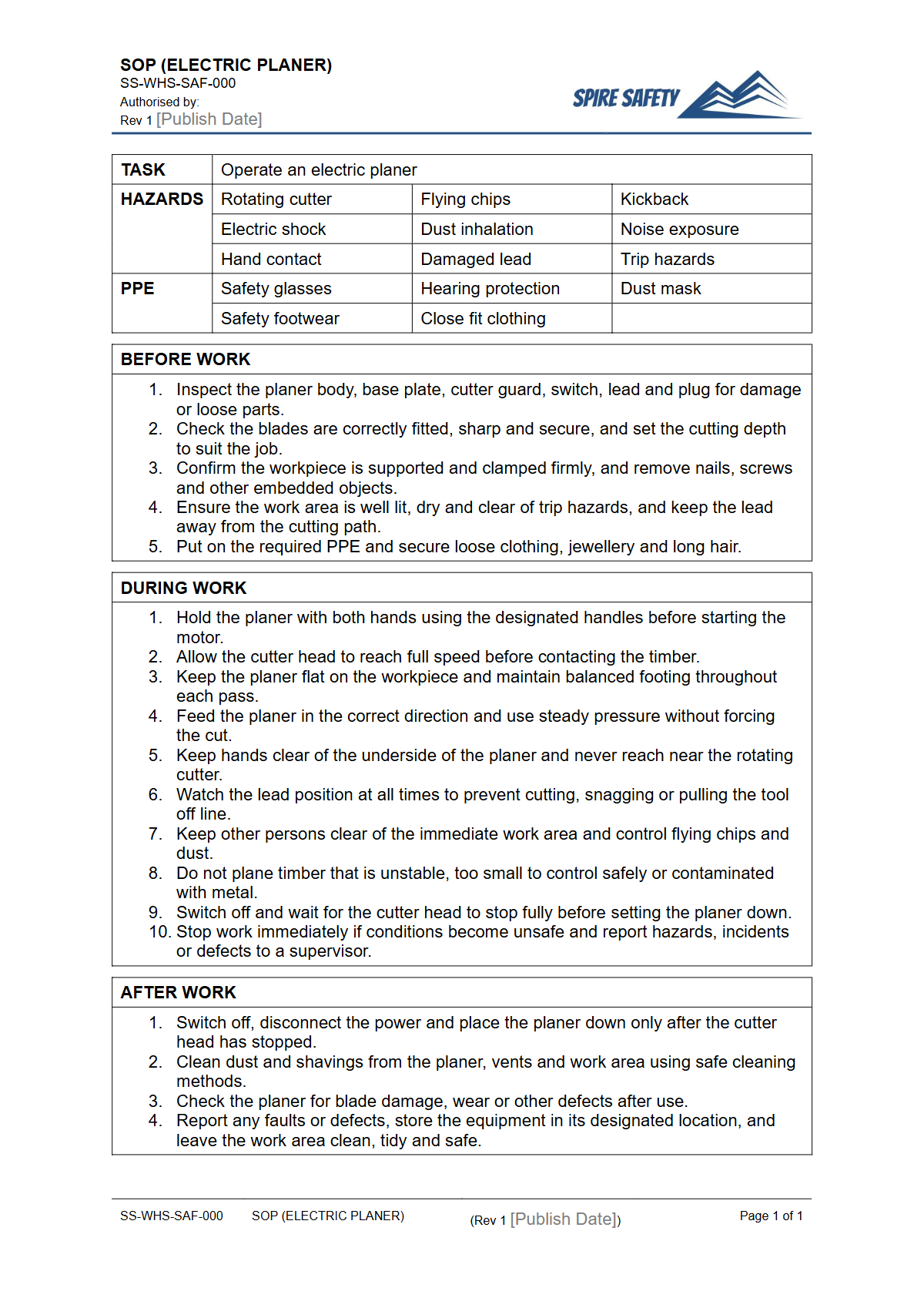
Download our free Safe Operating Procedure for electric planers. This customisable template helps you outline safety controls for your workplace.
Free Safe Operating Procedure (Electric Planer) Template
DOCX • 126 KB + PDF
Updated Oct 2026
No signup required
Purpose of the Free Safe Operating Procedure (Electric Planer) Template
This free Safe Operating Procedure (SOP) template for electric planers provides a structured framework for documenting the hazards and control measures associated with using this powerful woodworking tool. By clearly outlining pre-operational checks, safe work steps, and post-operational tasks, this document helps persons conducting a business or undertaking (PCBUs) fulfil their primary duty of care.
An effective SOP is a critical administrative control that standardises safe work practices, reduces the risk of injury from kickback or blade contact, and supports operator training. The goal is to create a safer work environment by formally documenting risk management processes.
Similar to our free Circular Saw SOP Template, this resource is designed to be a practical tool for on-the-ground safety management.
What's included in the template?
Available as both a DOCX and PDF file, this template is structured to align with Australian WHS best practices. It includes dedicated sections for:
- Required Personal Protective Equipment (PPE)
- Hazard identification and risk assessment specific to electric planers
- Pre-operational safety checks (e.g., blade condition, power cord integrity)
- Step-by-step instructions for safe operation
- Housekeeping and post-use cleaning procedures
- Emergency procedures
Video walkthrough
How to Use the Free Safe Operating Procedure (Electric Planer) Template
To effectively use this free Safe Operating Procedure for an electric planer, you must first download the DOCX version and adapt it to the specific context of your workplace. This resource is a starting point, not a finished document.
We cannot know your specific site, tools, materials, or personnel. You must conduct your own risk assessment and consult with your workers to ensure the controls you document are relevant and effective.
Customise the content to reflect the make and model of the planer, the types of materials being worked on, and any unique environmental factors in your workshop. Integrating these documents into your broader safety framework is a key part of developing robust WHS management systems.
Steps for Implementation
After customisation, the SOP should be used as a core part of your training and operational processes. Ensure all operators read and understand the document before using the equipment.
Supervisors should use it as a reference for monitoring safe work practices and for conducting competency assessments. Keep a printed and accessible copy near the work area where the electric planer is used.
Regularly review the SOP's effectiveness and update it as necessary.
When to Use It
A Safe Operating Procedure for an electric planer should be a living document, used consistently throughout your operations. It is essential during the induction and training of new employees or contractors who will be required to use the tool.
It should also be referenced during refresher training sessions to reinforce safe behaviours. Furthermore, the SOP is a critical document to review and update following any incident, near miss, or change in work processes involving the planer.
Regular reviews as part of a scheduled WHS compliance auditing program ensure the procedure remains current and effective against emerging risks.
Who Should Use It
This SOP is intended for a range of personnel within an organisation. Primarily, it is for the operators of the electric planer, providing them with clear, step-by-step guidance on how to perform their tasks safely.
Supervisors and team leaders should use the document to train staff, enforce safety standards, and investigate any deviations from the procedure. WHS managers and safety officers will use the SOP as a key piece of evidence in their risk register and safety management system, demonstrating how specific plant-related hazards are being controlled.
For other common workshop equipment, consider using our Free Air Compressor SOP Template to maintain consistency in your documentation.
Ultimately, the PCBU holds the responsibility to ensure safe systems of work are in place, making this template a valuable tool for demonstrating compliance efforts. You can find more templates and checklists like this in our complete free WHS resources library.
Common mistakes
Common mistakes to avoid
- Planing against the wood grain, which causes tear-out and increases kickback risk.
- Failing to securely clamp the workpiece, allowing it to move during operation.
- Not allowing the blade drum to reach full operational speed before making contact with the wood.
- Resting the planer on its side before the blades have completely stopped spinning.
- Attempting to remove too much material in a single pass.
Legal references
Legal considerations
The following legal requirements may be relevant to this type of work.
- Work Health and Safety Act (Harmonised) — Provides the primary duties for protecting workers and other people from work health and safety risks.
- Work Health and Safety Regulations (Harmonised) — Sets out requirements supporting the management of workplace hazards and risks.
The following codes may be relevant to this type of work.
- Managing WHS Risks Code of Practice — Provides practical guidance on identifying hazards, assessing risks and applying effective controls.
- Work Health and Safety Consultation, Cooperation and Coordination Code of Practice — Provides practical guidance on consulting workers and coordinating with other duty holders.
- Managing the Work Environment and Facilities Code of Practice — Provides practical guidance on safe work environments, workplace facilities and related controls.
Did you know
Kickback Danger
Electric planer kickback often occurs when planing against the grain, hitting a knot, or taking too deep a cut. The force can be strong enough to throw the tool out of the operator's hands, posing a serious laceration risk.
Dust Hazards
Fine dust from an electric planer, especially from MDF or treated timbers, can contain hazardous substances like formaldehyde or arsenic. Always use appropriate dust extraction and respiratory protection.
FAQ
Frequently asked questions
01What PPE is required for using an electric planer?
02How often should an electric planer SOP be reviewed?
03Can this template be used for any brand of electric planer?
04What are the main hazards of using an electric planer?
Share this resource
Free Safe Operating Procedure (Electric Planer) Template
Browse Categories
How To Use It
- 1Download and open in Word or PDF.
- 2Replace the placeholders with your business details.
- 3Get it reviewed by a WHS specialist before rollout.
Need it customised?
Our WHS consultants can adapt this template to your site, run a gap analysis, or audit what you already have in place.
Book a Free Consultation WHS consulting servicesor call 1300 156 382
Related templates
- Free Safe Operating Procedure (Electric Screwdriver) Template
- Free Safe Operating Procedure (Electric Shears) Template
- Free Safe Operating Procedure (Electric Stapler) Template
- Free Safe Operating Procedure (Electric Tug) Template
- Free Safe Operating Procedure (Electrical Isolation) Template
- Free Safe Operating Procedure (Electrical Test Bench) Template