
Free Safe Operating Procedure (Effluent Area Check) Template
Manage risks associated with effluent areas using our structured Safe Operating Procedure template. Download the free DOCX and PDF to get started.
Free Safe Operating Procedure (Effluent Area Check) Template
DOCX • 126 KB + PDF
Updated Oct 2026
No signup required
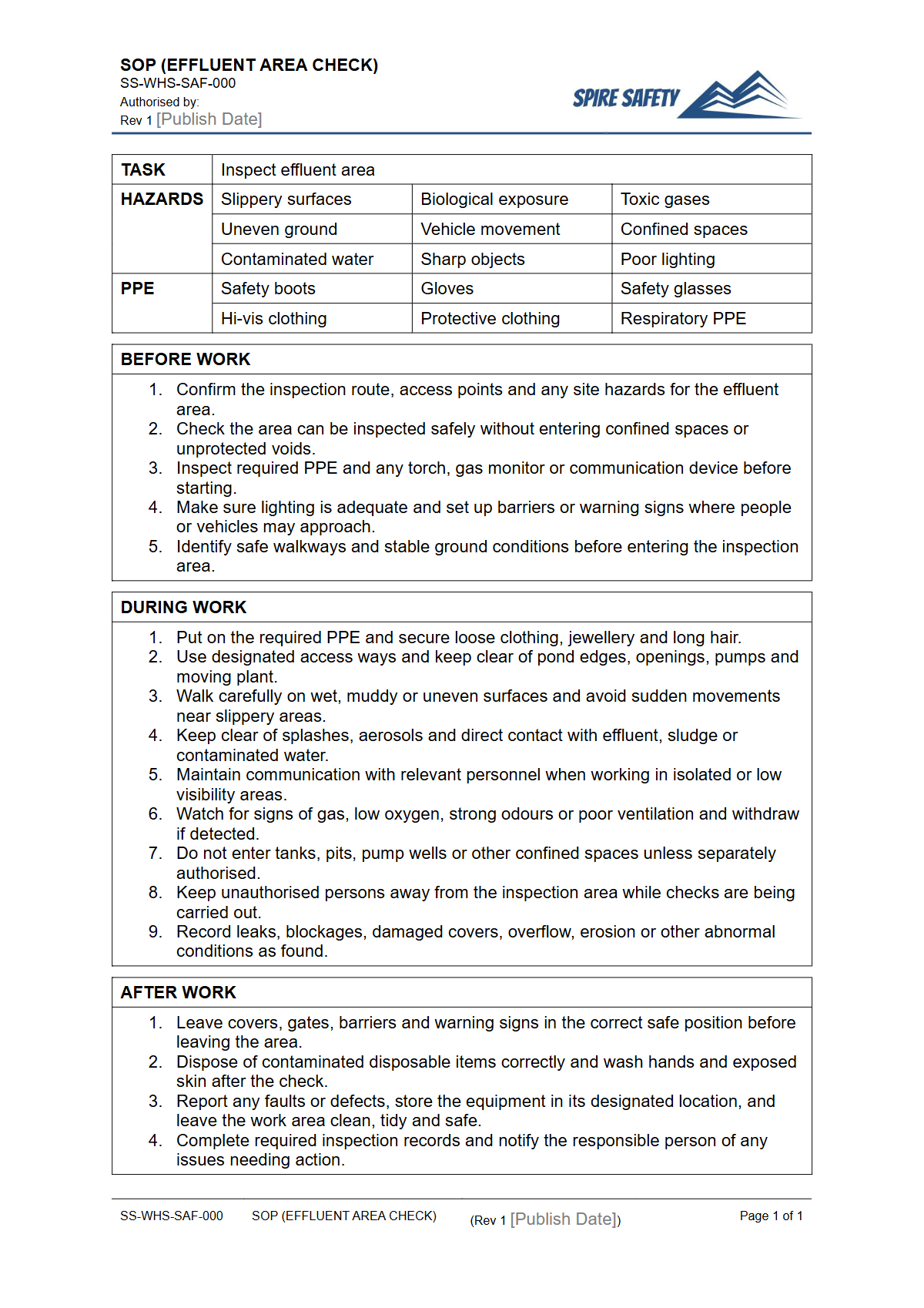
Purpose of the Free Safe Operating Procedure (Effluent Area Check) Template
This Safe Operating Procedure (SOP) template provides a structured framework for documenting the safe and systematic process for conducting checks in effluent treatment areas. Its primary purpose is to help Persons Conducting a Business or Undertaking (PCBUs) manage WHS risks associated with this specialised task.
Effluent areas often contain a combination of hazards, including hazardous chemicals, biological waste, confined spaces, moving parts, and wet or slippery surfaces. By clearly outlining the required steps, personal protective equipment (PPE), and emergency responses, this SOP serves as a critical tool for worker training and operational consistency.
A well-developed SOP demonstrates a commitment to workplace safety and is a key component of a proactive risk management strategy. It helps ensure that all personnel follow a standardised, pre-approved method for performing the check, reducing the likelihood of incidents, injuries, or environmental contamination.
Formalising this process is a fundamental part of any effective WHS management system, providing clear instructions that support compliance and protect workers.
Video walkthrough
How to use the Free Safe Operating Procedure (Effluent Area Check) Template
This document is designed as a starting point. To make it effective, you must adapt it to the specific conditions of your site.
Download the DOCX file and systematically work through each section, adding details relevant to your machinery, chemical inventory, layout, and personnel. Conduct a thorough risk assessment for the effluent area check task to identify all potential hazards and establish appropriate control measures.
The template includes sections for:
- Required PPE: Specify the exact gloves, eyewear, respiratory protection, and footwear needed.
- Pre-Operational Checks: Detail what to inspect before starting, such as equipment status, lighting, and ventilation.
- Step-by-Step Procedure: List every action in sequential order, from safely accessing the area to taking samples or readings and recording data.
- Post-Operational Checks: Outline clean-up, waste disposal, and equipment shutdown procedures.
- Emergency Procedures: Document the immediate actions for spills, personal exposure, equipment failure, or medical emergencies.
Important: This document is a template and must be customised to your specific workplace. We recommend a thorough risk assessment is conducted to identify all hazards and control measures relevant to your equipment, environment, and personnel. Once finalised, the SOP should be reviewed and approved by a competent person, and its effectiveness should be monitored through workplace inspections and regular WHS compliance auditing.
When to use this Safe Operating Procedure
An SOP for effluent area checks is not a document to be filed away; it is a practical tool for daily operations. It should be used consistently in several key situations to maximise its effectiveness and reinforce safe work behaviours.
Use this Safe Operating Procedure during initial worker induction and for task-specific training before an employee is authorised to perform the check independently. It ensures that everyone receives the same, correct information from the beginning.
It should also serve as a direct reference before and during the task, especially for checks that are not performed daily. For complex or high-risk tasks, reviewing the SOP beforehand helps refresh the operator's memory of the required steps and safety precautions.
Just as you would document procedures for specific plant like in a conveyer system SOP, this template helps formalise tasks in specialised areas. Furthermore, the SOP must be a central document in any incident investigation or near-miss review related to the effluent area, helping to identify procedural gaps or areas for improvement.
Who should use this Safe Operating Procedure
This template is designed for use by a range of personnel within an organisation. Primarily, WHS managers, safety officers, and environmental managers will use it as a foundational document to develop and implement site-specific safety protocols.
They are typically responsible for customising the template based on risk assessments and ensuring it aligns with broader organisational safety policies.
Supervisors and team leaders in charge of operations or maintenance are key users. They are responsible for training their teams on the finalised SOP, ensuring it is readily accessible in the work area, and supervising workers to confirm the procedures are being followed correctly.
If there is any uncertainty in defining roles or implementing safety systems, seeking advice from a WHS consulting professional can provide valuable clarity and direction.
Finally, the end-users are the workers or operators tasked with conducting the effluent area checks. For them, the SOP is a vital instruction manual that guides their actions, specifies the safety gear they must wear, and tells them what to do if something goes wrong.
Ensuring they understand and follow the SOP is the ultimate goal of the document. For other templates to support your operational safety, you can browse our complete free WHS resources library.
Common mistakes
Common mistakes to avoid
- Failing to customise the template with site-specific details, equipment, and chemicals.
- Neglecting to include specific emergency procedures for chemical spills, gas leaks, or personal exposure.
- Using the SOP as a one-time document instead of a live tool for training and regular review.
- Inadequate training on the SOP, leading to workers 'signing the form' without understanding the procedures.
Legal references
Legal considerations
The following legal requirements may be relevant to this type of work.
- Work Health and Safety Act (Harmonised) — Provides the primary duties for protecting workers and other people from work health and safety risks.
- Work Health and Safety Regulations (Harmonised) — Sets out requirements supporting the management of workplace hazards and risks.
The following codes may be relevant to this type of work.
- Managing WHS Risks Code of Practice — Provides practical guidance on identifying hazards, assessing risks and applying effective controls.
- Work Health and Safety Consultation, Cooperation and Coordination Code of Practice — Provides practical guidance on consulting workers and coordinating with other duty holders.
- Managing the Work Environment and Facilities Code of Practice — Provides practical guidance on safe work environments, workplace facilities and related controls.
Did you know
Biological Hazards
Effluent can contain harmful microorganisms like bacteria, protozoa, and viruses. Proper PPE, including gloves and face protection, is critical to prevent exposure and illness.
Confined Space Risk
Many components of an effluent treatment system, such as tanks, pits, and sumps, may be classified as confined spaces, requiring specific entry permits and safety procedures under Australian WHS Regulations.
FAQ
Frequently asked questions
01What is a Safe Operating Procedure for an effluent area check?
02What are common hazards in an effluent area?
03How often should an effluent area SOP be reviewed?
04Is using this template enough to be compliant?
Share this resource
Free Safe Operating Procedure (Effluent Area Check) Template
Browse Categories
How To Use It
- 1Download and open in Word or PDF.
- 2Replace the placeholders with your business details.
- 3Get it reviewed by a WHS specialist before rollout.
Need it customised?
Our WHS consultants can adapt this template to your site, run a gap analysis, or audit what you already have in place.
Book a Free Consultation WHS consulting servicesor call 1300 156 382
Related templates
- Free Safe Operating Procedure (Effluent Spill Cleanup) Template
- Free Safe Operating Procedure (Egg Collection) Template
- Free Safe Operating Procedure (Egg Grading) Template
- Free Safe Operating Procedure (Egg Packing) Template
- Free Safe Operating Procedure (Electric Bed Adjustment) Template
- Free Safe Operating Procedure (Electric Planer) Template