
Free Safe Operating Procedure (Egg Collection) Template
Effectively manage risks associated with egg collection with our free Safe Operating Procedure template. Download the customisable DOCX and PDF today.
Free Safe Operating Procedure (Egg Collection) Template
DOCX • 126 KB + PDF
Updated Oct 2026
No signup required
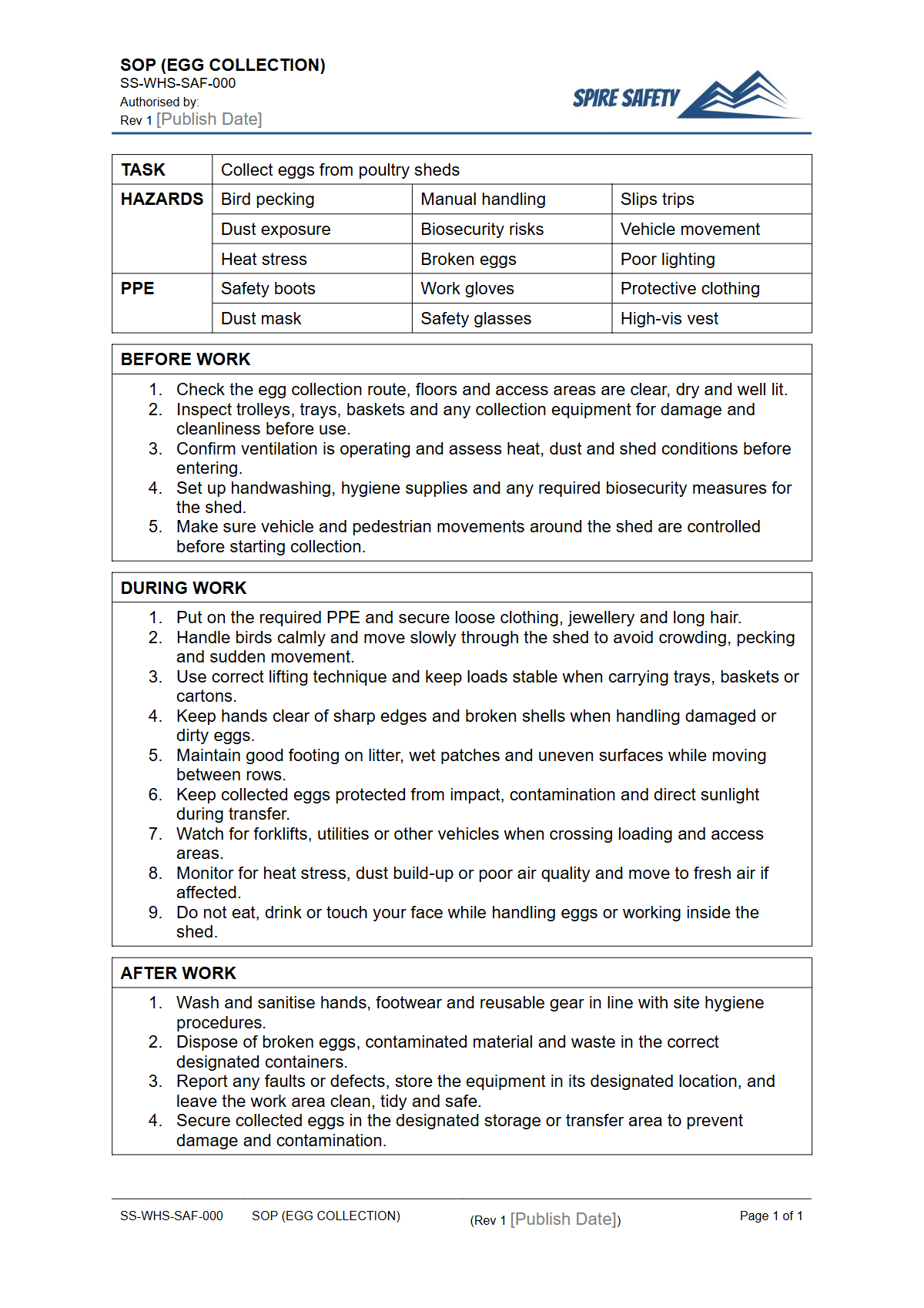
Purpose of the Free Safe Operating Procedure (Egg Collection) Template
This free Safe Operating Procedure (Egg Collection) template provides a structured starting point for businesses in the poultry and agricultural sectors to document safe work practices. Egg collection, whether manual or automated, involves a range of hazards, including manual handling, biological exposure, and interaction with machinery.
Using a clear SOP helps to ensure that all workers understand the identified risks and the control measures required to perform the task safely. A well-drafted SOP is a critical administrative control for managing workplace safety.
The primary goal of this document is to help you systematically outline the steps for collecting eggs while minimising risks to workers. It serves as a practical tool for training, supervision, and risk management, forming a key component of your overall safety framework.
For other farm-related procedures, you might also find our FREE Grain Drill SOP useful.
Video walkthrough
How to use the Free Safe Operating Procedure (Egg Collection) Template
To get the most value from this Safe Operating Procedure for egg collection, you must adapt it to your specific operational context. The downloadable DOCX file is fully editable, allowing you to insert details relevant to your farm, equipment, and biosecurity protocols.
Start by downloading the template and reviewing it with your team, including supervisors and the workers who perform the task. Incorporate specifics like the make and model of automated collection systems, the types of cleaning chemicals used, and the exact personal protective equipment (PPE) required.
Important: This template is a starting point. We have provided a comprehensive framework, but you must customise the document to reflect the specific equipment, environment, and processes of your workplace.
Effective implementation turns a generic document into a valuable site-specific safety tool. SOPs like this are a cornerstone of effective WHS management systems.
Key Hazards in Egg Collection
Identifying potential hazards is the first step in creating a robust SOP. Egg collection exposes workers to several common risks:
- Manual Handling: Repetitive bending, lifting, and carrying full trays of eggs can lead to musculoskeletal injuries affecting the back, shoulders, and wrists.
- Biological Hazards: Poultry sheds contain high levels of organic dust, dander, and dried faecal matter. Inhalation can cause respiratory issues, while direct contact can pose risks of zoonotic diseases like salmonellosis if hygiene protocols are not followed.
- Mechanical Hazards: Automated collection systems, including belts and conveyors, present risks of entanglement, crushing, and pinch points. Proper machine guarding and lockout/tagout procedures are essential. For detailed guidance on this, consider referencing procedures for the safe operation of conveyor systems.
- Slips, Trips, and Falls: Floors in poultry houses can be uneven or become slippery from water, manure, or broken eggs, increasing the risk of falls.
- Environmental Hazards: Poorly ventilated sheds can have high concentrations of ammonia, which is a respiratory irritant. High noise levels from machinery or birds can also contribute to long-term hearing damage.
Documenting these hazards and their controls is a core function of this SOP. For similar agricultural equipment with different hazards, you may benefit from reviewing our free Spreader SOP template.
Who should use this SOP
This Safe Operating Procedure is intended for use by a range of personnel within an agricultural business. This includes:
- Persons Conducting a Business or Undertaking (PCBUs): To meet their primary duty of care to provide and maintain a safe work environment and safe systems of work.
- Farm Managers and Supervisors: To train workers, enforce safe procedures, and conduct workplace inspections.
- WHS Officers/Advisors: To integrate the SOP into the broader safety management system and use it as a basis for risk assessments.
- Workers: As a clear, step-by-step guide for performing egg collection tasks safely and for reference during pre-start checks.
Ultimately, the SOP is a tool for everyone on-site who is involved in the task. Its effectiveness can be verified through processes like WHS compliance auditing to ensure procedures are being followed correctly. If you need more safety resources, you can explore our complete free WHS resources library.
Common mistakes
Common mistakes to avoid
- Failing to customise the generic template with site-specific machinery and hazards.
- Neglecting to train workers on the finalised SOP and confirm their understanding.
- Using the SOP only for induction and not as a tool for ongoing, pre-task risk assessment.
- Not reviewing or updating the SOP after an incident or change in farm processes.
Legal references
Legal considerations
The following legal requirements may be relevant to this type of work.
- Work Health and Safety Act (Harmonised) — Provides the primary duties for protecting workers and other people from work health and safety risks.
- Work Health and Safety Regulations (Harmonised) — Sets out requirements supporting the management of workplace hazards and risks.
The following codes may be relevant to this type of work.
- Managing WHS Risks Code of Practice — Provides practical guidance on identifying hazards, assessing risks and applying effective controls.
- Work Health and Safety Consultation, Cooperation and Coordination Code of Practice — Provides practical guidance on consulting workers and coordinating with other duty holders.
- Managing the Work Environment and Facilities Code of Practice — Provides practical guidance on safe work environments, workplace facilities and related controls.
Did you know
Dust Exposure
Dust in poultry sheds can contain a complex mixture of feed particles, dried faecal matter, broken feathers, and skin cells. Inhaling this dust can lead to respiratory conditions like "farmer's lung."
Egg Strength
Despite their fragility, eggshells are remarkably strong under uniform pressure. The curved shape distributes force, which is why it's hard to break an egg by squeezing it end-to-end.
FAQ
Frequently asked questions
01What personal protective equipment (PPE) is needed for egg collection?
02How does an SOP for egg collection help with biosecurity?
03Should manual and automated egg collection be covered in the same SOP?
04How often should an Egg Collection SOP be reviewed?
Share this resource
Free Safe Operating Procedure (Egg Collection) Template
Browse Categories
How To Use It
- 1Download and open in Word or PDF.
- 2Replace the placeholders with your business details.
- 3Get it reviewed by a WHS specialist before rollout.
Need it customised?
Our WHS consultants can adapt this template to your site, run a gap analysis, or audit what you already have in place.
Book a Free Consultation WHS consulting servicesor call 1300 156 382
Related templates
- Free Safe Operating Procedure (Egg Grading) Template
- Free Safe Operating Procedure (Egg Packing) Template
- Free Safe Operating Procedure (Electric Bed Adjustment) Template
- Free Safe Operating Procedure (Electric Planer) Template
- Free Safe Operating Procedure (Electric Screwdriver) Template
- Free Safe Operating Procedure (Electric Shears) Template