
Free Safe Operating Procedure (Egg Grading) Template
Establish safe work practices for egg grading tasks with our customisable template. Download your free Safe Operating Procedure to start creating yours today.
Free Safe Operating Procedure (Egg Grading) Template
DOCX • 126 KB + PDF
Updated Oct 2026
No signup required
Purpose of the Free Safe Operating Procedure (Egg Grading) Template
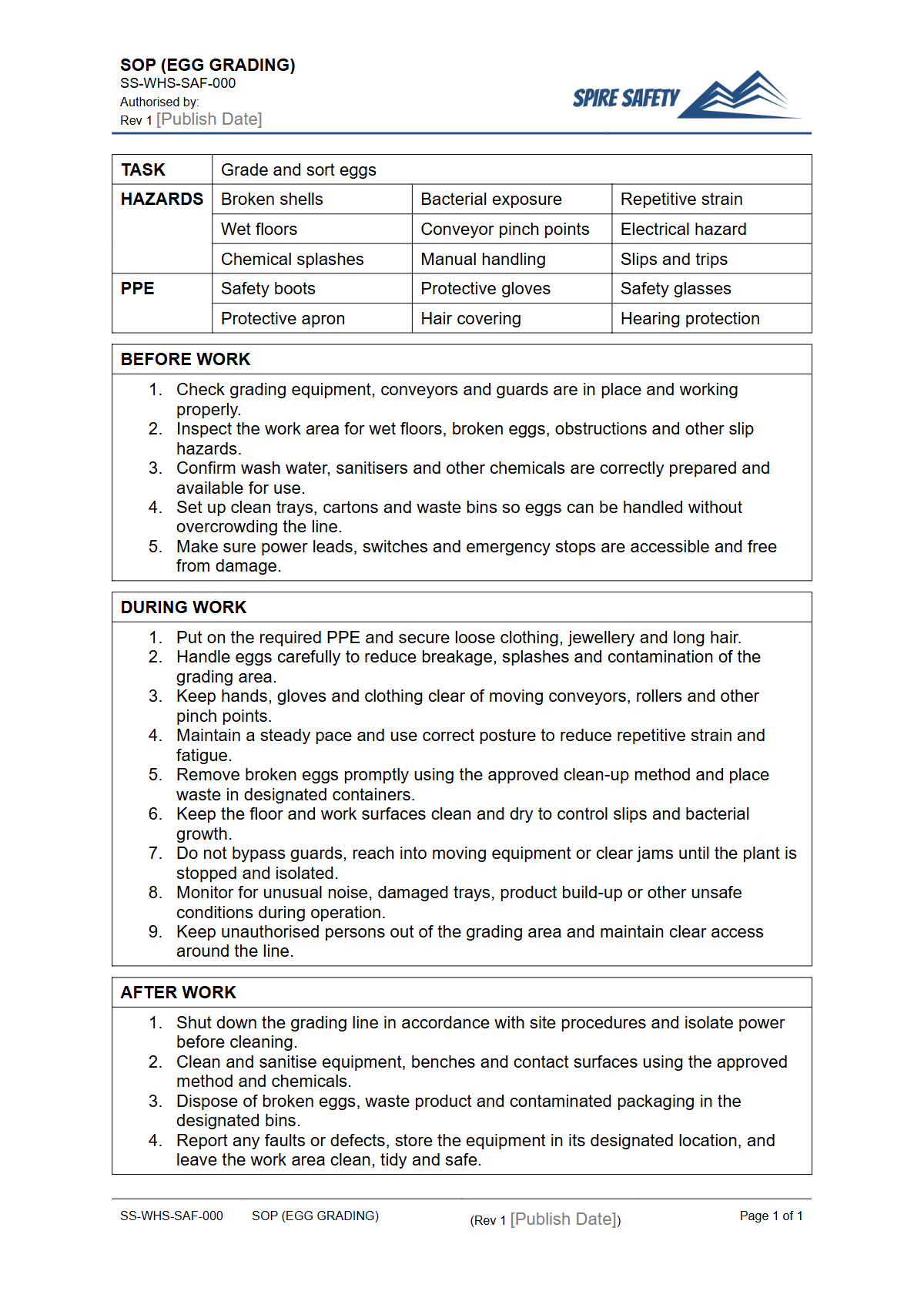
Operating egg grading equipment involves specific risks that must be managed to ensure worker safety. This Free Safe Operating Procedure (Egg Grading) Template provides a structured framework for documenting the safest, most efficient method to perform this task.
By clearly outlining step-by-step instructions, pre-operational checks, and potential hazards, it helps your organisation meet its primary duty of care. A well-developed SOP is a fundamental component of effective WHS management systems, promoting consistent and safe work practices across all shifts and personnel.
The document is designed to help you control hazards specific to egg grading, such as mechanical entanglement in moving parts, ergonomic strains from repetitive tasks, and electrical risks. Many egg grading facilities rely on automated systems, making it crucial to have documented procedures for safe interaction with machinery.
For related processes, you may also find our FREE Conveyer System SOP Template useful in managing associated equipment risks.
Video walkthrough
How to use the Free Safe Operating Procedure (Egg Grading) Template
This template is provided in an easy-to-edit DOCX format, allowing for complete customisation to your specific workplace. It is crucial to adapt the content to reflect the actual machinery, environment, and processes used by your team.
Generic procedures are not sufficient; a person with control of the business or undertaking (PCBU) must ensure the SOP is tailored to the site.
Important Customisation Note
You must customise this template. The information provided is a guide only. We have no way of knowing your unique site conditions, the specific model of egg grader you use, the skill level of your operators, or the other tasks they perform.
You must consult with your workers and other stakeholders to identify all foreseeable hazards and implement suitable control measures for your workplace. A regular review process, potentially as part of a formal WHS compliance audit, can help ensure your documented procedures remain current and effective.
When to use it
A Safe Operating Procedure for egg grading should be developed before any worker is authorised to operate the equipment. It serves as a key training document for new employees and a reference for experienced operators.
The SOP should be formally reviewed and, if necessary, updated whenever there is a change to the equipment, the process, or the work environment. It is also standard practice to review SOPs after any incident, near miss, or when a new hazard is identified.
Integrating this procedure into your induction and ongoing training programs ensures that safety standards are consistently communicated and reinforced. If you require expert assistance in developing or reviewing your safety documentation, our WHS consulting services can provide tailored support.
Who should use it
This SOP is intended for use by anyone involved in the egg grading process. This includes:
- Workers and Operators: As a primary guide for performing their tasks safely.
- Supervisors and Managers: For training staff, monitoring compliance, and conducting workplace inspections.
- Health and Safety Representatives (HSRs): As a tool for representing their work group on safety matters and ensuring risks are controlled.
- WHS Professionals: As a foundational document within the broader safety management system.
By formalising procedures, every person in the workplace has a clear understanding of their responsibilities for maintaining a safe environment. You can find more templates and guides to support various roles in our comprehensive free WHS resources library.
Common mistakes
Common mistakes to avoid
- Using a generic template without customising it for specific machinery and site conditions.
- Failing to consult with and train workers on the finalised SOP.
- Omitting crucial steps like lockout/tagout procedures for maintenance and cleaning.
- Not scheduling regular reviews to keep the document current with process changes.
Legal references
Legal considerations
The following legal requirements may be relevant to this type of work.
- Work Health and Safety Act (Harmonised) — Provides the primary duties for protecting workers and other people from work health and safety risks.
- Work Health and Safety Regulations (Harmonised) — Sets out requirements supporting the management of workplace hazards and risks.
The following codes may be relevant to this type of work.
- Managing WHS Risks Code of Practice — Provides practical guidance on identifying hazards, assessing risks and applying effective controls.
- Work Health and Safety Consultation, Cooperation and Coordination Code of Practice — Provides practical guidance on consulting workers and coordinating with other duty holders.
- Managing the Work Environment and Facilities Code of Practice — Provides practical guidance on safe work environments, workplace facilities and related controls.
Did you know
Automated Inspection
Modern egg grading machines can process over 250,000 eggs per hour, using cameras, lights, and acoustic sensors to automatically detect cracks, dirt, and internal defects.
Repetitive Strain Risk
The food processing industry, including roles like egg packing, has a high incidence of musculoskeletal disorders due to the repetitive nature of the tasks involved.
FAQ
Frequently asked questions
01What are the key hazards in egg grading?
02How often should an egg grading SOP be reviewed?
03Is an SOP a legal requirement for egg grading in Australia?
04What training should accompany an egg grading SOP?
Share this resource
Free Safe Operating Procedure (Egg Grading) Template
Browse Categories
How To Use It
- 1Download and open in Word or PDF.
- 2Replace the placeholders with your business details.
- 3Get it reviewed by a WHS specialist before rollout.
Need it customised?
Our WHS consultants can adapt this template to your site, run a gap analysis, or audit what you already have in place.
Book a Free Consultation WHS consulting servicesor call 1300 156 382
Related templates
- Free Safe Operating Procedure (Egg Packing) Template
- Free Safe Operating Procedure (Electric Bed Adjustment) Template
- Free Safe Operating Procedure (Electric Planer) Template
- Free Safe Operating Procedure (Electric Screwdriver) Template
- Free Safe Operating Procedure (Electric Shears) Template
- Free Safe Operating Procedure (Electric Stapler) Template