
Free Safe Operating Procedure (Earthing Stick) Template
Clearly document the steps for safely using an earthing stick to de-energise electrical equipment. Download our free, customisable template to start today.
Free Safe Operating Procedure (Earthing Stick) Template
DOCX • 126 KB + PDF
Updated Oct 2026
No signup required
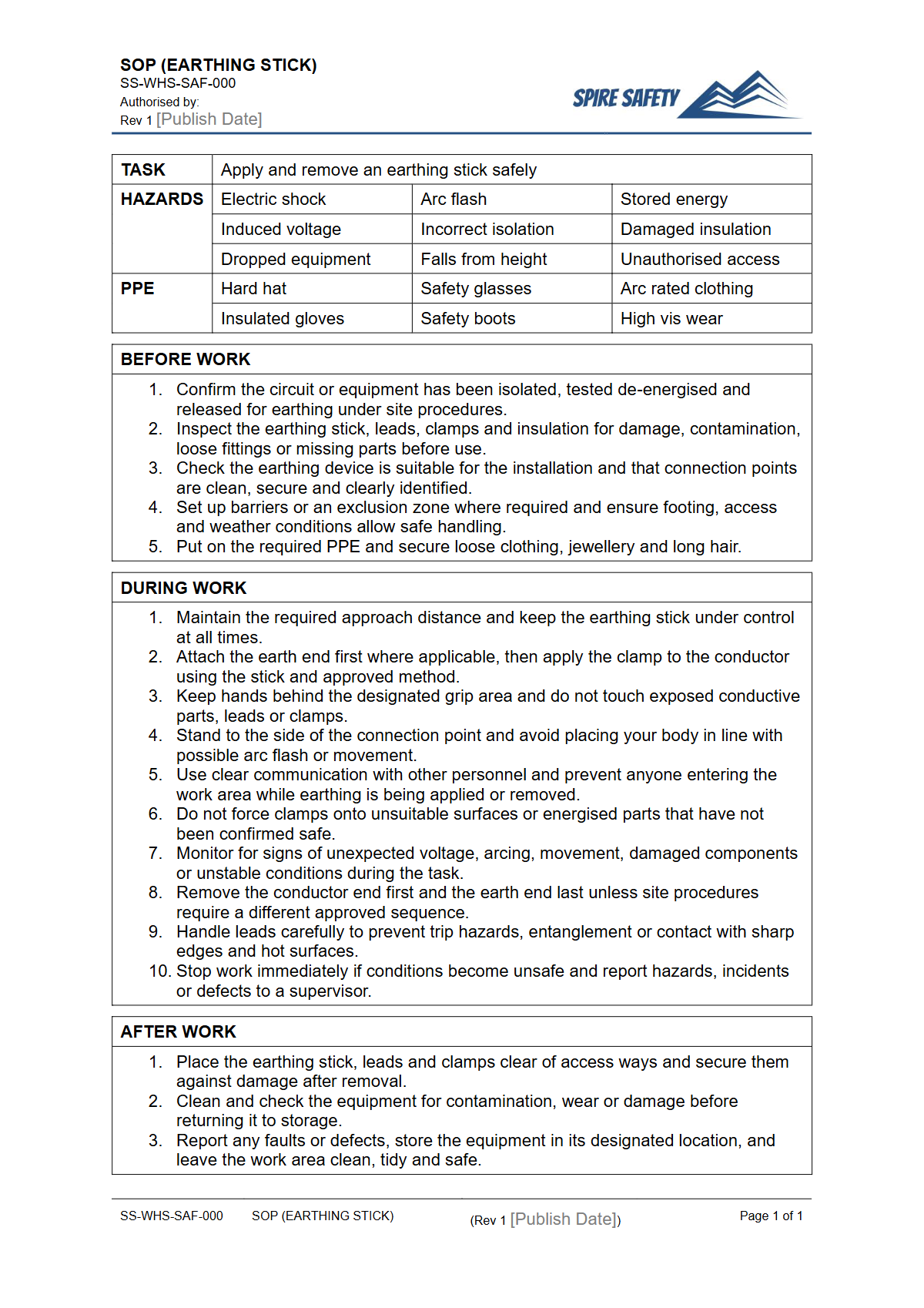
Purpose of the Free Safe Operating Procedure (Earthing Stick) Template
Working with electrical systems carries inherent, severe risks. This Free Safe Operating Procedure (Earthing Stick) Template provides a structured framework for documenting the safe use of portable earthing equipment.
An earthing stick, or insulating stick, is a critical piece of safety equipment used by qualified electrical workers to confirm that an electrical conductor is de-energised and to apply a temporary earth connection, making it safe to work on. Using a clear, documented SOP helps standardise this high-risk process, reducing the chance of catastrophic incidents like electric shock or arc flash.
A well-defined SOP ensures that every authorised worker follows the same verified steps for pre-use checks, testing, application, and removal of the earthing device. This process is a non-negotiable part of establishing an electrically safe work area and forms a critical component of robust WHS management systems. Documenting procedures is a fundamental safety principle, whether for complex electrical tasks or operating plant like a telehandler.
Video walkthrough
How to use the Free Safe Operating Procedure (Earthing Stick) Template
This template is designed as a starting point. To implement it effectively, download the DOCX file and systematically work through each section.
You must adapt the content to align with your specific operational context, including the types of earthing sticks used, the voltage levels of your systems, and your organisation's existing electrical safety and permit-to-work procedures.
Important: This is a template, not a completed document. It is essential that you customise this SOP to reflect your specific workplace, equipment, risk assessments, and legal obligations.
We recommend a competent person reviews and approves the final document. The effectiveness of your safety procedures should be reviewed regularly, often as part of your internal processes or formal WHS compliance auditing activities.
Incorporate details from your own risk assessments, including specific hazards identified at your site. Consultation with your workers is a key part of developing effective SOPs.
If you are unsure how to complete a risk assessment or tailor this document, seeking professional WHS consulting is recommended to ensure your procedures are robust and fit for purpose.
When to use an Earthing Stick SOP
This Safe Operating Procedure should be referenced every time a worker needs to verify isolation and apply temporary earths to an electrical installation. It is a critical control measure used during maintenance, repair, testing, or alteration of electrical equipment that has been isolated from a power source.
The SOP is typically used in conjunction with a broader Lockout-Tagout (LOTO) or isolation procedure.
The principles of isolating equipment before maintenance are universal across all workplace equipment. A formal process ensures that machinery cannot be accidentally re-energised, a danger that exists whether working on high-voltage switchgear or a simple workshop tool like a circular saw. This SOP is specifically for the task of applying the earth, which happens after the equipment has been isolated and before physical work begins.
Who should use this SOP
The use of an earthing stick is a high-risk task that must only be performed by competent and authorised personnel. This includes licensed electricians or other electrical workers who have received specific training on the equipment and procedures for the voltage levels involved.
Untrained individuals must never attempt to use an earthing stick or work on any electrical system believed to be de-energised.
A person is deemed competent when they have the necessary training, skills, and experience to perform the task safely. Your organisation must keep records of this training and authorisation.
This formal approach to documenting procedures is a core WHS requirement for all specialised equipment, just as one would have a dedicated procedure for using a free trencher SOP in a construction setting. You can find more templates to help formalise your workplace procedures by exploring our complete free WHS resources library.
Common mistakes
Common mistakes to avoid
- Failing to visually inspect the earthing stick for cracks, dirt, or moisture before each use.
- Neglecting to test the voltage detector on a known live source before and after confirming a de-energised state.
- Applying the earth connection before confirming the absence of all voltage.
- Using an earthing stick with an incorrect voltage rating for the system being worked on.
Legal references
Legal considerations
The following legal requirements may be relevant to this type of work.
- Work Health and Safety Act (Harmonised) — Provides the primary duties for protecting workers and other people from work health and safety risks.
- Work Health and Safety Regulations (Harmonised) — Sets out requirements supporting the management of workplace hazards and risks.
The following codes may be relevant to this type of work.
- Managing WHS Risks Code of Practice — Provides practical guidance on identifying hazards, assessing risks and applying effective controls.
- Work Health and Safety Consultation, Cooperation and Coordination Code of Practice — Provides practical guidance on consulting workers and coordinating with other duty holders.
- Managing the Work Environment and Facilities Code of Practice — Provides practical guidance on safe work environments, workplace facilities and related controls.
Did you know
Test Before Touch
The 'Test Before Touch' (or 'Test for Dead') principle is a non-negotiable rule in electrical work. It mandates that a qualified person must always test for the absence of voltage before any part of the body makes contact with potentially live components.
Arc Flash Dangers
An arc flash, a potential hazard when working near energised equipment, can release enormous amounts of energy, reaching temperatures of up to 20,000°C. Proper testing and earthing procedures are critical controls for mitigating this risk.
FAQ
Frequently asked questions
01What is an earthing stick?
02Is this earthing stick SOP template compliant with Australian WHS laws?
03Who is considered competent to use an earthing stick?
04What should be included in an earthing stick SOP?
Share this resource
Free Safe Operating Procedure (Earthing Stick) Template
Browse Categories
How To Use It
- 1Download and open in Word or PDF.
- 2Replace the placeholders with your business details.
- 3Get it reviewed by a WHS specialist before rollout.
Need it customised?
Our WHS consultants can adapt this template to your site, run a gap analysis, or audit what you already have in place.
Book a Free Consultation WHS consulting servicesor call 1300 156 382
Related templates
- Free Safe Operating Procedure (Edge Bander) Template
- Free Safe Operating Procedure (Edge Protection) Template
- Free Safe Operating Procedure (Effluent Area Check) Template
- Free Safe Operating Procedure (Effluent Spill Cleanup) Template
- Free Safe Operating Procedure (Egg Collection) Template
- Free Safe Operating Procedure (Egg Grading) Template