
Free Safe Operating Procedure (Edge Bander) Template
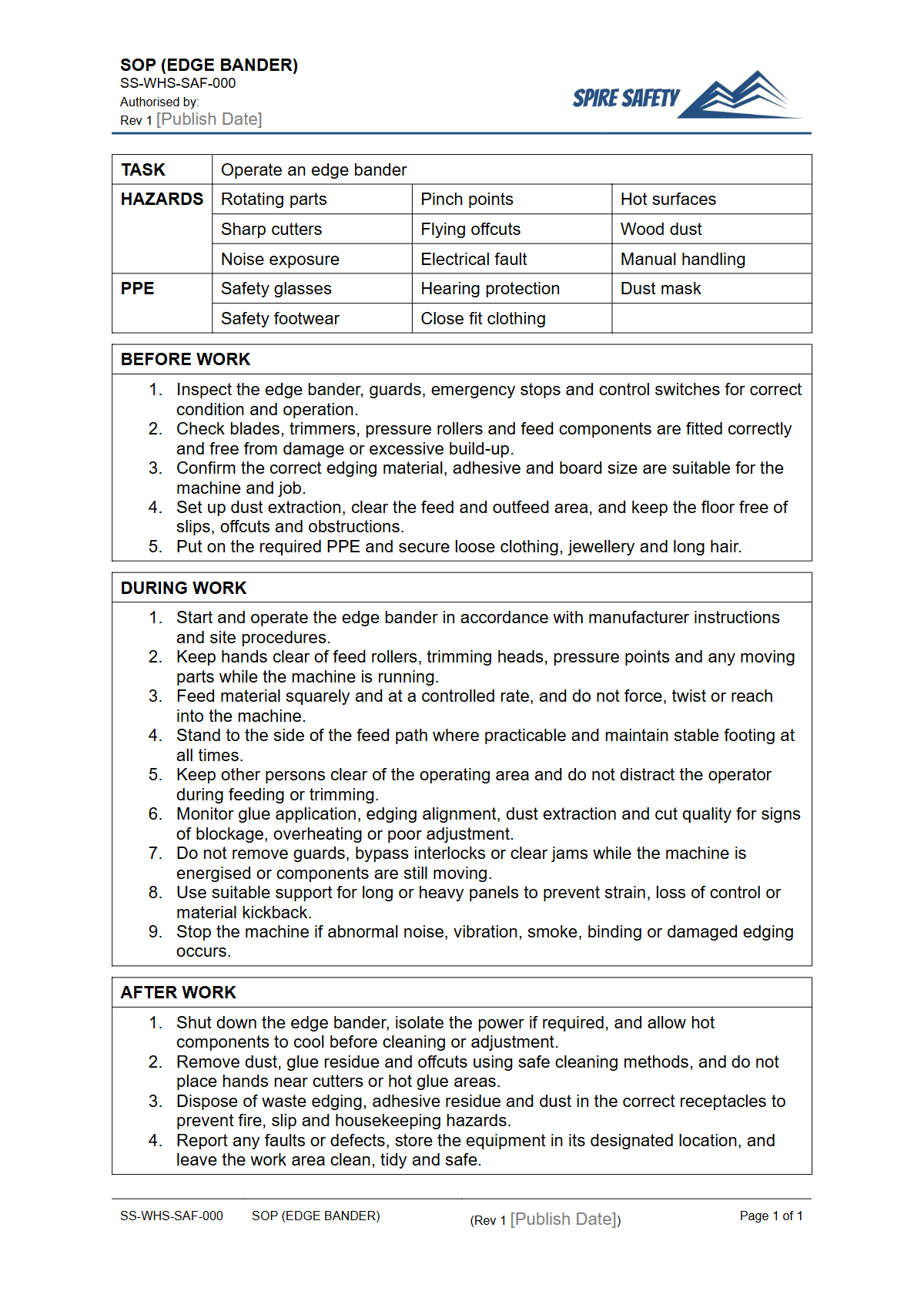
Download our free Safe Operating Procedure (Edge Bander) template to formalise safety steps for your workshop. This DOCX and PDF helps you manage risks.
Free Safe Operating Procedure (Edge Bander) Template
DOCX • 126 KB + PDF
Updated Oct 2026
No signup required
Purpose of the Free Safe Operating Procedure (Edge Bander) Template
Our free Safe Operating Procedure (Edge Bander) Template provides a structured framework for documenting the safe use of edge banding machinery in your workshop. Edge banders present several significant hazards, including nip points between rollers, hot surfaces and molten glue, rotating trimming and cutting units, sharp edges on finished workpieces, and hazardous dust from board materials.
Formalising your process with a Safe Operating Procedure (SOP) is a critical administrative control measure to manage these risks effectively.
This document guides operators through pre-start checks, operational steps, and shutdown procedures to ensure consistent and safe work practices. Using an SOP helps fulfil your duty of care by providing clear instructions and helps standardise training. While edge banders are common, they are just one type of equipment found in a workshop; similar documented procedures are essential for other tools, as shown in our FREE Circular Saw SOP.
Video walkthrough
How to use the Free Safe Operating Procedure (Edge Bander) Template
To benefit from this free Safe Operating Procedure (Edge Bander) Template, you must adapt it to your specific operational context. The downloaded document is a starting point, not a finished product.
You should review every section and fill in the details relevant to your workplace, including the specific make and model of your edge bander, required personal protective equipment (PPE), site-specific emergency contacts, and any unique hazards identified in your risk assessment.
Please note: This document is a template and is not a substitute for professional WHS advice. We have provided it as a starting point, and you must customise it to reflect the specific hazards, equipment, and work environment of your business.
Involve your operators and Health and Safety Representatives (HSRs) in the customisation process to ensure the SOP is practical and reflects how the work is actually done. You should also incorporate procedures for any ancillary equipment, such as dust extraction systems or compressed air lines, for which we also offer a Free Air Compressor SOP.
When to use this Safe Operating Procedure
An SOP for an edge bander is a dynamic document that should be used throughout the equipment's lifecycle. It is not a document to be filed away and forgotten.
Key usage scenarios include:
- Training and Induction: Use the SOP as a core training document for new operators and for providing refresher training to existing staff. It ensures all workers receive the same baseline safety information.
- Pre-operational Checks: Operators should reference the SOP before starting the machine each day or at the beginning of each shift to complete vital safety checks on guards, emergency stops, and extraction systems.
- Supervision and Monitoring: Supervisors can use the SOP as a benchmark to observe work practices and confirm that procedures are being followed correctly.
- Incident Investigation: If an incident or near-miss occurs, the SOP provides a reference point to determine if procedures were followed and whether the procedure itself needs revision.
- Audits and Reviews: The SOP should be a key document reviewed during internal and external safety audits. Scheduled reviews are a cornerstone of continuous improvement in safety, often forming part of routine WHS compliance auditing.
Who should use this Safe Operating Procedure
This SOP is designed for use by various personnel within an organisation to foster a comprehensive approach to safety. Primary users include:
- Machine Operators: The end-users of the SOP who must understand and follow the documented steps to perform their work safely.
- Supervisors and Workshop Managers: Responsible for implementing the SOP, ensuring operators are trained, and monitoring compliance on the workshop floor.
- WHS/HSE Officers: Health and safety professionals use the SOP as part of the broader safety management system, assisting with its development, review, and integration. It's a key component in building robust WHS management systems.
- Maintenance Personnel: While this SOP covers operation, separate procedures for maintenance are required. Maintenance teams may refer to the operational SOP for lockout/tagout and shutdown instructions before commencing their work.
Developing and implementing effective SOPs can be a complex task. If your organisation requires assistance in creating site-specific documentation or implementing safety systems, engaging expert WHS consulting can provide valuable guidance and support.
You can also explore our complete free WHS resources library for more templates and guides to support your safety efforts.
Common mistakes
Common mistakes to avoid
- Failing to customise the template with machine-specific details and workplace risks.
- Not providing practical training to workers on the contents of the finalised SOP.
- Skipping pre-start checks and assuming the machine is always safe to operate.
- Treating the SOP as a paperwork exercise rather than a live document for daily use.
Legal references
Legal considerations
The following legal requirements may be relevant to this type of work.
- Work Health and Safety Act (Harmonised) — Provides the primary duties for protecting workers and other people from work health and safety risks.
- Work Health and Safety Regulations (Harmonised) — Sets out requirements supporting the management of workplace hazards and risks.
The following codes may be relevant to this type of work.
- Managing WHS Risks Code of Practice — Provides practical guidance on identifying hazards, assessing risks and applying effective controls.
- Work Health and Safety Consultation, Cooperation and Coordination Code of Practice — Provides practical guidance on consulting workers and coordinating with other duty holders.
- Managing the Work Environment and Facilities Code of Practice — Provides practical guidance on safe work environments, workplace facilities and related controls.
Did you know
Wood Dust Hazards
Wood dust is classified as a hazardous substance. Fine dust from materials like MDF can cause serious respiratory diseases, making effective dust extraction a critical safety control when using an edge bander.
Glue Temperature
The hot-melt glue used in many edge banders is typically heated to temperatures between 180°C and 220°C. Contact with molten glue can cause severe burns, which is why SOPs emphasise careful handling and appropriate PPE.
FAQ
Frequently asked questions
01What is a Safe Operating Procedure for an edge bander?
02Who is responsible for writing an SOP?
03How often should an edge bander SOP be reviewed?
04Does this SOP template cover all types of edge banders?
Share this resource
Free Safe Operating Procedure (Edge Bander) Template
Browse Categories
How To Use It
- 1Download and open in Word or PDF.
- 2Replace the placeholders with your business details.
- 3Get it reviewed by a WHS specialist before rollout.
Need it customised?
Our WHS consultants can adapt this template to your site, run a gap analysis, or audit what you already have in place.
Book a Free Consultation WHS consulting servicesor call 1300 156 382
Related templates
- Free Safe Operating Procedure (Edge Protection) Template
- Free Safe Operating Procedure (Effluent Area Check) Template
- Free Safe Operating Procedure (Effluent Spill Cleanup) Template
- Free Safe Operating Procedure (Egg Collection) Template
- Free Safe Operating Procedure (Egg Grading) Template
- Free Safe Operating Procedure (Egg Packing) Template