
Free Safe Operating Procedure (Earth Tester) Template
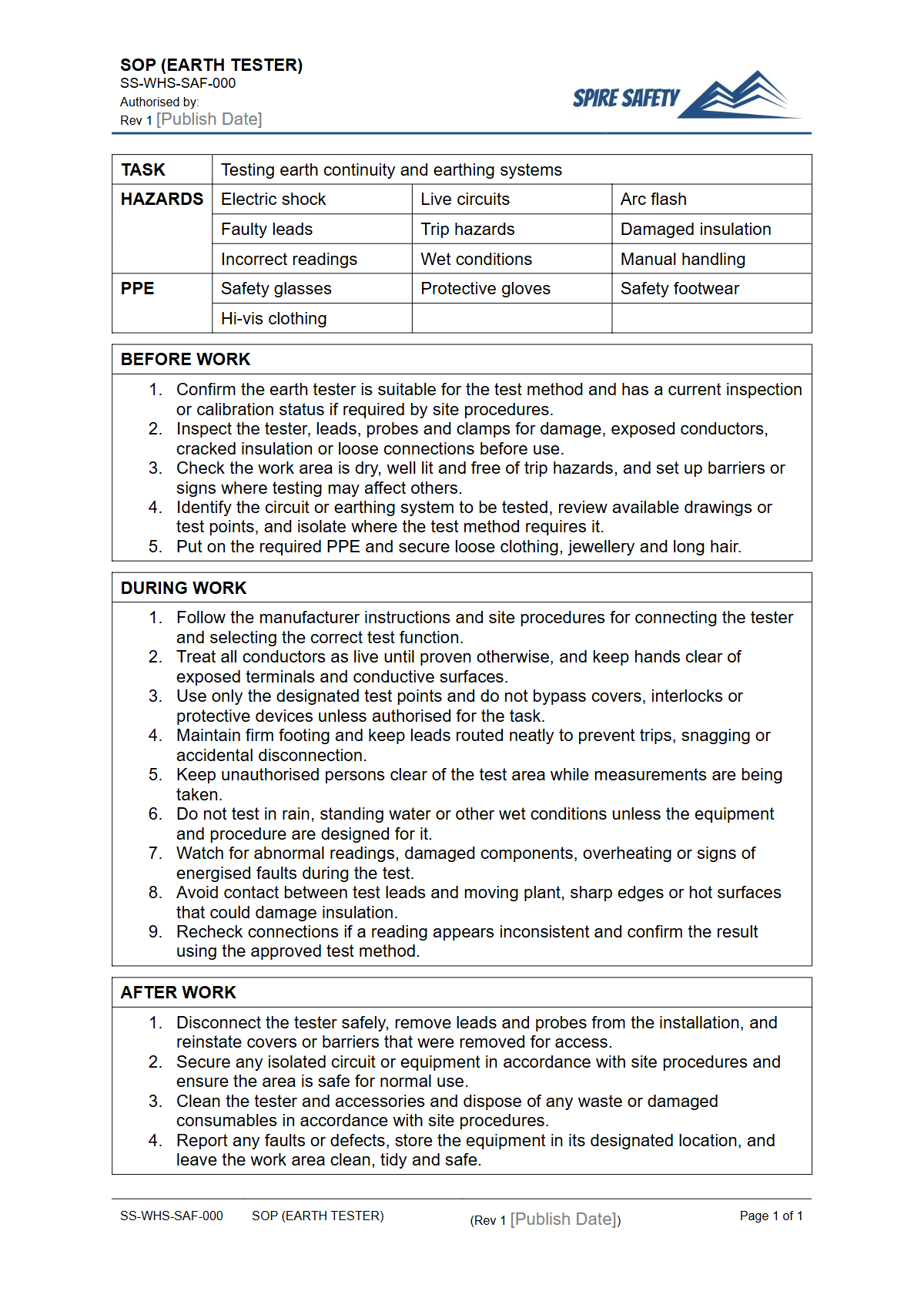
Download our free Safe Operating Procedure (Earth Tester) Template to manage electrical testing risks.
Free Safe Operating Procedure (Earth Tester) Template
DOCX • 126 KB + PDF
Updated Oct 2026
No signup required
Purpose of the Free Safe Operating Procedure (Earth Tester) Template
The primary purpose of this Safe Operating Procedure is to provide a clear, step-by-step guide for using an earth tester safely. Earth testers are specialised instruments used to measure the resistance of grounding and earthing systems, a crucial check for electrical safety.
Operating them introduces significant hazards, including direct contact with live parts, arc flash, and potential for creating unsafe conditions if used incorrectly. This template helps a Person Conducting a Business or Undertaking (PCBU) meet their duty of care by formally documenting risk controls.
A documented SOP helps standardise work methods, ensuring every operator follows the same safety-critical steps. It forms a key component of your broader WHS management systems, demonstrating a systematic approach to hazard identification and risk control.
Furthermore, it serves as an official record for training and competency assessment, ensuring only authorised and trained personnel perform these high-risk tasks.
Video walkthrough
How to use the Free Safe Operating Procedure (Earth Tester) Template
This resource is provided in both DOCX and PDF formats for your convenience. The DOCX file is fully editable, allowing you to tailor the content to the specific models of earth testers used at your site, your unique work environment, and your organisation's existing safety policies.
We strongly advise that you conduct a site-specific risk assessment before finalising the document.
You must customise this template to reflect your workplace's specific needs. We recommend a competent person, such as an experienced electrician or safety manager, leads this customisation process in consultation with the workers who will be using the equipment. Key areas to update include:
- Specific makes and models of earth testers
- Required Personal Protective Equipment (PPE) such as insulated gloves and safety glasses
- Site-specific emergency procedures
- Lock-Out Tag-Out (LOTO) procedures relevant to your operations
Once customised, the SOP should be used for training, inductions, and ongoing reference. Regular reviews are essential to ensure it remains current.
If you need assistance developing or implementing your procedures, our WHS consulting team can provide expert support tailored to your business.
When to use this Safe Operating Procedure
This SOP should be referenced before any task involving an earth tester. It is not a document to be filed away; it is an active tool for risk management.
Its use is critical in several scenarios, including commissioning new electrical installations, performing routine preventative maintenance on earthing systems, and conducting fault-finding activities after an electrical issue. It also serves as the primary training document for new or inexperienced workers learning to operate the equipment under supervision.
Implementing this procedure is also vital before any work near other energised systems, ensuring all necessary precautions, such as establishing exclusion zones or de-energising adjacent circuits, are taken. Regular reviews and updates should be triggered by any changes in equipment, procedures, or after a WHS compliance auditing process identifies gaps or improvements.
Who should use it
This Safe Operating Procedure is intended for use by 'competent persons'. In the context of electrical work, a competent person is someone who has the necessary training, qualifications, and experience to carry out the task safely.
This typically includes licensed electricians, electrical engineers, and specialised technicians who have received specific training on the principles of earth testing and the operation of the specific device. Supervisors and WHS managers should also be familiar with the SOP to effectively oversee work and ensure procedures are followed correctly.
Unqualified or untrained personnel should never operate an earth tester. This document helps reinforce that requirement, providing a clear reference for the level of skill needed.
Just as you would have a specific procedure for other high-risk equipment, such as our Free Air Compressor SOP, this document ensures a consistent and safe approach to a specialised electrical task.
Integrating SOPs into your Safety System
A Safe Operating Procedure is most effective when it is part of a holistic safety management system. It should not exist in isolation.
This document should be integrated with your broader risk assessments, training programs, and incident reporting processes. For example, the competency requirements outlined in this SOP should align with your organisation's training matrix and verification of competency (VOC) records.
Similarly, any incidents or near misses related to earth testing should trigger a review of this SOP to identify any gaps.
This systematic approach applies to all high-risk tasks in your workplace. Whether your team is using electrical testing equipment or operating power tools, having a clear and consistent procedural framework is key.
For instance, the same principles of pre-start checks, hazard control, and PPE apply when documenting procedures for other equipment, as seen in our FREE Circular Saw SOP Template. A library of well-maintained SOPs forms the backbone of a safe work culture.
This template is one of many resources we offer to help improve safety in Australian workplaces. You can explore our complete free WHS resources library for other templates, checklists, and guides covering a wide range of tasks and equipment.
Common mistakes
Common mistakes to avoid
- Using the equipment without being formally deemed competent.
- Failing to inspect test leads, probes, and connections for damage before each use.
- Neglecting to isolate, lock out, and tag out adjacent energised circuits where required.
- Performing tests in wet conditions or hazardous atmospheres without appropriate controls.
- Placing auxiliary test stakes incorrectly, leading to inaccurate readings and a false sense of security.
Legal references
Legal considerations
The following legal requirements may be relevant to this type of work.
- Work Health and Safety Act (Harmonised) — Provides the primary duties for protecting workers and other people from work health and safety risks.
- Work Health and Safety Regulations (Harmonised) — Sets out requirements supporting the management of workplace hazards and risks.
The following codes may be relevant to this type of work.
- Managing WHS Risks Code of Practice — Provides practical guidance on identifying hazards, assessing risks and applying effective controls.
- Work Health and Safety Consultation, Cooperation and Coordination Code of Practice — Provides practical guidance on consulting workers and coordinating with other duty holders.
- Managing the Work Environment and Facilities Code of Practice — Provides practical guidance on safe work environments, workplace facilities and related controls.
Did you know
Fall-of-Potential Method
The most common method for earth resistance testing is the 'Fall-of-Potential' method, also known as the three-point method. It involves placing two auxiliary earth stakes at specific distances from the earth electrode being tested to measure resistance.
Electrical Risks
According to Safe Work Australia, contact with electricity is one of the top five causes of traumatic workplace fatalities in Australia, highlighting the critical need for robust electrical safety procedures.
FAQ
Frequently asked questions
01What is an earth tester and why is testing important?
02Is this Safe Operating Procedure template ready to use immediately?
03Who is considered a 'competent person' to use an earth tester?
04How often should an earth tester be calibrated?
Share this resource
Free Safe Operating Procedure (Earth Tester) Template
Browse Categories
How To Use It
- 1Download and open in Word or PDF.
- 2Replace the placeholders with your business details.
- 3Get it reviewed by a WHS specialist before rollout.
Need it customised?
Our WHS consultants can adapt this template to your site, run a gap analysis, or audit what you already have in place.
Book a Free Consultation WHS consulting servicesor call 1300 156 382
Related templates
- Free Safe Operating Procedure (Earthing Stick) Template
- Free Safe Operating Procedure (Edge Bander) Template
- Free Safe Operating Procedure (Edge Protection) Template
- Free Safe Operating Procedure (Effluent Area Check) Template
- Free Safe Operating Procedure (Effluent Spill Cleanup) Template
- Free Safe Operating Procedure (Egg Collection) Template