
Free Safe Operating Procedure (Dust Monitor) Template
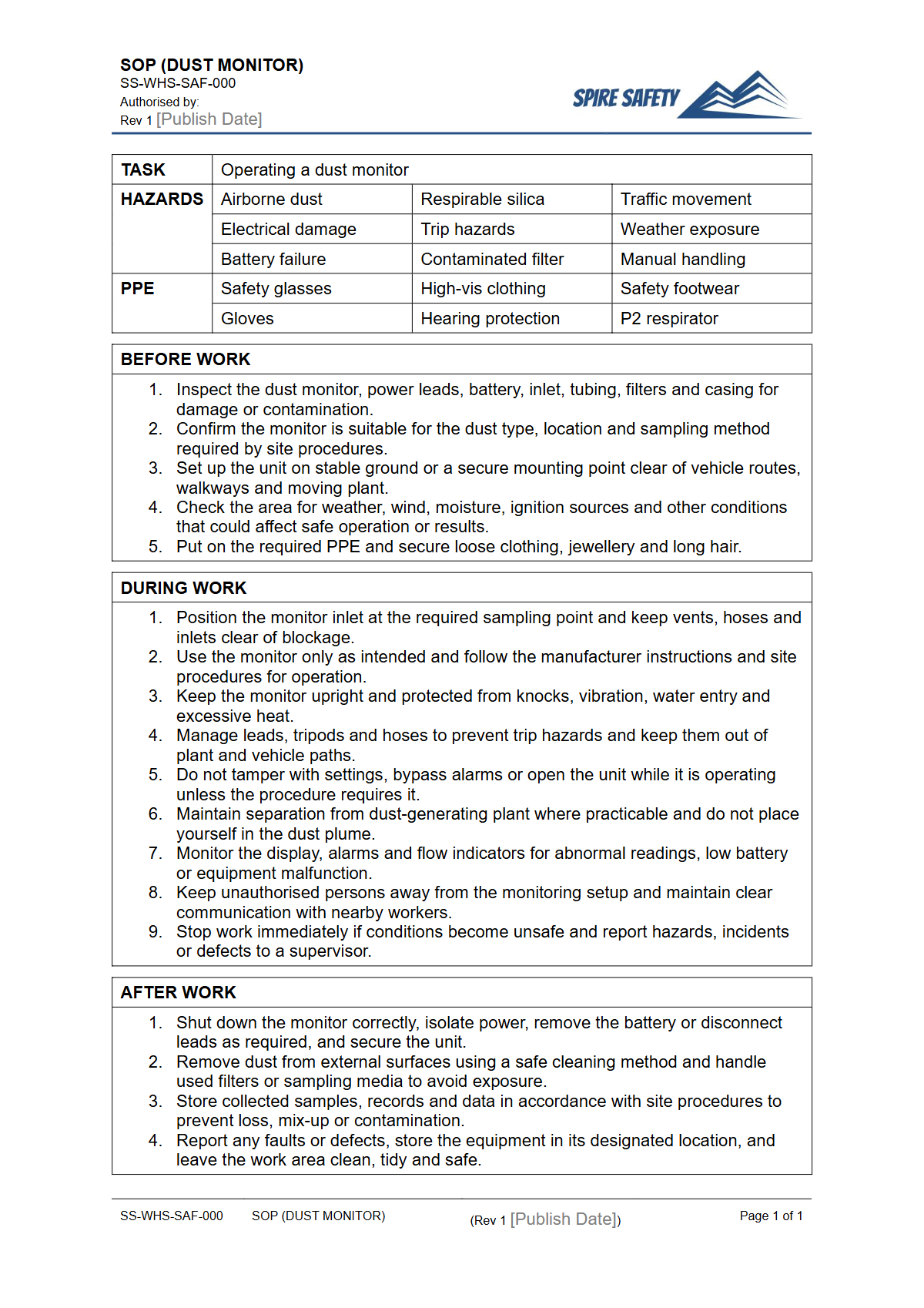
Effectively manage airborne dust hazards with our free Safe Operating Procedure (Dust Monitor) Template. Download the DOCX and PDF to start customising.
Free Safe Operating Procedure (Dust Monitor) Template
DOCX • 126 KB + PDF
Updated Oct 2026
No signup required
Purpose of the Free Safe Operating Procedure (Dust Monitor) Template
Controlling airborne contaminants is a critical component of workplace health and safety, particularly in industries where dust is a common byproduct. This free Safe Operating Procedure (Dust Monitor) Template provides a structured framework for documenting the correct use of dust monitoring equipment.
Its primary purpose is to help your organisation establish and communicate a consistent, safe method for sampling and measuring airborne dust levels, including hazardous substances like respirable crystalline silica.
Using a documented SOP ensures that monitoring is performed accurately and consistently by all trained personnel. This leads to more reliable data, which is essential for assessing exposure risks, verifying the effectiveness of dust control measures, and making informed decisions about worker health.
This procedure forms a vital part of broader WHS management systems, demonstrating a proactive approach to managing known workplace hazards and fulfilling duties of care.
Video walkthrough
How to use the Free Safe Operating Procedure (Dust Monitor) Template
This document is a comprehensive starting point, designed for easy adaptation to your specific operational needs. After downloading the DOCX or PDF file, you must customise it to reflect the exact make and model of the dust monitoring equipment used at your site, your specific work environment, and the types of dust being measured.
The template includes sections for pre-operational checks, step-by-step operating instructions, calibration, data recording, and post-use maintenance.
Important: To ensure this Safe Operating Procedure is effective, you must consult with your workers and any health and safety representatives during its development. We recommend a site-specific risk assessment is conducted to identify all relevant hazards and control measures before finalising the document.
Your final SOP should be a practical tool that reflects the real-world tasks your team performs.
When to use a Dust Monitor SOP
A Safe Operating Procedure for a dust monitor should be implemented in any workplace where activities generate airborne dust that could pose a health risk to workers. This is especially important where exposure standards for specific contaminants may be exceeded. Key industries and situations include:
- Construction and Demolition: Cutting, grinding, or breaking concrete, bricks, or stone; excavation and earthmoving activities. Tasks involving this type of work often require other specialised equipment, and having clear procedures, like a FREE Trencher SOP Template, for all machinery is best practice.
- Mining and Quarrying: Extraction, crushing, and processing of rock and minerals.
- Manufacturing: Working with engineered stone, sand casting in foundries, or manufacturing cement products.
- Agriculture: Handling grain or working in dry, dusty field conditions.
- Road Works and Civil Construction: Site preparation and grading can generate significant dust, requiring management similar to that outlined in our FREE Grader SOP (Safe Operating Procedure) Template.
Who should use this Safe Operating Procedure
This SOP is intended for several key roles within an organisation to ensure a coordinated approach to safety. The primary users are the workers or technicians directly responsible for setting up and operating the dust monitoring equipment.
They must be trained on the procedure to ensure they perform the task safely and gather accurate data.
Supervisors and site managers should use this document to induct and train workers, as well as to supervise monitoring activities and verify that the documented steps are being followed. WHS officers and safety managers will use the SOP as part of the overall safety management system, for risk assessments, and to ensure procedural compliance. Regular reviews and audits of these procedures are a key part of maintaining a safe workplace, a process that can be supported by formal WHS compliance auditing.
Finally, this document serves as a valuable record during safety consultations, incident investigations, and regulatory inspections. You can find more templates and checklists to support your safety framework in our free WHS resources library.
Common mistakes
Common mistakes to avoid
- Failing to calibrate the dust monitor before each use, leading to inaccurate readings.
- Placing the monitor in a location that does not represent the worker's breathing zone.
- Not keeping detailed records of monitoring times, locations, activities, and results.
- Using the wrong sampling head or flow rate for the type of dust being measured.
Legal references
Legal considerations
The following legal requirements may be relevant to this type of work.
- Work Health and Safety Act (Harmonised) — Provides the primary duties for protecting workers and other people from work health and safety risks.
- Work Health and Safety Regulations (Harmonised) — Sets out requirements supporting the management of workplace hazards and risks.
The following codes may be relevant to this type of work.
- Managing WHS Risks Code of Practice — Provides practical guidance on identifying hazards, assessing risks and applying effective controls.
- Work Health and Safety Consultation, Cooperation and Coordination Code of Practice — Provides practical guidance on consulting workers and coordinating with other duty holders.
- Managing the Work Environment and Facilities Code of Practice — Provides practical guidance on safe work environments, workplace facilities and related controls.
Did you know
Invisible Danger
Respirable crystalline silica (RCS) particles are microscopic, approximately 100 times smaller than a grain of sand. They are too small to see and can penetrate deep into the lungs when inhaled, causing irreversible damage.
Long Latency
Silicosis, a lung disease caused by inhaling silica dust, can take 10 to 30 years to develop after initial exposure. However, acute silicosis can occur after only a few months of very high exposure.
FAQ
Frequently asked questions
01What is a Safe Operating Procedure for a dust monitor?
02Why is dust monitoring important in Australian workplaces?
03Can I use this template for any type of dust monitor?
04How often should dust monitoring be performed?
Share this resource
Free Safe Operating Procedure (Dust Monitor) Template
Browse Categories
How To Use It
- 1Download and open in Word or PDF.
- 2Replace the placeholders with your business details.
- 3Get it reviewed by a WHS specialist before rollout.
Need it customised?
Our WHS consultants can adapt this template to your site, run a gap analysis, or audit what you already have in place.
Book a Free Consultation WHS consulting servicesor call 1300 156 382
Related templates
- Free Safe Operating Procedure (Dye Penetrant Test) Template
- Free Safe Operating Procedure (Dyeing Machine) Template
- Free Safe Operating Procedure (Dynamic Cone Penetrometer) Template
- Free Safe Operating Procedure (E-Waste Collection) Template
- Free Safe Operating Procedure (E-Waste Dropoff Intake) Template
- Free Safe Operating Procedure (Earth Tester) Template