
Free Safe Operating Procedure (Dynamic Cone Penetrometer) Template
Download our free Safe Operating Procedure (Dynamic Cone Penetrometer) template. This document provides a structured starting point for your workplace safety.
Free Safe Operating Procedure (Dynamic Cone Penetrometer) Template
DOCX • 126 KB + PDF
Updated Oct 2026
No signup required
Purpose of the Free Safe Operating Procedure (Dynamic Cone Penetrometer) Template
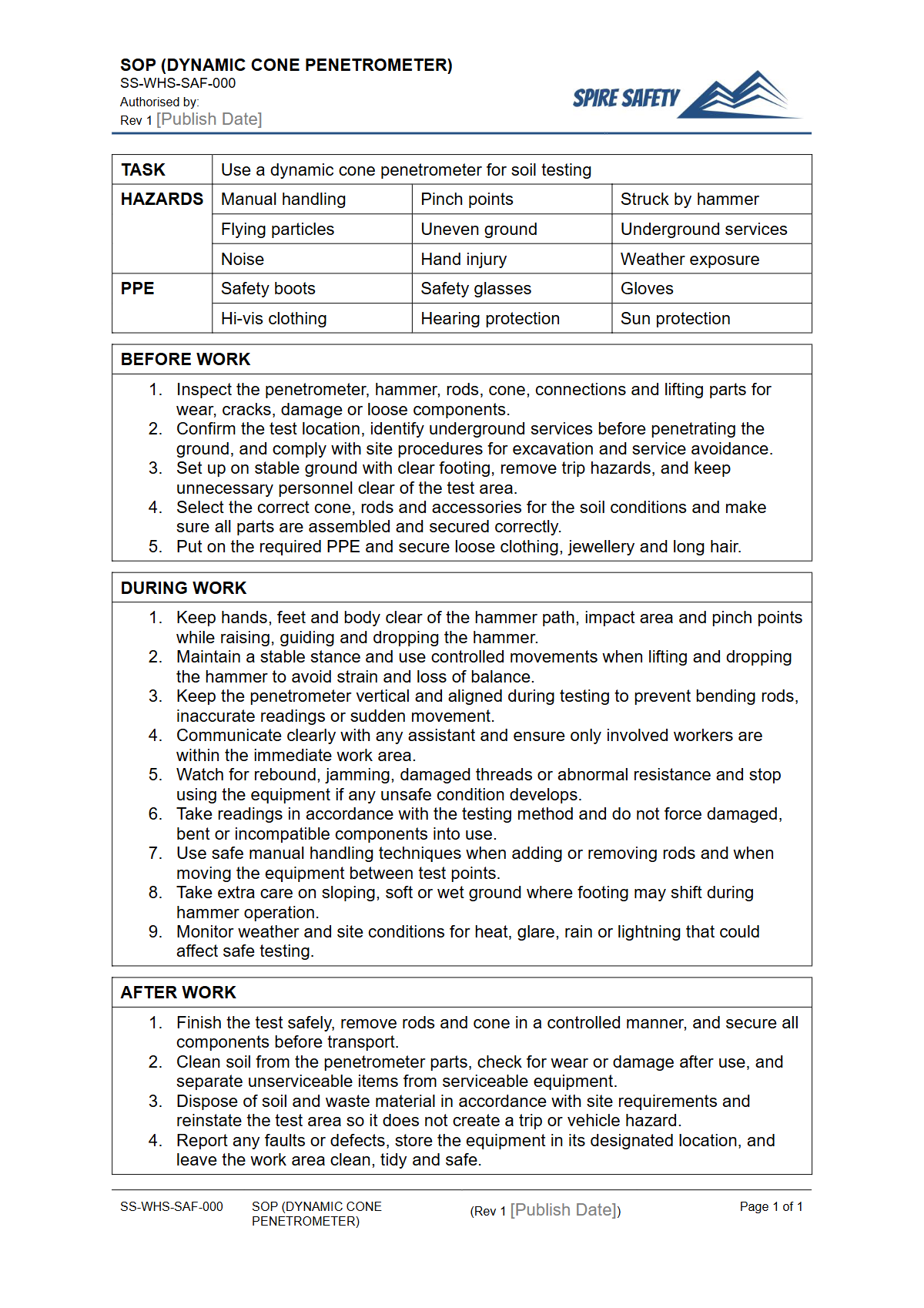
A Dynamic Cone Penetrometer (DCP) is essential for geotechnical investigation, but its manual operation presents distinct workplace hazards. This free Safe Operating Procedure (Dynamic Cone Penetrometer) template provides a structured foundation for documenting the safest way to perform this task.
By clearly outlining steps, identifying risks, and specifying controls, the SOP helps your organisation meet its primary duty of care under WHS law.
Using a documented procedure ensures that all operators, regardless of experience, follow a consistent, safety-focused method. It helps in identifying risks such as manual handling injuries, repetitive strain, and struck-by hazards from the hammer.
Implementing this SOP is a practical step in developing more robust WHS management systems that protect workers and improve operational standards.
Video walkthrough
How to use the Free Safe Operating Procedure (Dynamic Cone Penetrometer) Template
This document is a template, not a finished product. To make it effective, you must customise it to reflect the specific equipment, environment, and work practices at your site.
Download the DOCX file and consult directly with the workers who operate the DCP. Their input is invaluable for identifying practical risks and effective controls.
Important: We have provided this template as a starting point. It is your responsibility to ensure it is adapted to your specific workplace context, including a thorough risk assessment.
If you require assistance in tailoring safety documentation for your unique operational needs, our WHS consulting services can provide expert guidance.
When to use it
A Safe Operating Procedure for a DCP should be used as a primary reference tool in several situations. It is mandatory reading during the induction and training of new operators to establish a baseline for safe behaviour.
It should also be used as a guide for pre-start checks and as a reference for regular toolbox talks to reinforce safety standards.
The SOP serves as a benchmark for correct procedure, particularly for tasks that involve potential ground disturbance or interaction with other site activities, such as those detailed in our free Trencher SOP template. It should be readily accessible to operators at all times during DCP use.
Who should use it
This SOP is intended for all personnel involved with geotechnical testing using a DCP. This includes Geotechnical Engineers, Field Technicians, and Site Supervisors who oversee the work.
WHS Managers and Safety Officers should also use this document to integrate it into the broader site safety framework and to verify its correct implementation.
Ultimately, the direct operators of the Dynamic Cone Penetrometer are the primary users. They must understand and follow the procedure to protect themselves and others. Regular review and feedback from these users are crucial for keeping the document relevant and effective, a process often checked during WHS compliance audits.
Key Hazards and Control Measures
Operating a DCP involves several predictable hazards that require specific controls. Your site-specific risk assessment will identify others, but key risks include:
- Manual Handling: The 8kg sliding hammer creates significant ergonomic risk. Controls include using correct lifting techniques, keeping the back straight, rotating operators on tasks, and using mechanical extraction aids where possible.
- Repetitive Strain: The repeated action of lifting and dropping the hammer can lead to shoulder, back, and arm injuries. Controls involve taking regular breaks, job rotation, and ensuring operators are trained in ergonomic best practice.
- Struck-by Hazards: The operator's hands or feet can be struck by the sliding hammer or other components. Controls include maintaining focus, wearing steel-capped boots and protective gloves, and ensuring a firm grip.
- Trip Hazards: Uneven ground, the equipment itself, and excavated materials can create trip hazards. Controls involve a thorough site inspection before starting, clearing the immediate work area, and maintaining good housekeeping.
The process of identifying and controlling these risks is fundamental to all plant and equipment operation, similar to the process for operating heavy equipment covered in our FREE Grader SOP. By documenting these in your SOP, you create a clear standard for all workers to follow.
Explore our extensive free WHS resources library to find more templates and checklists to support your organisation's safety management system.
Common mistakes
Common mistakes to avoid
- Failing to properly inspect the equipment for wear and tear before use.
- Not ensuring the ground surface is stable and clear of trip hazards.
- Using poor posture or manual handling techniques, leading to back and shoulder strain.
- Neglecting to record data accurately, leading to incorrect geotechnical assessments.
Legal references
Legal considerations
The following legal requirements may be relevant to this type of work.
- Work Health and Safety Act (Harmonised) — Provides the primary duties for protecting workers and other people from work health and safety risks.
- Work Health and Safety Regulations (Harmonised) — Sets out requirements supporting the management of workplace hazards and risks.
The following codes may be relevant to this type of work.
- Managing WHS Risks Code of Practice — Provides practical guidance on identifying hazards, assessing risks and applying effective controls.
- Work Health and Safety Consultation, Cooperation and Coordination Code of Practice — Provides practical guidance on consulting workers and coordinating with other duty holders.
- Managing the Work Environment and Facilities Code of Practice — Provides practical guidance on safe work environments, workplace facilities and related controls.
Did you know
Geotechnical Insight
The DCP was originally developed in the 1950s by George Sowers and is still one of the most common and cost-effective methods for assessing soil strength and compaction worldwide.
Manual Handling Risk
A standard DCP hammer weighs 8 kg. Repetitively lifting this weight is a significant manual handling risk that must be managed through proper technique, team rotation, and regular breaks.
FAQ
Frequently asked questions
01What is a Dynamic Cone Penetrometer (DCP) used for?
02Does this DCP SOP template cover all legal requirements?
03What PPE is required when using a Dynamic Cone Penetrometer?
04How often should a Safe Operating Procedure for a DCP be reviewed?
Share this resource
Free Safe Operating Procedure (Dynamic Cone Penetrometer) Template
Browse Categories
How To Use It
- 1Download and open in Word or PDF.
- 2Replace the placeholders with your business details.
- 3Get it reviewed by a WHS specialist before rollout.
Need it customised?
Our WHS consultants can adapt this template to your site, run a gap analysis, or audit what you already have in place.
Book a Free Consultation WHS consulting servicesor call 1300 156 382
Related templates
- Free Safe Operating Procedure (E-Waste Collection) Template
- Free Safe Operating Procedure (E-Waste Dropoff Intake) Template
- Free Safe Operating Procedure (Earth Tester) Template
- Free Safe Operating Procedure (Earthing Stick) Template
- Free Safe Operating Procedure (Edge Bander) Template
- Free Safe Operating Procedure (Edge Protection) Template