
Free Safe Operating Procedure (Dyeing Machine) Template
Download our free Safe Operating Procedure (Dyeing Machine) Template to formalise safety protocols for textile dyeing. Get your customisable DOCX now.
Free Safe Operating Procedure (Dyeing Machine) Template
DOCX • 126 KB + PDF
Updated Oct 2026
No signup required
Purpose of the Free Safe Operating Procedure (Dyeing Machine) Template
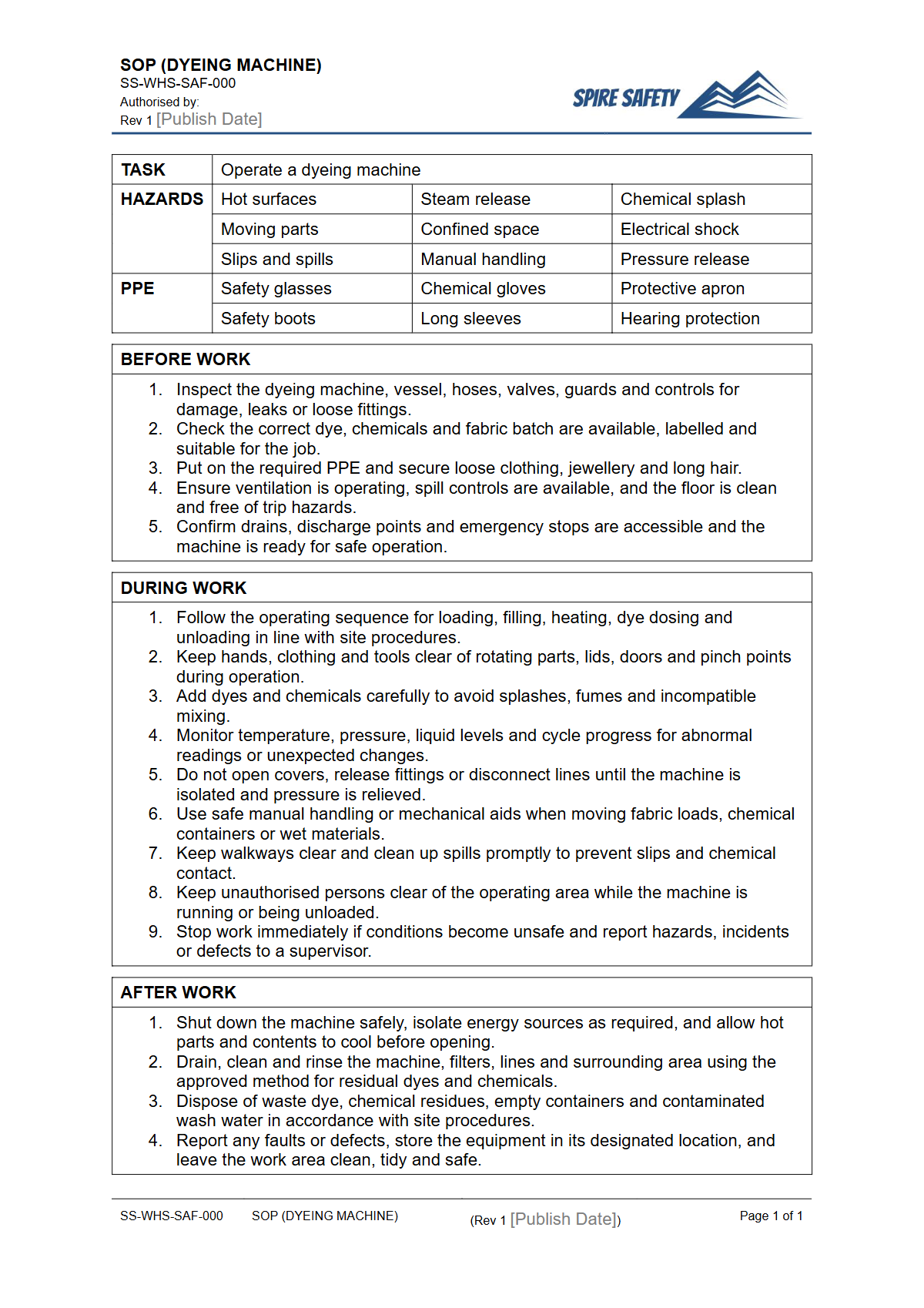
The primary purpose of a Safe Operating Procedure (SOP) for a dyeing machine is to provide clear, step-by-step instructions to ensure tasks are performed safely and consistently. Implementing a formal SOP helps your business meet its primary duty of care under WHS law by actively managing workplace risks.
A well-written SOP minimises the risk of serious injuries such as chemical or thermal burns, respiratory illness from vapours, or entanglement in machinery. It also serves as a critical training tool for new operators and a reference for experienced staff, promoting a consistent safety-first culture across all shifts.
Video walkthrough
How to use the Free Safe Operating Procedure (Dyeing Machine) Template
This document is a template and must be customised to reflect your specific workplace environment and machinery. To use it effectively, download the DOCX file and populate the sections with details relevant to your dyeing machine's make and model, the specific chemicals and dyes used, and your site's emergency procedures.
We strongly recommend a Person Conducting a Business or Undertaking (PCBU) consults with operators and supervisors during this process to ensure the final SOP is practical and accurate. The finished document should be a true reflection of your safe work practices.
Key Hazards in Dyeing Machine Operation
Dyeing machines present a unique combination of hazards that require careful management. A thorough risk assessment should identify site-specific dangers, which commonly include:
- Thermal Hazards: Exposure to hot surfaces, steam, and hot liquids can cause severe burns. This includes the main vessel, associated pipework, and discharge points. Managing these risks is similar to protocols for other high-temperature equipment, as detailed in resources like a deep fryer SOP template.
- Chemical Hazards: Dyes, pigments, fixing agents, and cleaning chemicals can be toxic, corrosive, or irritant. Risks include inhalation of vapours, skin contact, and splashes to the eyes. Always have Safety Data Sheets (SDS) readily available for all chemicals used.
- Mechanical Hazards: Moving parts such as rollers, paddles, or rotating drums create risks of entanglement, crushing, and shearing. Proper machine guarding and isolation procedures are essential.
- Pressure Hazards: Many modern dyeing machines operate under pressure. This creates a risk of violent rupture or uncontrolled release of hot, chemical-laden steam or liquid if not correctly operated, monitored, and maintained. For related pressure system guidance, you can refer to our Free Air Compressor SOP Template.
What to Include in Your Dyeing Machine SOP
A comprehensive SOP should be more than just operating steps. It must provide a complete guide to performing the task safely from start to finish. Key sections to include are:
- Required PPE: List all mandatory Personal Protective Equipment, such as heat-resistant gloves, chemical splash goggles, face shields, aprons, and appropriate respiratory protection.
- Pre-Operational Checks: Detail the safety checks an operator must perform before starting the machine, including verifying safety guards are in place, checking pressure relief valves, and ensuring emergency stops are functional.
- Step-by-Step Operating Sequence: Outline the entire process, from loading fabric and chemicals to setting parameters (temperature, pressure, time), running the cycle, and unloading. Use clear, simple language.
- Shutdown and Cleaning: Provide instructions for normal shutdown, as well as procedures for cleaning the machine and managing waste chemicals and effluent.
- Emergency Procedures: Clearly define actions to take in case of an emergency, such as chemical spills, equipment malfunction, or operator injury. Include the location of emergency stops, eyewash stations, and safety showers. This documentation forms a vital part of your overall WHS management systems.
When to use this Safe Operating Procedure
An SOP is a living document used throughout the equipment's lifecycle. It should be used during the induction and training of all new operators to establish a baseline of safe behaviour.
It serves as an on-the-job reference for all workers to ensure consistency. Furthermore, the SOP is a critical tool for refresher training and must be reviewed and updated following any incident, near miss, or when there is a change to the machinery, chemicals, or process.
Regular reviews ensure the procedure remains relevant and effective.
For organisations that use complex, interconnected equipment, this SOP can be integrated with other procedures, such as a FREE Conveyer System SOP for automated loading and unloading, to create a seamless safety workflow.
Who should use this SOP
This SOP is intended for several key roles within an organisation. Primarily, machine operators must use it as their guide for safe operation and refer to it regularly.
Supervisors and team leaders are responsible for using the SOP to train their staff and monitor compliance during daily work. Maintenance personnel should also refer to the SOP to understand the correct procedures for isolation and lockout/tagout before commencing any work.
Finally, WHS managers and auditors will use the SOP as a benchmark when conducting workplace inspections and WHS compliance auditing to verify that documented procedures are being followed in practice.
You can find this and many other helpful documents in our free WHS resources library to support your safety goals.
Common mistakes
Common mistakes to avoid
- Using the template as-is without customising it for the specific machine and chemicals used on site.
- Failing to reference corresponding Safety Data Sheets (SDS) for all dyes and chemicals within the SOP.
- Treating the SOP as a 'tick-and-flick' exercise without providing practical, hands-on training to operators.
- Forgetting to include specific lockout/tagout procedures for maintenance, cleaning, and clearing blockages.
Legal references
Legal considerations
The following legal requirements may be relevant to this type of work.
- Work Health and Safety Act (Harmonised) — Provides the primary duties for protecting workers and other people from work health and safety risks.
- Work Health and Safety Regulations (Harmonised) — Sets out requirements supporting the management of workplace hazards and risks.
The following codes may be relevant to this type of work.
- Managing WHS Risks Code of Practice — Provides practical guidance on identifying hazards, assessing risks and applying effective controls.
- Work Health and Safety Consultation, Cooperation and Coordination Code of Practice — Provides practical guidance on consulting workers and coordinating with other duty holders.
- Managing the Work Environment and Facilities Code of Practice — Provides practical guidance on safe work environments, workplace facilities and related controls.
Did you know
A Colourful Danger
In the 19th century, a popular vibrant green pigment called 'Scheele's Green' was made with copper arsenite. It was used in everything from textiles and wallpaper to children's toys, leading to widespread chronic arsenic poisoning.
Manufacturing Risks
According to Safe Work Australia, the manufacturing industry consistently ranks among the top industries for serious workers' compensation claims, with machinery operation being a leading cause of injury.
FAQ
Frequently asked questions
01What is the primary purpose of a Safe Operating Procedure for a dyeing machine?
02Who is responsible for writing a dyeing machine SOP?
03How often should a dyeing machine SOP be reviewed?
04Can this template be used for all types of dyeing machines?
Share this resource
Free Safe Operating Procedure (Dyeing Machine) Template
Browse Categories
How To Use It
- 1Download and open in Word or PDF.
- 2Replace the placeholders with your business details.
- 3Get it reviewed by a WHS specialist before rollout.
Need it customised?
Our WHS consultants can adapt this template to your site, run a gap analysis, or audit what you already have in place.
Book a Free Consultation WHS consulting servicesor call 1300 156 382
Related templates
- Free Safe Operating Procedure (Dynamic Cone Penetrometer) Template
- Free Safe Operating Procedure (E-Waste Collection) Template
- Free Safe Operating Procedure (E-Waste Dropoff Intake) Template
- Free Safe Operating Procedure (Earth Tester) Template
- Free Safe Operating Procedure (Earthing Stick) Template
- Free Safe Operating Procedure (Edge Bander) Template