
Free Safe Operating Procedure (Duct Lifter) Template
Effectively manage the risks associated with duct lifter operation with our detailed Safe Operating Procedure template.
Free Safe Operating Procedure (Duct Lifter) Template
DOCX • 126 KB + PDF
Updated Oct 2026
No signup required
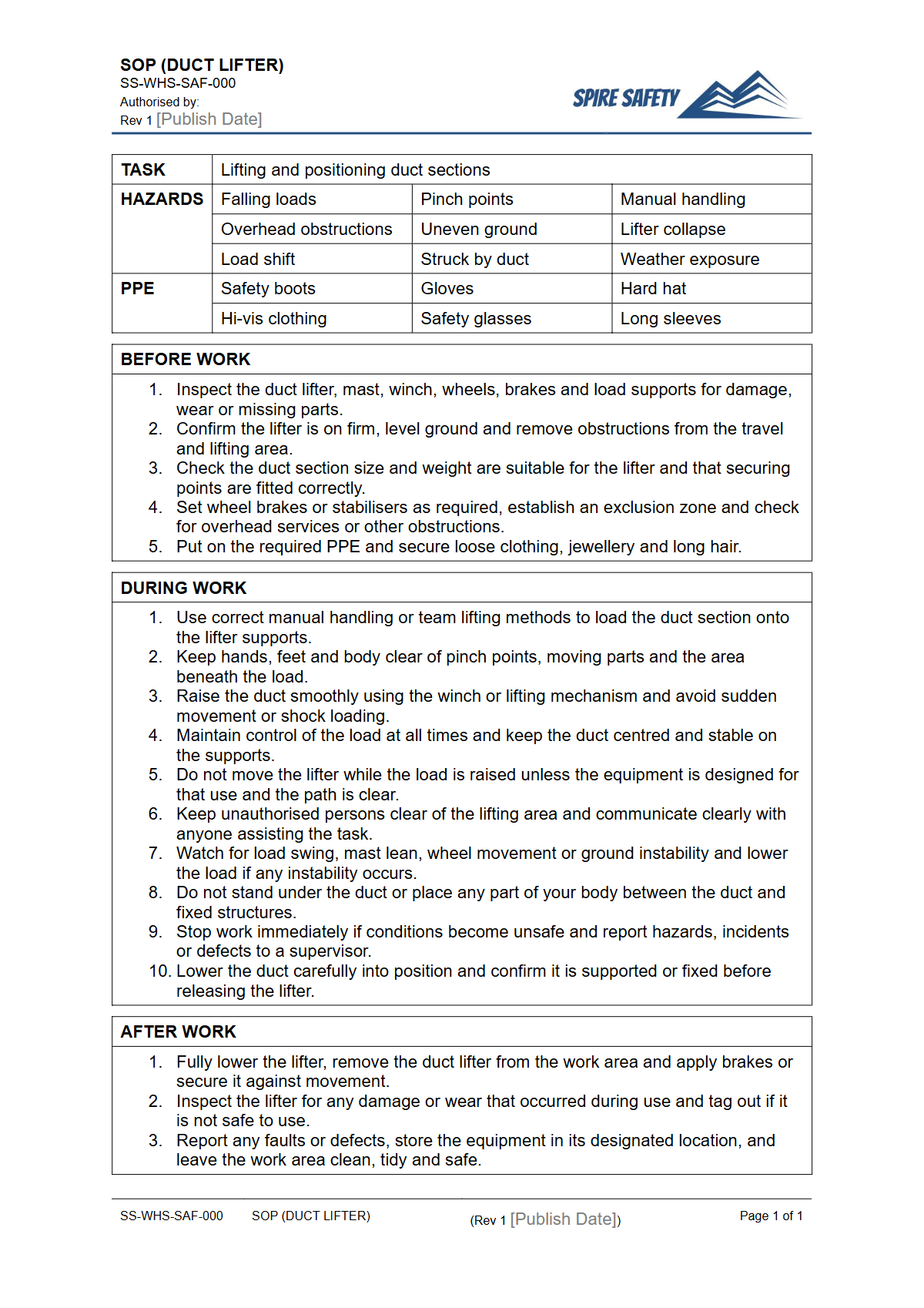
Purpose of the Free Safe Operating Procedure (Duct Lifter) Template
A well-defined Safe Operating Procedure (SOP) for a duct lifter is crucial for preventing injuries and ensuring operational safety in Australian workplaces. Its primary purpose is to provide clear, step-by-step instructions for operating the equipment, from pre-start checks to shutdown procedures.
This document helps to standardise practices, reduce the risk of incidents caused by operator error, and serves as a key training resource for new and existing workers. By formally documenting the process, you create an auditable record of your commitment to managing workplace hazards, such as falling objects, manual handling strains, and equipment instability.
Much like the procedures documented in our free Telehandler SOP template, this document provides a clear reference point for safe operation.
Video walkthrough
How to use the Free Safe Operating Procedure (Duct Lifter) Template
This template is available in both DOCX and PDF formats. We recommend downloading the DOCX file to easily add, remove, and edit sections to reflect your specific workplace environment and the particular make and model of your duct lifter.
Important: This document is a template and must be customised to your specific needs. We are not providing a completed Safe Operating Procedure.
You must consult with equipment operators, supervisors, and other relevant persons to identify all site-specific hazards and develop effective control measures. Your final document should accurately reflect your equipment, work environment, and internal procedures to be effective.
Review every section, paying close attention to pre-operational checks, operating steps, and emergency responses. Add details about your specific site, including emergency contact numbers, required Personal Protective Equipment (PPE), and any unique environmental conditions.
A regular review of your WHS processes, potentially through WHS compliance auditing, ensures your documentation remains current and effective.
When to use a Duct Lifter SOP
A Safe Operating Procedure for a duct lifter should be used consistently across your operations. It is an essential reference during the training and induction of new operators, ensuring they understand the correct procedures from the start.
It should also be readily available in the work area for experienced operators to reference. Furthermore, the SOP is a critical document to review during WHS consulting engagements, after any incident or near miss involving the equipment, and as part of periodic safety reviews to ensure its continued relevance and effectiveness.
Who should use this Safe Operating Procedure
This SOP is intended for a range of personnel within an organisation to ensure a shared understanding of safe work practices:
- Operators: To follow step-by-step instructions for the safe use of the duct lifter.
- Supervisors and Managers: To supervise work, provide training, and verify that procedures are being followed correctly.
- WHS/Safety Officers: To use as a tool for risk assessments, incident investigations, and workplace inspections.
- Training Personnel: To use as a foundational document for developing training programs and assessing operator competency.
By ensuring all relevant parties use and understand the SOP, you create a more consistent and robust safety culture. This documentation forms a key part of your overall risk management strategy for plant and equipment, forming one component of a complete WHS management system.
For examples of how procedures are documented for different types of machinery, consider reviewing resources like our Free Air Compressor SOP. This can help in developing a consistent approach to safety documentation across your workplace.
Common mistakes
Common mistakes to avoid
- Failing to customise the template for site-specific conditions and equipment models.
- Operating the lifter on uneven or soft ground, leading to instability.
- Exceeding the manufacturer's specified Safe Working Load (SWL).
- Neglecting to perform and document pre-start safety checks before use.
Legal references
Legal considerations
The following legal requirements may be relevant to this type of work.
- Work Health and Safety Act (Harmonised) — Provides the primary duties for protecting workers and other people from work health and safety risks.
- Work Health and Safety Regulations (Harmonised) — Sets out requirements supporting the management of workplace hazards and risks.
The following codes may be relevant to this type of work.
- Managing WHS Risks Code of Practice — Provides practical guidance on identifying hazards, assessing risks and applying effective controls.
- Work Health and Safety Consultation, Cooperation and Coordination Code of Practice — Provides practical guidance on consulting workers and coordinating with other duty holders.
- Managing the Work Environment and Facilities Code of Practice — Provides practical guidance on safe work environments, workplace facilities and related controls.
Did you know
Material Lifts
Duct lifters are a type of material lift, specifically designed for lifting and positioning ductwork, pipes, and other items for overhead installation, significantly reducing manual handling risks.
Stability is Key
Most incidents involving material lifts like duct lifters are due to instability. Always ensure the ground is level and firm, outriggers are correctly deployed, and you never exceed the rated load capacity.
FAQ
Frequently asked questions
01What should be included in a duct lifter SOP?
02Is training required to operate a duct lifter?
03How often should a Safe Operating Procedure be reviewed?
04Can I use this template for any brand of duct lifter?
Share this resource
Free Safe Operating Procedure (Duct Lifter) Template
Browse Categories
How To Use It
- 1Download and open in Word or PDF.
- 2Replace the placeholders with your business details.
- 3Get it reviewed by a WHS specialist before rollout.
Need it customised?
Our WHS consultants can adapt this template to your site, run a gap analysis, or audit what you already have in place.
Book a Free Consultation WHS consulting servicesor call 1300 156 382
Related templates
- Free Safe Operating Procedure (Duct Notcher) Template
- Free Safe Operating Procedure (Dump Point Cleaning) Template
- Free Safe Operating Procedure (Dump Point Inspection) Template
- Free Safe Operating Procedure (Dust Collector) Template
- Free Safe Operating Procedure (Dust Extractor) Template
- Free Safe Operating Procedure (Dust Monitor) Template