
Free Safe Operating Procedure (Dust Collector) Template
Effectively manage airborne dust hazards with our free Safe Operating Procedure (Dust Collector) Template.
Free Safe Operating Procedure (Dust Collector) Template
DOCX • 126 KB + PDF
Updated Oct 2026
No signup required
Purpose of the Free Safe Operating Procedure (Dust Collector) Template
Controlling airborne dust is critical for maintaining a safe and healthy work environment. This free Safe Operating Procedure (Dust Collector) Template provides a structured framework for documenting the safe use of industrial and workshop dust extraction systems.
It guides you in outlining the necessary steps to protect workers from respiratory hazards, such as wood dust or crystalline silica, and mitigate risks like fire and explosion associated with combustible dusts.
Using this template helps formalise your organisation's processes for pre-operational checks, safe startup, operation, cleaning, and shutdown of dust collectors. A documented SOP is an essential tool for training, inductions, and ensuring consistent, safe work practices.
It provides a clear reference for operators, reducing the chance of incidents and demonstrating a commitment to proactive risk management. This is especially important when the dust collector is used with equipment that generates high volumes of fine particles, for which our free Circular Saw SOP template may also be useful.
Video walkthrough
How to use the Free Safe Operating Procedure (Dust Collector) Template
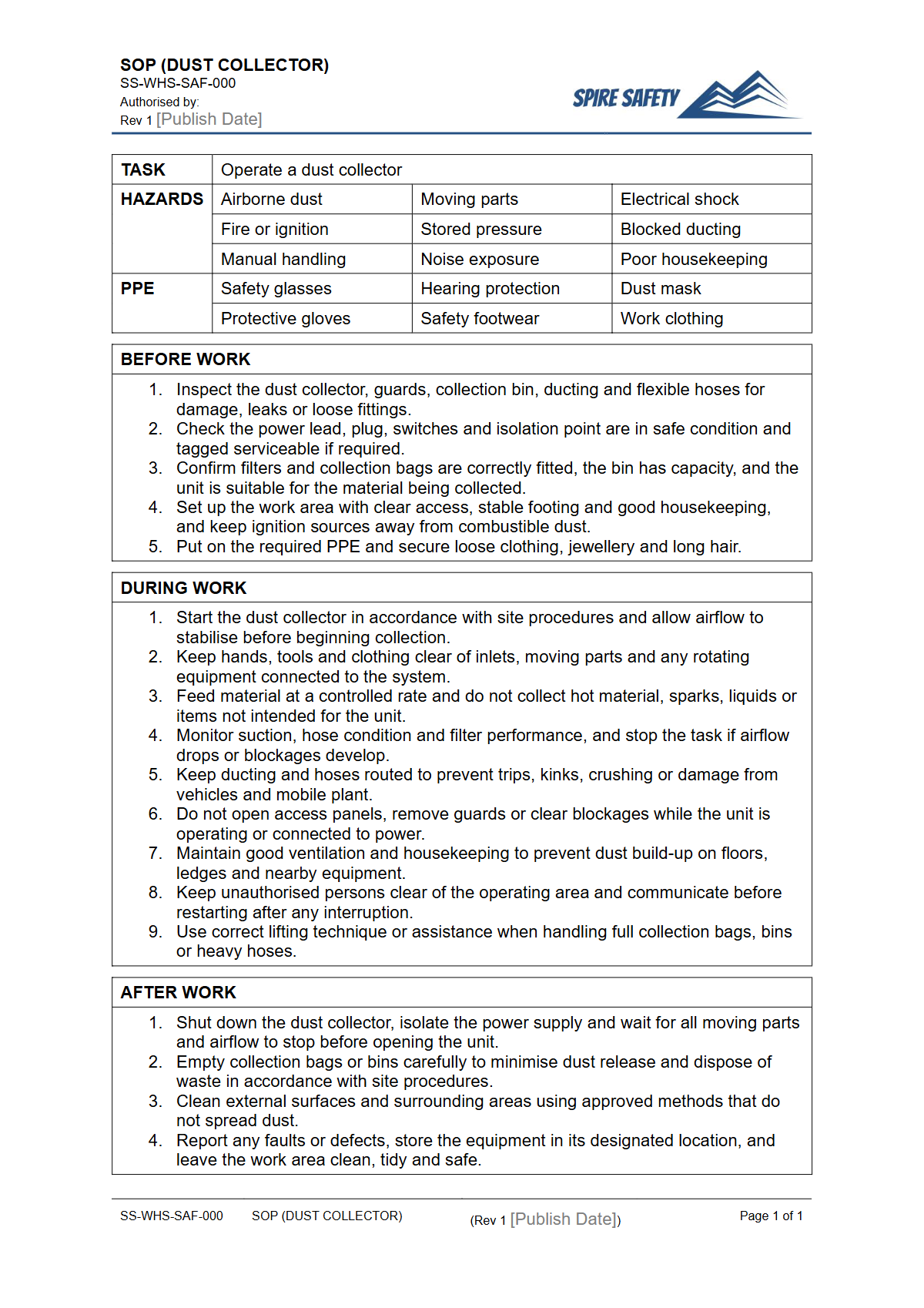
This Safe Operating Procedure is provided as a fully editable DOCX file and a print-ready PDF. To use it, simply download the file and adapt the content to match the specific equipment and operational context of your workplace.
Fill in the required fields, including your company details, the specific dust collector model, and the designated personal protective equipment (PPE).
It is crucial to conduct a site-specific risk assessment to inform the content of your final SOP. This template provides a solid foundation, but it is essential that you customise it to reflect the specific dust collector models, workplace layout, types of dust generated, and control measures unique to your organisation.
We cannot guarantee its suitability for your specific circumstances. For assistance with developing and implementing robust safety documentation, our WHS consulting services can provide expert guidance.
Key Sections to Customise
- Personal Protective Equipment (PPE): Specify the exact type of respiratory protection (e.g., P2 respirator), eye protection, and hearing protection required for operating and maintaining the unit.
- Pre-operational Checks: Detail the visual inspections operators must perform before use, such as checking hose integrity, collection bag/bin levels, filter condition, and ensuring the unit is properly grounded.
- Operating Procedures: Outline the step-by-step process for safely starting, using, and shutting down the dust collector. Include instructions specific to your system, like opening and closing blast gates for different machines.
- Cleaning and Maintenance: Document the safe procedures for emptying collection bags/bins, cleaning or replacing filters, and performing routine maintenance tasks. Address how to manage collected dust, especially if it is hazardous.
- Emergency Procedures: Clearly state the steps to take in an emergency, such as a fire, blockage, or equipment malfunction.
When to use a Safe Operating Procedure
An SOP for a dust collector should be developed and implemented before any worker is permitted to operate the equipment. It serves as a core training document for new employees and a vital refresher for experienced staff.
The SOP should be readily accessible in the work area, allowing operators to reference it as needed to confirm safe practices.
This procedure is a fundamental component of a comprehensive safety framework and should be integrated into your broader WHS management system. It should be reviewed and updated regularly—at least every two years, or whenever there is a change in equipment, processes, legislation, or following an incident.
Who should use this template
This template is designed for use by anyone responsible for workplace health and safety. This includes WHS Managers, Health and Safety Representatives (HSRs), Supervisors, and business owners in industries like woodworking, manufacturing, construction, and fabrication.
It provides a structured starting point for creating a crucial safety document that standardises the operation of essential plant.
Operators of the equipment are the end-users of the finalised SOP, but the template itself is a tool for those tasked with drafting and implementing safety documentation. It's built on principles that apply to various types of workshop plant, similar to our Free Air Compressor SOP. In larger facilities, the dust extraction system might be part of an integrated network, where a FREE Conveyer System SOP could also be relevant for managing associated risks.
By customising this document, you can create a practical tool that helps fulfil your duty of care. Explore our complete free WHS resources library for more templates to support your safety management efforts.
Common mistakes
Common mistakes to avoid
- Connecting incompatible equipment to the collector, leading to poor extraction efficiency.
- Allowing dust to accumulate in collection bins or bags, creating a fire hazard and reducing performance.
- Neglecting regular filter inspection and cleaning, causing system blockages and motor strain.
- Failing to correctly ground the system, which can lead to static electricity buildup and a potential ignition source for combustible dusts.
Legal references
Legal considerations
The following legal requirements may be relevant to this type of work.
- Work Health and Safety Act (Harmonised) — Provides the primary duties for protecting workers and other people from work health and safety risks.
- Work Health and Safety Regulations (Harmonised) — Sets out requirements supporting the management of workplace hazards and risks.
The following codes may be relevant to this type of work.
- Managing WHS Risks Code of Practice — Provides practical guidance on identifying hazards, assessing risks and applying effective controls.
- Work Health and Safety Consultation, Cooperation and Coordination Code of Practice — Provides practical guidance on consulting workers and coordinating with other duty holders.
- Managing the Work Environment and Facilities Code of Practice — Provides practical guidance on safe work environments, workplace facilities and related controls.
Did you know
Combustible Dust Risk
Many seemingly harmless dusts, including wood, flour, and some plastics, can become explosive when suspended in the air in a confined space. A dust collector system can concentrate this risk if not designed and maintained correctly.
Invisible Danger
The most dangerous dust particles, known as respirable dust, are too small to be seen with the naked eye. These particles can penetrate deep into the lungs, causing serious and irreversible diseases like silicosis and lung cancer.
FAQ
Frequently asked questions
01What hazards are associated with operating a dust collector?
02How often should a Safe Operating Procedure for a dust collector be reviewed?
03Is a Safe Operating Procedure legally required for a dust collector in Australia?
04What should be included in training for dust collector operation?
Share this resource
Free Safe Operating Procedure (Dust Collector) Template
Browse Categories
How To Use It
- 1Download and open in Word or PDF.
- 2Replace the placeholders with your business details.
- 3Get it reviewed by a WHS specialist before rollout.
Need it customised?
Our WHS consultants can adapt this template to your site, run a gap analysis, or audit what you already have in place.
Book a Free Consultation WHS consulting servicesor call 1300 156 382
Related templates
- Free Safe Operating Procedure (Dust Extractor) Template
- Free Safe Operating Procedure (Dust Monitor) Template
- Free Safe Operating Procedure (Dye Penetrant Test) Template
- Free Safe Operating Procedure (Dyeing Machine) Template
- Free Safe Operating Procedure (Dynamic Cone Penetrometer) Template
- Free Safe Operating Procedure (E-Waste Collection) Template