
Free Safe Operating Procedure (Dump Point Inspection) Template
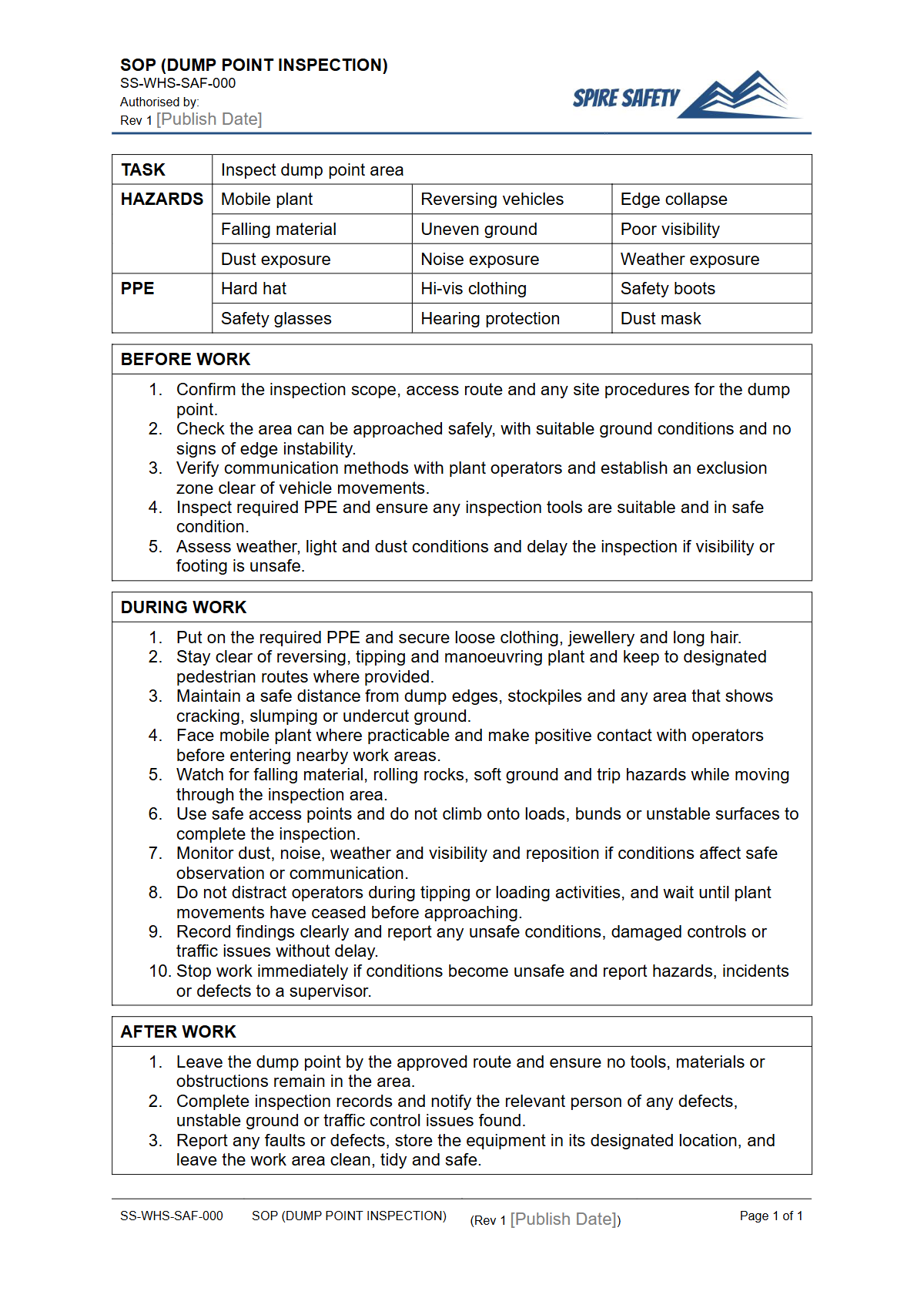
Download our free Safe Operating Procedure for Dump Point Inspection. This template offers a structured starting point for managing WHS risks during this task.
Free Safe Operating Procedure (Dump Point Inspection) Template
DOCX • 126 KB + PDF
Updated Oct 2026
No signup required
Purpose of the Free Safe Operating Procedure (Dump Point Inspection) Template
Managing a dump point at a caravan park, campground, or public facility involves significant work health and safety risks. This Free Safe Operating Procedure (Dump Point Inspection) Template provides a clear framework for organisations to document a safe system of work for inspecting, cleaning, and maintaining these facilities.
The primary goal is to minimise risks to workers, including exposure to biological hazards, hazardous chemicals, musculoskeletal injuries from manual tasks, and slips, trips, and falls.
Using a standardised SOP ensures that all inspections are performed consistently and thoroughly, regardless of who performs the task. It formalises safety requirements, outlining necessary personal protective equipment (PPE), required tools, and emergency procedures.
Documenting these steps is a critical component of building robust WHS management systems, demonstrating due diligence and a commitment to protecting your team.
What hazards does this Safe Operating Procedure address?
This SOP template is designed to help you control risks specific to dump point maintenance, including:
- Biological Hazards: Contact with raw sewage and contaminated water, which can contain bacteria, viruses, and parasites.
- Chemical Hazards: Exposure to cleaning agents, deodorisers, and other chemicals used for sanitation.
- Manual Tasks: Lifting heavy hoses, covers, or equipment, leading to sprains and strains.
- Slips, Trips, and Falls: Wet and potentially slippery surfaces around the dump point area.
- Confined Spaces: Risks associated with accessing underground tanks or pits, if applicable to your site.
Video walkthrough
How to use the Free Safe Operating Procedure (Dump Point Inspection) Template
This document is a template, not a finished procedure. To be effective, it must be customised to reflect the specific circumstances of your workplace.
Download the DOCX file and adapt it by incorporating your site-specific details, including the type of dump point, the exact chemicals used, and your organisation's emergency contacts and procedures.
We strongly recommend a consultation process involving the workers who actually perform the inspections. Their direct experience is invaluable for identifying practical hazards and effective controls.
Once customised, the SOP should be used as a primary training document for new employees and for refresher training. The process for developing procedures for other equipment, such as an Air Compressor SOP, follows a similar principle of site-specific customisation.
When to use it
The Safe Operating Procedure for Dump Point Inspection should be an integral part of your daily or weekly operational rhythm. It should be used:
- Before every inspection task: As a pre-start checklist to ensure all safety measures are in place.
- During worker training: To induct new staff on the correct and safe method for conducting inspections.
- For competency assessments: To verify that workers understand and can follow the required safety protocols.
- After an incident or near miss: As a tool for investigation and review to identify any gaps in the current procedure.
- During safety reviews: Regular reviews ensure the SOP remains relevant and effective. Integrating these checks into your schedule is a key part of regular WHS compliance auditing.
Who should use it
This SOP is intended for any person responsible for the inspection, cleaning, or maintenance of sanitary dump points. This includes a range of roles across different industries:
- Caravan Park and Campground Managers/Staff: Responsible for the day-to-day operation and safety of park facilities.
- Maintenance and Groundskeeping Personnel: The primary workers tasked with carrying out the inspections.
- Cleaning Contractors: Third-party providers hired to maintain amenities.
- Local Council and Public Works Officers: For dump points located in public rest areas or council-managed facilities.
Ultimately, the Person Conducting a Business or Undertaking (PCBU) is responsible for ensuring a safe work environment. This includes providing clear instructions and procedures, like this SOP, for all high-risk tasks.
This responsibility extends across all site activities, from maintaining amenities to operating heavy machinery covered by a specific Scraper SOP or other plant-related procedures. If you need assistance developing procedures tailored to your unique operational risks, our WHS consulting services can provide expert guidance.
You can find many other helpful documents like this in our complete free WHS resources library, which covers a wide range of tasks and equipment.
Common mistakes
Common mistakes to avoid
- Failing to customise the generic template with site-specific equipment, chemicals, and emergency details.
- Neglecting to wear the specified personal protective equipment (PPE) for every task.
- Using unauthorised or incorrect cleaning chemicals that can damage the system or cause a chemical reaction.
- Not providing adequate training to staff on the finalised Safe Operating Procedure before they undertake the work.
Legal references
Legal considerations
The following legal requirements may be relevant to this type of work.
- Work Health and Safety Act (Harmonised) — Provides the primary duties for protecting workers and other people from work health and safety risks.
- Work Health and Safety Regulations (Harmonised) — Sets out requirements supporting the management of workplace hazards and risks.
The following codes may be relevant to this type of work.
- Managing WHS Risks Code of Practice — Provides practical guidance on identifying hazards, assessing risks and applying effective controls.
- Work Health and Safety Consultation, Cooperation and Coordination Code of Practice — Provides practical guidance on consulting workers and coordinating with other duty holders.
- Managing the Work Environment and Facilities Code of Practice — Provides practical guidance on safe work environments, workplace facilities and related controls.
Did you know
RV Growth
There are over 770,000 registered recreational vehicles in Australia. This continuous growth puts increasing pressure on public and private dump points, highlighting the need for robust inspection and maintenance procedures.
FAQ
Frequently asked questions
01What are the main hazards associated with dump point inspections?
02How often should a dump point SOP be reviewed?
03Is this dump point inspection SOP suitable for all types of dump points?
04What personal protective equipment (PPE) is typically required for a dump point inspection?
Share this resource
Free Safe Operating Procedure (Dump Point Inspection) Template
Browse Categories
How To Use It
- 1Download and open in Word or PDF.
- 2Replace the placeholders with your business details.
- 3Get it reviewed by a WHS specialist before rollout.
Need it customised?
Our WHS consultants can adapt this template to your site, run a gap analysis, or audit what you already have in place.
Book a Free Consultation WHS consulting servicesor call 1300 156 382
Related templates
- Free Safe Operating Procedure (Dust Collector) Template
- Free Safe Operating Procedure (Dust Extractor) Template
- Free Safe Operating Procedure (Dust Monitor) Template
- Free Safe Operating Procedure (Dye Penetrant Test) Template
- Free Safe Operating Procedure (Dyeing Machine) Template
- Free Safe Operating Procedure (Dynamic Cone Penetrometer) Template