
Free Safe Operating Procedure (Dump Point Cleaning) Template
Effectively manage the health and safety risks associated with dump point cleaning. Download our free Safe Operating Procedure template to get started.
Free Safe Operating Procedure (Dump Point Cleaning) Template
DOCX • 126 KB + PDF
Updated Oct 2026
No signup required
Purpose of the Free Safe Operating Procedure (Dump Point Cleaning) Template
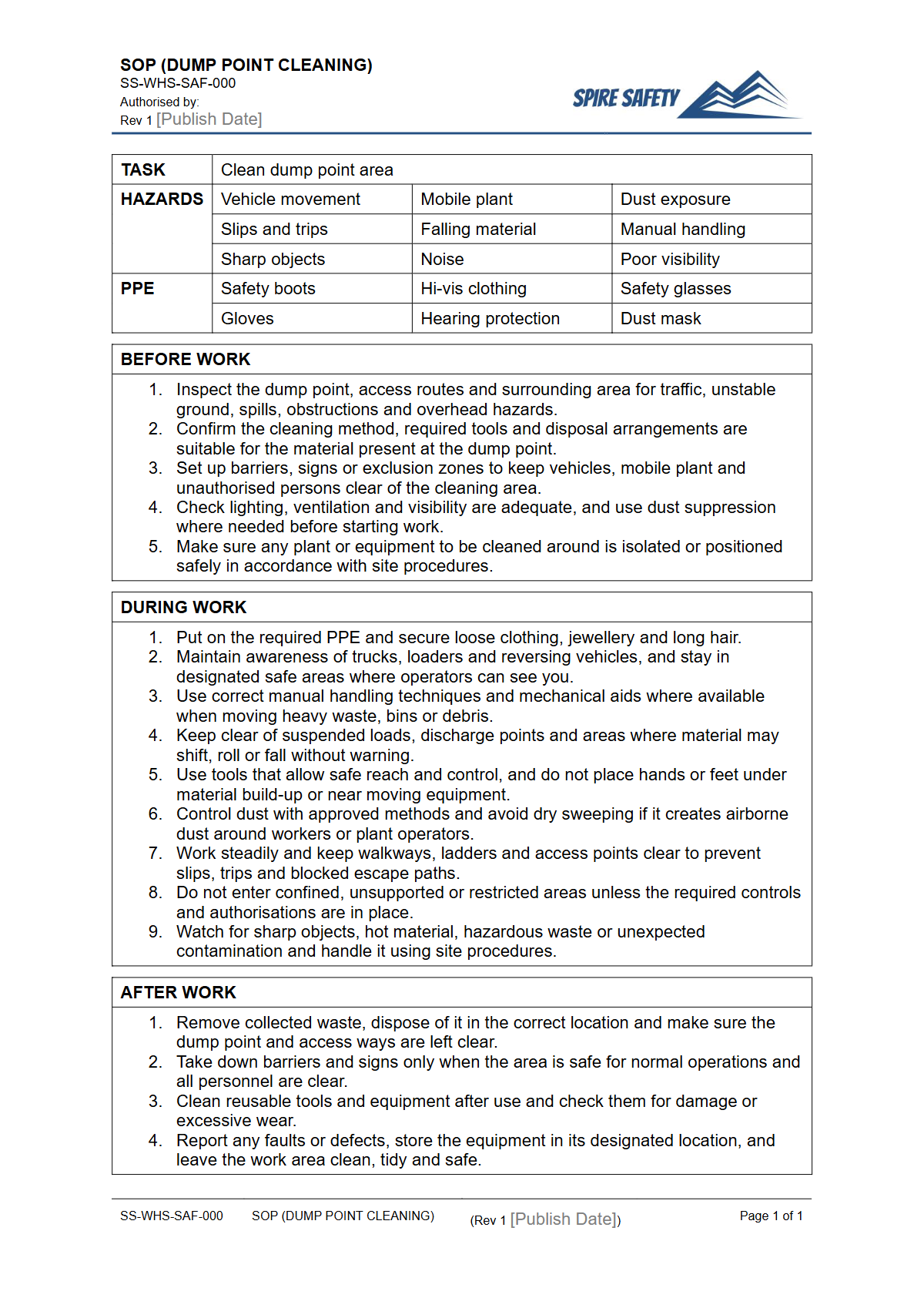
This Free Safe Operating Procedure (Dump Point Cleaning) Template provides a structured framework for documenting the required steps to clean dump points safely. Cleaning these facilities involves significant risks, including exposure to biological hazards, hazardous chemicals, and musculoskeletal injuries from manual tasks.
A documented SOP is a critical tool for any Person Conducting a Business or Undertaking (PCBU) to meet their primary duty of care under Australian WHS laws. It ensures tasks are performed consistently and safely, providing clear instructions to workers and minimising the risk of incidents or illness.
By implementing a specific SOP, you create a safer work environment and a clear reference point for training, supervision, and incident investigation. This document formalises risk control measures, such as the correct use of Personal Protective Equipment (PPE), appropriate handling of cleaning chemicals, and emergency response actions.
It acts as a key component of a proactive safety culture, demonstrating an organisational commitment to worker health and safety.
Video walkthrough
How to use the Free Safe Operating Procedure (Dump Point Cleaning) Template
This Safe Operating Procedure is available for download as a DOCX file for easy customisation and as a PDF for straightforward distribution and printing. The DOCX version is designed to be a starting point.
It is essential that you adapt the content to reflect the specific hazards and control measures relevant to your worksite. This includes detailing the exact location, types of cleaning agents used, specific equipment available, and emergency contact details for your organisation.
Important: This is a template, not a finished document. To be effective, you must customise it to your specific operational context.
We have provided a structured foundation aligned with Australian WHS principles, but you are responsible for ensuring the final document accurately reflects your workplace's unique risks and procedures. Integrating such procedures is a fundamental part of building comprehensive WHS management systems.
When to use a Safe Operating Procedure for Dump Point Cleaning
An SOP for dump point cleaning should be used as the primary reference document for all personnel involved in the task. It should be consulted during worker induction and task-specific training to ensure everyone understands the established safety protocols before they begin work.
It serves as an on-the-job guide and a critical tool for supervisors to monitor work practices. The procedure should be reviewed regularly (e.g., annually) or whenever there is a change in equipment, chemicals, processes, or following an incident or near miss.
Like our Safe Operating Procedure for floor scrubber operation, this document helps standardise high-risk, non-routine tasks.
Who should use it
This Safe Operating Procedure is intended for several key groups within an organisation. Primarily, it is for the workers who directly perform the cleaning tasks, providing them with clear, step-by-step instructions for working safely.
Supervisors and managers should also use the SOP to ensure work is conducted according to the established safety standards and to facilitate toolbox talks or pre-start meetings. WHS managers and safety officers will use the template as a foundational document to build, review, and integrate into the broader safety management system.
For businesses needing expert guidance on defining these roles and responsibilities, our WHS consulting services can provide tailored support.
Key Elements Covered in the Template
Our template provides a comprehensive structure to guide your customisation. It prompts you to include critical safety information, such as:
- Required PPE: Specifies the necessary personal protective equipment, such as chemical-resistant gloves, safety glasses or goggles, enclosed footwear, and waterproof aprons.
- Hazard Identification: Outlines potential hazards like biological agents, chemical exposure (inhalation or skin contact), slips on wet surfaces, and ergonomic strains.
- Pre-operational Checks: A checklist to ensure the work area is secure, all necessary equipment is present and functional, and safety data sheets (SDS) for chemicals are available. This methodical approach is similar to what you'd find in an SOP for deep fryer operation, where preparation is key to safety.
- Step-by-Step Procedure: A logical sequence of actions from setting up the work area to the final clean-up and waste disposal, designed to minimise risk at each stage.
- Emergency Procedures: Clear instructions on how to respond to incidents like chemical spills, accidental exposure, or injuries.
Regularly verifying that these documented steps are being followed is just as important as writing them. Procedures like this SOP form the basis for practical assessments and WHS compliance audits, which confirm that safe work practices are actually happening on the ground. For more templates and safety documents, browse our complete free WHS resources library.
Common mistakes
Common mistakes to avoid
- Using the template without customising it for the specific site, chemicals, and equipment.
- Failing to provide the specific PPE listed in the SOP or ensure workers use it correctly.
- Not providing practical training on the procedure, assuming workers will just read and understand it.
- Forgetting to review and update the SOP after an incident or when a process changes.
Legal references
Legal considerations
The following legal requirements may be relevant to this type of work.
- Work Health and Safety Act (Harmonised) — Provides the primary duties for protecting workers and other people from work health and safety risks.
- Work Health and Safety Regulations (Harmonised) — Sets out requirements supporting the management of workplace hazards and risks.
The following codes may be relevant to this type of work.
- Managing WHS Risks Code of Practice — Provides practical guidance on identifying hazards, assessing risks and applying effective controls.
- Work Health and Safety Consultation, Cooperation and Coordination Code of Practice — Provides practical guidance on consulting workers and coordinating with other duty holders.
- Managing the Work Environment and Facilities Code of Practice — Provides practical guidance on safe work environments, workplace facilities and related controls.
Did you know
A Hierarchy of Controls
A Safe Operating Procedure (SOP) is an administrative control, which is part of the 'hierarchy of risk control'. While essential, it should always be used alongside higher-level controls like eliminating the hazard or substituting it where possible.
Biological Hazards
Waste from dump points can contain a range of pathogenic microorganisms, including E. coli, Salmonella, and Norovirus. A robust cleaning and disinfection procedure is critical to preventing the spread of infectious diseases.
FAQ
Frequently asked questions
01What are the main hazards when cleaning a dump point?
02What PPE is required for dump point cleaning?
03How often should a Safe Operating Procedure be reviewed?
04Can I use this template for both public and commercial dump points?
Share this resource
Free Safe Operating Procedure (Dump Point Cleaning) Template
Browse Categories
How To Use It
- 1Download and open in Word or PDF.
- 2Replace the placeholders with your business details.
- 3Get it reviewed by a WHS specialist before rollout.
Need it customised?
Our WHS consultants can adapt this template to your site, run a gap analysis, or audit what you already have in place.
Book a Free Consultation WHS consulting servicesor call 1300 156 382
Related templates
- Free Safe Operating Procedure (Dump Point Inspection) Template
- Free Safe Operating Procedure (Dust Collector) Template
- Free Safe Operating Procedure (Dust Extractor) Template
- Free Safe Operating Procedure (Dust Monitor) Template
- Free Safe Operating Procedure (Dye Penetrant Test) Template
- Free Safe Operating Procedure (Dyeing Machine) Template