
Free Safe Operating Procedure (Duct Notcher) Template
Formalise your duct notching safety protocols with our free Safe Operating Procedure template. Download the customisable DOCX to define safe work practices.
Free Safe Operating Procedure (Duct Notcher) Template
DOCX • 126 KB + PDF
Updated Oct 2026
No signup required
Purpose of the Free Safe Operating Procedure (Duct Notcher) Template
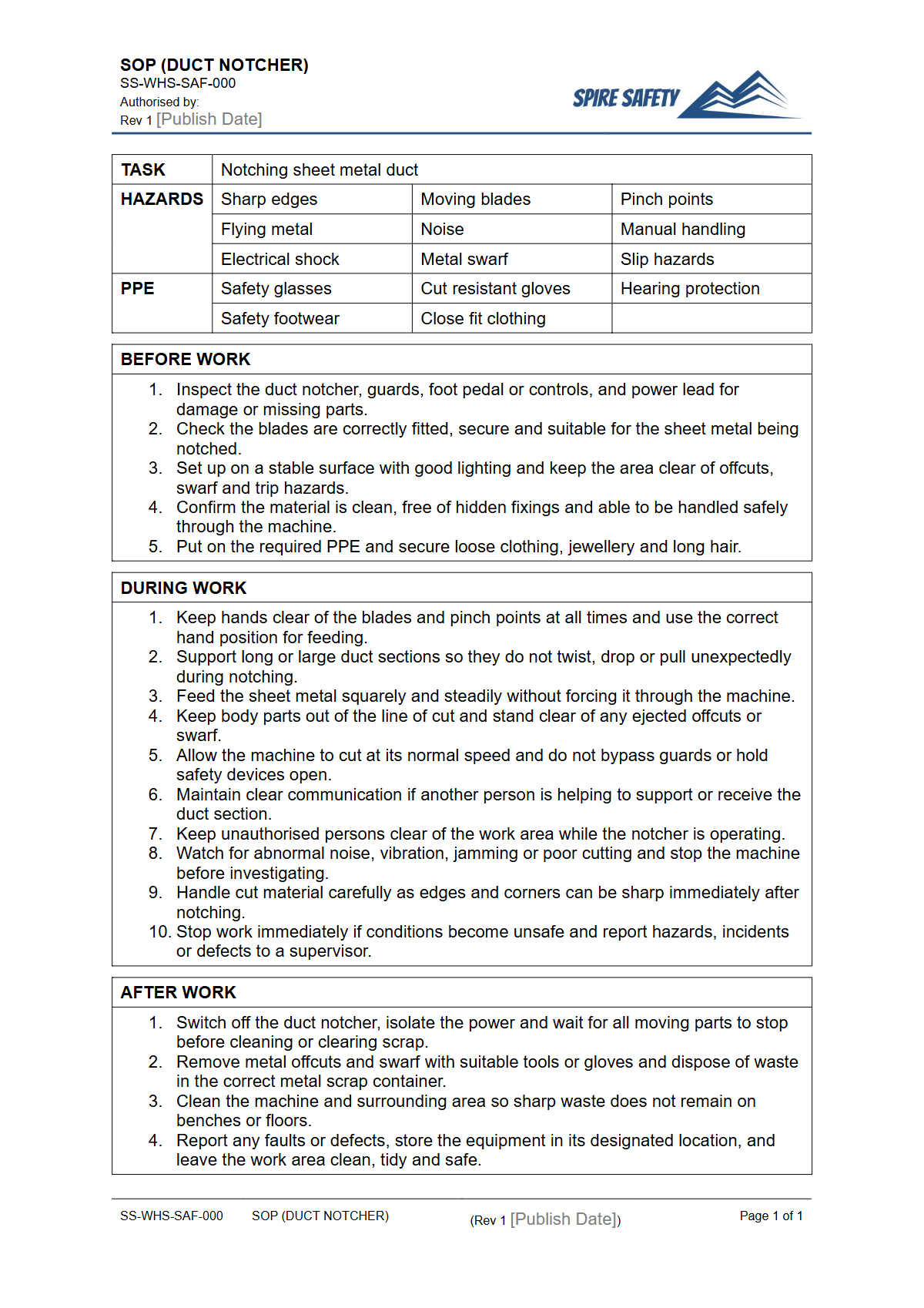
This Free Safe Operating Procedure (Duct Notcher) Template provides a structured starting point for documenting the safe use of duct notchers in sheet metal, roofing, and HVAC fabrication. A duct notcher is a powerful tool used to create precise cuts and notches in sheet metal, but it also presents significant hazards, including severe cuts, lacerations, and amputations from the sharp cutting blades and powerful pinch points.
An effective Safe Operating Procedure (SOP) is a critical administrative control that provides clear, step-by-step instructions for performing tasks safely, helping to minimise these risks.
By implementing and enforcing a detailed Safe Operating Procedure, your organisation can standardise safe work practices, assist in worker training, and demonstrate a commitment to meeting its duties under WHS legislation. This template is aligned with Australian WHS principles and is designed to be adapted to your specific operational context.
In larger fabrication environments, duct notchers may be used alongside other machinery documented in procedures like a FREE Conveyer System SOP to ensure end-to-end process safety.
Video walkthrough
How to use the Free Safe Operating Procedure (Duct Notcher) Template
Our template is provided in both DOCX and PDF formats to streamline the creation of your workplace-specific document. The DOCX file is fully editable, allowing you to incorporate details relevant to your equipment and processes.
Effective implementation involves more than just filling in the blanks; it requires a systematic approach.
Follow these steps for best results:
- Download and Review: Start by downloading the template and familiarising yourself with its structure, which includes sections for pre-operational checks, step-by-step procedures, and emergency responses.
- Consult with Workers: Engage directly with the operators who use the duct notchers daily. Their practical experience is invaluable for identifying real-world hazards and outlining workable, safe procedures. Consultation is a key part of managing WHS risks.
- Customise the Content: This is the most critical step. You must adapt the document to your specific needs. Add the make and model of your duct notcher, detail the types of materials being cut, specify the required Personal Protective Equipment (PPE) like cut-resistant gloves and safety glasses, and outline your site's unique emergency and shutdown procedures.
- Train and Induct: Once finalised, the SOP must be used to train all relevant workers. Ensure they understand every step and have demonstrated their competence before operating the equipment unsupervised.
- Review and Update: Safety documents should be living documents. Review the SOP annually, after any incident or near miss, or when changes occur to the equipment, process, or legislation.
It is crucial to remember that this is a template, not a finished document. We have provided a structured starting point, but you must customise the content to reflect the specific duct notcher models, materials, and unique environmental conditions of your workplace.
SOPs form a core part of robust WHS management systems that drive a proactive safety culture.
When to use this Safe Operating Procedure
A well-drafted Safe Operating Procedure for a duct notcher serves multiple functions within a safety management system. It should be used consistently in various scenarios to ensure its effectiveness.
Primarily, it is a tool for instruction and standardisation, ensuring every operator performs the task using the same verified safe method. It should be a central document during worker inductions and any task-specific training.
The SOP also serves as an on-the-job reference, and a copy should be kept in a visible and accessible location near the equipment. Furthermore, it becomes a critical reference document during incident investigations to understand if procedures were followed.
The SOP is also a key piece of evidence reviewed as part of regular WHS compliance auditing to verify that safe work practices are being implemented and followed correctly.
Who should use it
This template is designed for use by anyone with responsibility for workplace health and safety in industries where sheet metal is handled. This includes WHS Managers, Safety Officers, Workshop Supervisors, and Team Leaders in HVAC, plumbing, roofing, and general metal fabrication businesses.
It provides a professional, easy-to-use format that helps formalise undocumented processes and improve existing safety documentation.
Business owners and managers in small to medium-sized enterprises (SMEs) will also find it particularly useful as a tool for building a foundational safety system without starting from scratch. If you are responsible for creating similar procedures for other workshop equipment, you may also find value in resources like our FREE Circular Saw SOP Template.
Ultimately, while managers or safety personnel may draft the document, it is 'used' by the operators themselves. A good SOP is written in clear, simple language that is easily understood by the workers performing the task.
To control hazards associated with related workshop equipment like compressors, you might also need a Free Air Compressor SOP to ensure all machinery is managed safely.
By using this template as a guide, you can create a practical safety tool that helps protect your workers from harm. You can find this document and other helpful guides in our comprehensive free WHS resources library.
Common mistakes
Common mistakes to avoid
- Using a generic template without customising it for specific machine models and workplace conditions.
- Failing to train workers on the SOP's contents after it has been created or updated.
- Storing the SOP in an office, making it inaccessible to operators at the point of use.
- Forgetting to review and update the procedure after an incident or when new equipment is introduced.
Legal references
Legal considerations
The following legal requirements may be relevant to this type of work.
- Work Health and Safety Act (Harmonised) — Provides the primary duties for protecting workers and other people from work health and safety risks.
- Work Health and Safety Regulations (Harmonised) — Sets out requirements supporting the management of workplace hazards and risks.
The following codes may be relevant to this type of work.
- Managing WHS Risks Code of Practice — Provides practical guidance on identifying hazards, assessing risks and applying effective controls.
- Work Health and Safety Consultation, Cooperation and Coordination Code of Practice — Provides practical guidance on consulting workers and coordinating with other duty holders.
- Managing the Work Environment and Facilities Code of Practice — Provides practical guidance on safe work environments, workplace facilities and related controls.
Did you know
Administrative Control
Safe Operating Procedures (SOPs) are an 'administrative control' in the hierarchy of controls. While essential, they are less effective than higher-level controls like elimination or engineering, and should be used in combination with them.
Consultation is Key
Under model WHS laws, PCBUs have a duty to consult with workers on health and safety matters. Involving operators in drafting an SOP not only fulfils this duty but also makes the final document more practical and effective.
FAQ
Frequently asked questions
01What hazards are associated with using a duct notcher?
02Is a Safe Operating Procedure a legal requirement in Australia?
03How often should a duct notcher SOP be reviewed?
04Who should be involved in creating a duct notcher SOP?
Share this resource
Free Safe Operating Procedure (Duct Notcher) Template
Browse Categories
How To Use It
- 1Download and open in Word or PDF.
- 2Replace the placeholders with your business details.
- 3Get it reviewed by a WHS specialist before rollout.
Need it customised?
Our WHS consultants can adapt this template to your site, run a gap analysis, or audit what you already have in place.
Book a Free Consultation WHS consulting servicesor call 1300 156 382
Related templates
- Free Safe Operating Procedure (Dump Point Cleaning) Template
- Free Safe Operating Procedure (Dump Point Inspection) Template
- Free Safe Operating Procedure (Dust Collector) Template
- Free Safe Operating Procedure (Dust Extractor) Template
- Free Safe Operating Procedure (Dust Monitor) Template
- Free Safe Operating Procedure (Dye Penetrant Test) Template