
Free Safe Operating Procedure (Duct Crimper) Template
Streamline your workshop safety with our free Safe Operating Procedure (Duct Crimper) Template. Download our customisable DOCX and PDF to start today.
Free Safe Operating Procedure (Duct Crimper) Template
DOCX • 126 KB + PDF
Updated Oct 2026
No signup required
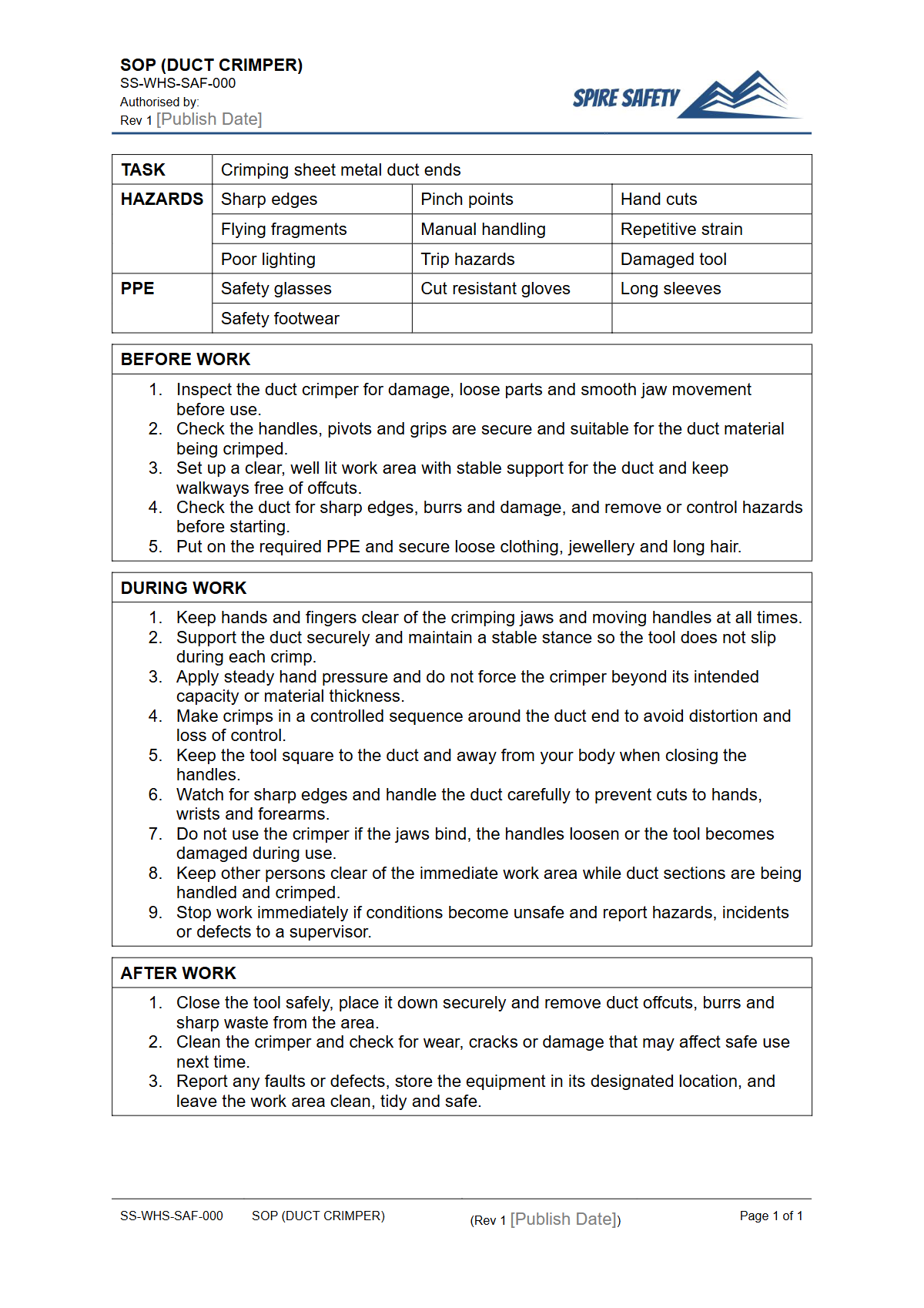
Purpose of the Free Safe Operating Procedure (Duct Crimper) Template
A duct crimper is a fundamental hand tool in HVAC, roofing, and sheet metal fabrication, used to create crimped ends on round metal ducts for easy connection. While seemingly simple, its use presents risks such as severe pinch-point injuries, cuts from sharp metal, and repetitive strain.
This Free Safe Operating Procedure (Duct Crimper) Template provides a structured framework for documenting the required safety controls and work steps to manage these hazards effectively.
Using a formal SOP helps standardise operator training, ensures consistent application of safety measures, and demonstrates a commitment to proactive risk management. It serves as a vital component within broader WHS management systems, helping your organisation meet its duty of care to provide a safe working environment.
Video walkthrough
How to use the Free Safe Operating Procedure (Duct Crimper) Template
This resource is available as a customisable DOCX file and a ready-to-use PDF. The DOCX version is designed for you to adapt to your specific operational context.
It is crucial to review and modify the content to align with the exact models of duct crimpers used in your workplace, the materials being worked on, and the unique environmental factors present.
Important: This document is a template, not a finished safety procedure. We provide this as a starting point based on established Australian WHS practice.
To be effective, you must customise it by conducting your own risk assessment and incorporating your specific site controls, emergency procedures, and PPE requirements. Spire Safety is not liable for any incident arising from the use of this template.
For workshops with multiple powered tools, you can use this document alongside others, such as our Free Air Compressor SOP, to build a comprehensive library of procedural documents.
When to use a Duct Crimper SOP
A Safe Operating Procedure for a duct crimper should be a core part of your safety documentation. It should be used:
- As the basis for training new workers before they are authorised to use the tool.
- During routine refresher training to reinforce safe work habits.
- As a reference tool for workers to consult before starting a task.
- During incident investigations to understand if procedural gaps contributed to the event.
- As a key document reviewed during WHS compliance auditing to verify that processes are documented and controlled.
Who should use it
This template is designed for use by a range of personnel responsible for workplace safety and operational management. This includes:
- WHS Managers and Safety Officers: To develop and implement standardised safety procedures across the organisation.
- Supervisors and Team Leaders: To train their teams and enforce safe work practices on the workshop floor or job site.
- Small Business Owners: For those in trades like HVAC or plumbing who manage their own safety processes and need a reliable starting point for documentation.
By creating clear, task-specific procedures for all equipment, including simpler hand tools, you establish a culture of safety. The principles used here can be adapted to create other documents, such as an SOP for a circular saw or other common workshop plant.
Key Elements of a Duct Crimper SOP
A comprehensive SOP for a duct crimper should cover several key areas to ensure all risks are addressed. The template guides you through documenting:
- Required Personal Protective Equipment (PPE): Specifying the need for cut-resistant gloves and safety glasses as a minimum.
- Pre-Operational Checks: A checklist to ensure the tool's jaws, handles, and pivot points are free from damage, dirt, or defects before each use.
- Step-by-Step Operating Guide: Instructions on how to correctly position the tool on the duct, apply steady and controlled pressure, and maintain a safe hand position away from the jaws.
- Post-Operational Care: Procedures for cleaning the tool, inspecting it for wear, and storing it correctly to prevent damage or unauthorised use.
- Emergency Response: Clear instructions on how to respond to an injury, such as a deep cut or pinch, including first aid measures and reporting requirements.
If you need assistance integrating this SOP into your existing safety framework or developing more complex procedures, consider engaging professional WHS consulting services. You can also explore our extensive free WHS resources library for more templates and guides.
Common mistakes
Common mistakes to avoid
- Using the wrong size crimper for the duct gauge, leading to poor connections or tool damage.
- Placing fingers too close to the jaws during operation, risking serious pinch injuries.
- Failing to wear appropriate cut-resistant gloves and safety glasses.
- Neglecting to inspect the tool for wear, damage, or loose components before use.
Legal references
Legal considerations
The following legal requirements may be relevant to this type of work.
- Work Health and Safety Act (Harmonised) — Provides the primary duties for protecting workers and other people from work health and safety risks.
- Work Health and Safety Regulations (Harmonised) — Sets out requirements supporting the management of workplace hazards and risks.
The following codes may be relevant to this type of work.
- Managing WHS Risks Code of Practice — Provides practical guidance on identifying hazards, assessing risks and applying effective controls.
- Work Health and Safety Consultation, Cooperation and Coordination Code of Practice — Provides practical guidance on consulting workers and coordinating with other duty holders.
- Managing the Work Environment and Facilities Code of Practice — Provides practical guidance on safe work environments, workplace facilities and related controls.
Did you know
Ergonomic Advantage
Modern duct crimpers often feature compound leverage mechanisms that can reduce the required hand force by up to 50%, significantly lowering the risk of musculoskeletal disorders.
The 5-Blade Standard
Most manual duct crimpers use a five-blade design. This configuration produces a uniform, factory-quality crimp on round metal pipes, ensuring a secure and leak-resistant connection.
FAQ
Frequently asked questions
01What are the main risks associated with using a duct crimper?
02Is formal training required to use a manual duct crimper?
03Can I use this template for a pneumatic duct crimper?
04How often should a Safe Operating Procedure be reviewed?
Share this resource
Free Safe Operating Procedure (Duct Crimper) Template
Browse Categories
How To Use It
- 1Download and open in Word or PDF.
- 2Replace the placeholders with your business details.
- 3Get it reviewed by a WHS specialist before rollout.
Need it customised?
Our WHS consultants can adapt this template to your site, run a gap analysis, or audit what you already have in place.
Book a Free Consultation WHS consulting servicesor call 1300 156 382
Related templates
- Free Safe Operating Procedure (Duct Cutter) Template
- Free Safe Operating Procedure (Duct Grille Cleaning) Template
- Free Safe Operating Procedure (Duct Lifter) Template
- Free Safe Operating Procedure (Duct Notcher) Template
- Free Safe Operating Procedure (Dump Point Cleaning) Template
- Free Safe Operating Procedure (Dump Point Inspection) Template