
Free Safe Operating Procedure (Duct Access Cleaning) Template
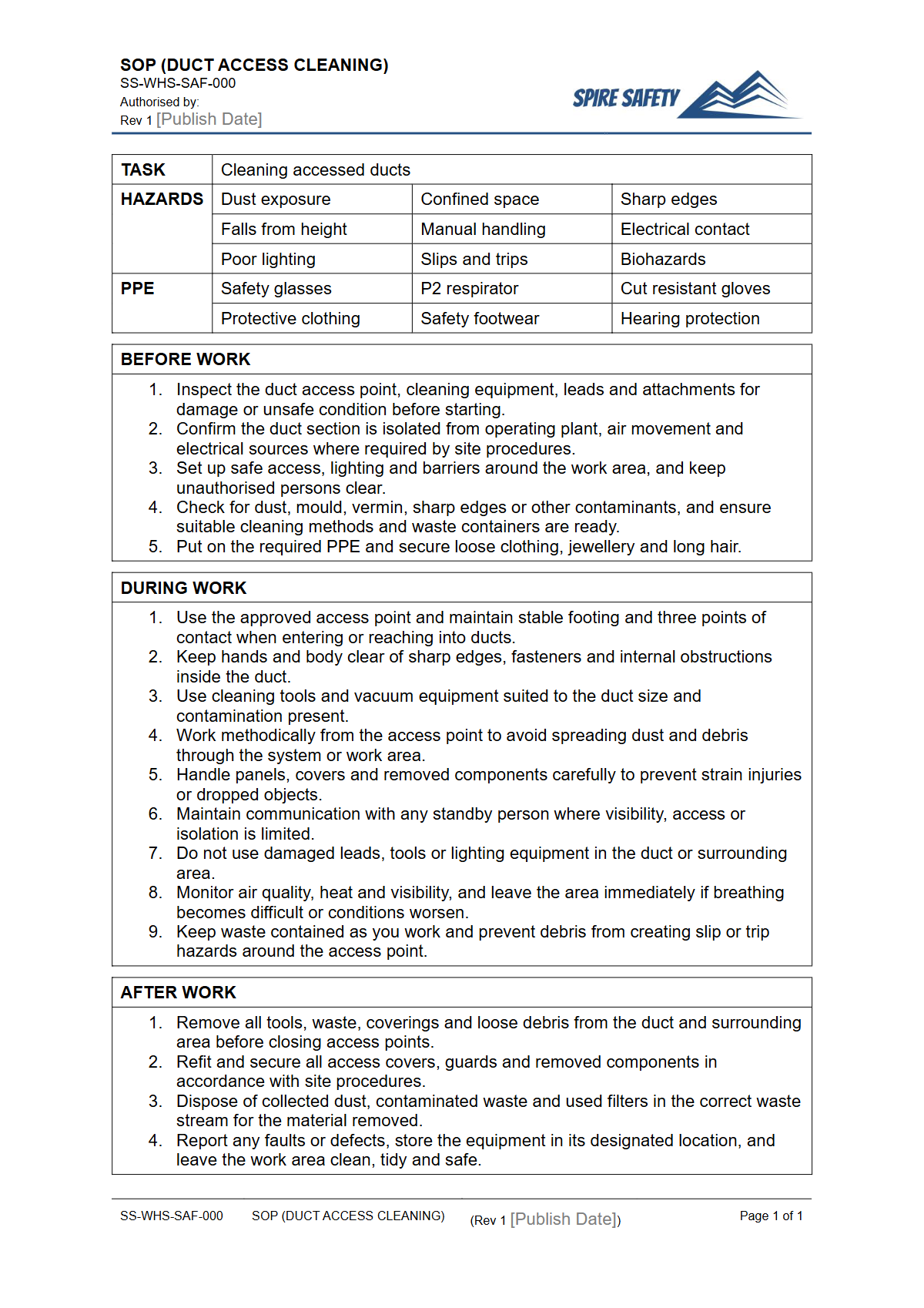
Formalise safety protocols for duct access cleaning with our customisable template. Download this free Safe Operating Procedure to standardise your processes.
Free Safe Operating Procedure (Duct Access Cleaning) Template
DOCX • 126 KB + PDF
Updated Oct 2026
No signup required
Purpose of the Free Safe Operating Procedure (Duct Access Cleaning) Template
This Free Safe Operating Procedure (Duct Access Cleaning) Template provides a structured framework for businesses to document the required steps for safely accessing and cleaning ventilation ducts. Duct cleaning is a critical task for maintaining indoor air quality, ensuring system efficiency, and mitigating fire hazards, but it introduces risks such as working at heights, exposure to biological contaminants, and interaction with energised systems.
Using this SOP helps a Person Conducting a Business or Undertaking (PCBU) establish and communicate a consistent, safe method for the task. It outlines key safety controls, personal protective equipment (PPE) requirements, and emergency procedures, forming a vital component of your broader WHS management systems.
Video walkthrough
How to use the Free Safe Operating Procedure (Duct Access Cleaning) Template
To effectively use this Free Safe Operating Procedure (Duct Access Cleaning) Template, you must adapt it to the specific context of your workplace. Download the DOCX file and systematically work through each section, adding details relevant to your site, equipment, and personnel.
This includes specifying the exact types of ducts, the cleaning agents used, and the tools required. Conduct a site-specific risk assessment and ensure the controls listed in the SOP are adequate to manage the identified hazards.
It is critical to note that this document is a template, not a finished procedure. We have provided a foundation based on Australian WHS principles, but you must complete it with your operational details.
Involve your workers in the customisation process to ensure the procedure is practical and reflects how the work is actually done. Once finalised, use the SOP as a basis for training and competency assessments for all relevant personnel.
For example, if cleaning involves powered tools, ensure you have a corresponding Free Air Compressor SOP available for operators.
When to use this Safe Operating Procedure
This Safe Operating Procedure should be used whenever workers are required to perform cleaning and maintenance work inside or via access points to ventilation, exhaust, or air conditioning ductwork. It is applicable for scheduled preventative maintenance, reactive cleaning following a contamination event, or as part of post-construction commissioning.
The SOP should be reviewed and referenced before every job, especially for non-routine tasks or in unfamiliar environments. It is also particularly useful in commercial kitchens where regular cleaning of grease-laden exhaust systems is required, a task related to those covered in our Free Safe Operating Procedure for deep fryer use.
Who should use this Duct Access Cleaning SOP
This SOP should be used by all individuals involved in the duct cleaning process. This includes:
- Workers and Technicians: As a step-by-step guide to perform their tasks safely and consistently.
- Supervisors and Team Leaders: To induct new workers, conduct pre-start briefings, and monitor adherence to safety protocols. Supervisors can also use this document as a baseline during internal checks, which are a key component of formal WHS compliance auditing.
- WHS Managers and Advisors: As a tool for risk management, training development, and incident investigation.
In facilities with multiple operational hazards, this SOP must be integrated with other safety documents. For example, in an industrial plant, it's vital to coordinate with procedures for nearby equipment, such as a FREE Conveyer System SOP, to prevent simultaneous conflicting work. For more templates and safety documents, browse our complete free WHS resources library.
Common mistakes
Common mistakes to avoid
- Failing to customise the template with site-specific details, rendering it ineffective.
- Neglecting to implement a robust Lockout/Tagout (LOTO) procedure for the HVAC system before starting work.
- Specifying inadequate or incorrect Personal Protective Equipment (PPE) for dust, mould, or chemical exposure.
- Poor communication with building occupants about when cleaning will occur, leading to unexpected system shutdowns or exposure.
Legal references
Legal considerations
The following legal requirements may be relevant to this type of work.
- Work Health and Safety Act (Harmonised) — Provides the primary duties for protecting workers and other people from work health and safety risks.
- Work Health and Safety Regulations (Harmonised) — Sets out requirements supporting the management of workplace hazards and risks.
The following codes may be relevant to this type of work.
- Managing WHS Risks Code of Practice — Provides practical guidance on identifying hazards, assessing risks and applying effective controls.
- Work Health and Safety Consultation, Cooperation and Coordination Code of Practice — Provides practical guidance on consulting workers and coordinating with other duty holders.
- Managing the Work Environment and Facilities Code of Practice — Provides practical guidance on safe work environments, workplace facilities and related controls.
Did you know
Air Quality and Productivity
Studies have shown that poor indoor air quality, often caused by dirty ventilation ducts, can reduce office worker productivity by up to 10%.
Kitchen Fire Risk
In commercial kitchens, grease buildup in exhaust ducts is a leading cause of fires. Regular, documented cleaning according to a formal SOP is a critical fire prevention measure.
FAQ
Frequently asked questions
01What should be included in a Duct Access Cleaning SOP?
02Is a Safe Operating Procedure a legal requirement for duct cleaning in Australia?
03How often should a duct cleaning SOP be reviewed?
04Can this template be used for residential and commercial duct cleaning?
Share this resource
Free Safe Operating Procedure (Duct Access Cleaning) Template
Browse Categories
How To Use It
- 1Download and open in Word or PDF.
- 2Replace the placeholders with your business details.
- 3Get it reviewed by a WHS specialist before rollout.
Need it customised?
Our WHS consultants can adapt this template to your site, run a gap analysis, or audit what you already have in place.
Book a Free Consultation WHS consulting servicesor call 1300 156 382
Related templates
- Free Safe Operating Procedure (Duct Crimper) Template
- Free Safe Operating Procedure (Duct Cutter) Template
- Free Safe Operating Procedure (Duct Grille Cleaning) Template
- Free Safe Operating Procedure (Duct Lifter) Template
- Free Safe Operating Procedure (Duct Notcher) Template
- Free Safe Operating Procedure (Dump Point Cleaning) Template