
Free Safe Operating Procedure (Drywall Lift) Template
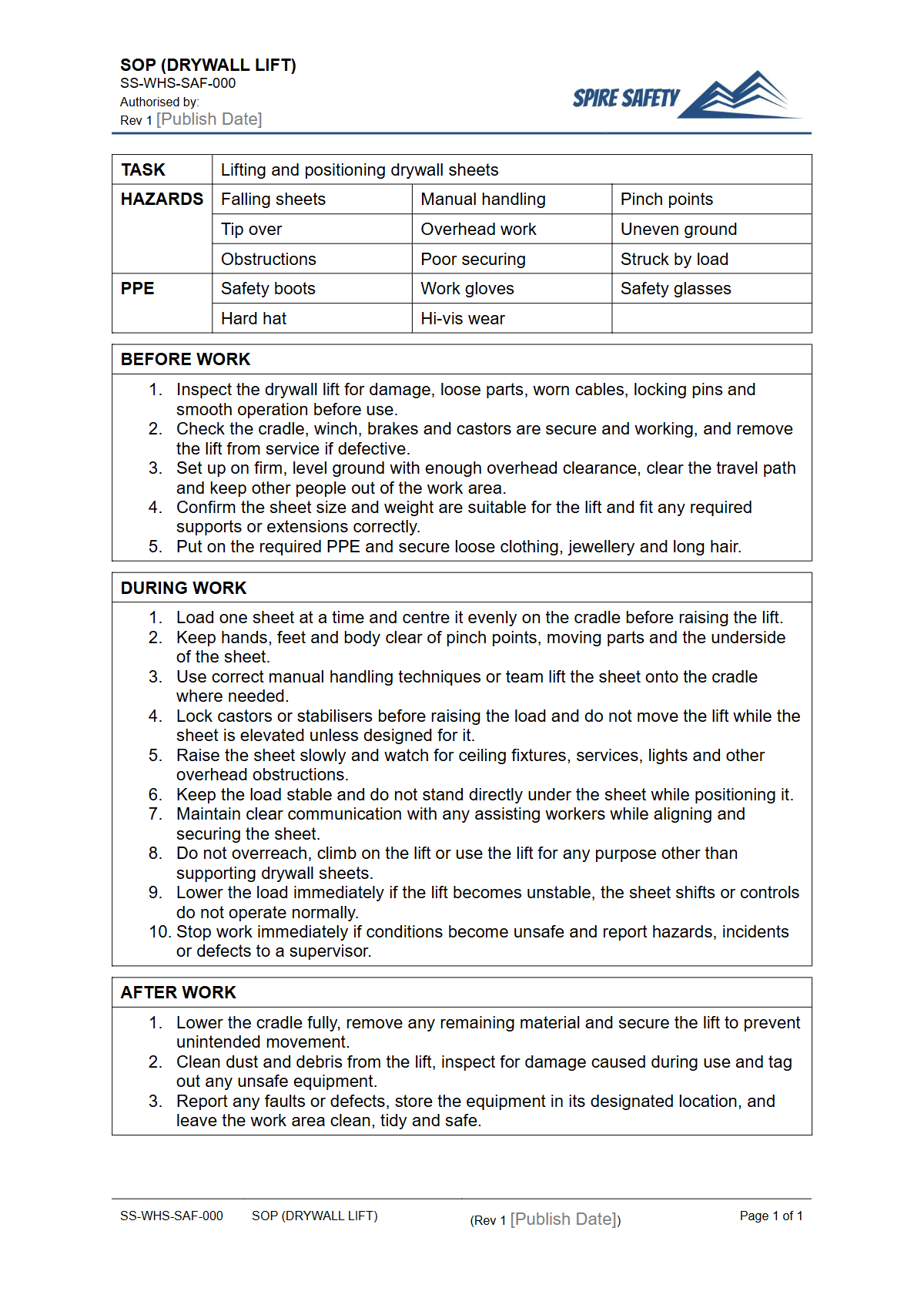
Download our free Safe Operating Procedure for drywall lifts. This template provides a structured format for outlining key safety steps. Get your DOCX now.
Free Safe Operating Procedure (Drywall Lift) Template
DOCX • 126 KB + PDF
Updated Oct 2026
No signup required
Purpose of the Free Safe Operating Procedure (Drywall Lift) Template
A Safe Operating Procedure (SOP) is a fundamental administrative control used to manage health and safety risks in the workplace. The purpose of this Free Safe Operating Procedure (Drywall Lift) Template is to provide a clear, step-by-step guide for operators to follow, ensuring the equipment is used in a safe and consistent manner.
It formalises pre-start checks, operational steps, and shutdown procedures, which helps to prevent incidents, reduce equipment damage, and standardise training. By documenting the correct usage, you create a reliable reference for workers and a key piece of evidence demonstrating your commitment to providing a safe system of work.
For other lifting equipment, you might find our FREE Telehandler SOP Template a useful reference.
Video walkthrough
How to use the Free Safe Operating Procedure (Drywall Lift) Template
Using this template effectively involves more than just filling in the blanks. First, download the DOCX or PDF file.
Then, consult directly with the workers who will be using the drywall lift. Their hands-on experience is invaluable for identifying practical challenges and effective controls.
You must adapt the document to reflect the specific make and model of your drywall lift, the site conditions (e.g., ground surface, overhead obstructions), and your organisation's unique procedures. This process is a vital part of your due diligence and can be verified through processes like regular WHS compliance auditing.
Important Customisation Note
Please be aware that this document is a template, not a completed Safe Operating Procedure. We have provided a structured starting point aligned with Australian WHS practice, but you must customise it with your specific equipment details, risk controls, and operational context to ensure it is suitable and effective for your workplace.
Final approval should come from a competent person within your organisation, such as a Site Manager or WHS Advisor.
When to Use a Safe Operating Procedure
An SOP for a drywall lift should be in place before any worker is permitted to operate the equipment. It is a critical tool for several key activities:
- Training and Induction: Use the SOP as the foundation for training new operators and verifying their competency.
- Refresher Training: Revisit the SOP during regular safety meetings or refresher courses to reinforce safe work habits.
- On-the-Job Reference: Workers should have easy access to the SOP as a quick reference guide during their tasks.
- Incident Investigation: If an incident occurs, the SOP can be reviewed to determine if procedures were followed or if they need to be updated.
- Risk Assessment Support: The SOP works alongside risk assessments and Safe Work Method Statements (SWMS), providing the detailed 'how-to' for the controls identified. It complements other task-specific documents, such as a circular saw SOP, used during the same phase of construction.
Who Should Use This Template
This template is designed for use by several key personnel within a business, particularly in the construction, fit-out, and maintenance industries. Key users include:
- WHS Managers and Advisors: To develop and implement standardised safety documentation as part of the overall safety management system.
- Site Managers and Supervisors: To ensure their teams have clear, practical instructions for operating equipment safely and to assist in supervision.
- Team Leaders and Forepersons: To conduct pre-start meetings and toolbox talks, using the SOP as a guide.
- Operators: The end-users of the SOP, who must understand and follow the procedures to ensure their own safety and the safety of others. When developing the SOP, consulting with operators who also use equipment like air compressors can provide useful insights, which can be captured in documents like our Air Compressor SOP.
Ultimately, this Safe Operating Procedure serves as a cornerstone for building robust and comprehensive WHS management systems. It bridges the gap between identifying a hazard and implementing a practical, repeatable control measure. For more tools to support your safety framework, explore our complete free WHS resources library.
Common mistakes
Common mistakes to avoid
- Failing to customise the template for the specific lift model and site conditions.
- Neglecting pre-operational checks, such as inspecting cables, welds, casters, and locking mechanisms.
- Overloading the lift beyond its specified weight capacity, increasing the risk of collapse or failure.
- Using the lift on uneven, sloping, or unstable ground, which creates a serious tipping hazard.
Legal references
Legal considerations
The following legal requirements may be relevant to this type of work.
- Work Health and Safety Act (Harmonised) — Provides the primary duties for protecting workers and other people from work health and safety risks.
- Work Health and Safety Regulations (Harmonised) — Sets out requirements supporting the management of workplace hazards and risks.
The following codes may be relevant to this type of work.
- Managing WHS Risks Code of Practice — Provides practical guidance on identifying hazards, assessing risks and applying effective controls.
- Work Health and Safety Consultation, Cooperation and Coordination Code of Practice — Provides practical guidance on consulting workers and coordinating with other duty holders.
- Managing the Work Environment and Facilities Code of Practice — Provides practical guidance on safe work environments, workplace facilities and related controls.
Did you know
Strain and Sprain Risk
Musculoskeletal injuries from handling large plasterboard sheets are a leading risk in the construction industry. A drywall lift can significantly reduce manual handling risks when used correctly as part of a safe system of work.
Not Just for Ceilings
While primarily used for ceilings, many modern drywall lifts are also designed to safely position and hold plasterboard on high or angled walls, further reducing awkward postures and manual strain.
FAQ
Frequently asked questions
01What is the difference between an SOP and a SWMS for a drywall lift?
02Do I need a licence to operate a drywall lift in Australia?
03How often should a Safe Operating Procedure for a drywall lift be reviewed?
04Can I use this template for any brand of drywall lift?
Share this resource
Free Safe Operating Procedure (Drywall Lift) Template
Browse Categories
How To Use It
- 1Download and open in Word or PDF.
- 2Replace the placeholders with your business details.
- 3Get it reviewed by a WHS specialist before rollout.
Need it customised?
Our WHS consultants can adapt this template to your site, run a gap analysis, or audit what you already have in place.
Book a Free Consultation WHS consulting servicesor call 1300 156 382
Related templates
- Free Safe Operating Procedure (Duct Access Cleaning) Template
- Free Safe Operating Procedure (Duct Crimper) Template
- Free Safe Operating Procedure (Duct Cutter) Template
- Free Safe Operating Procedure (Duct Grille Cleaning) Template
- Free Safe Operating Procedure (Duct Lifter) Template
- Free Safe Operating Procedure (Duct Notcher) Template