
Free Safe Operating Procedure (Dry Ice Handling) Template
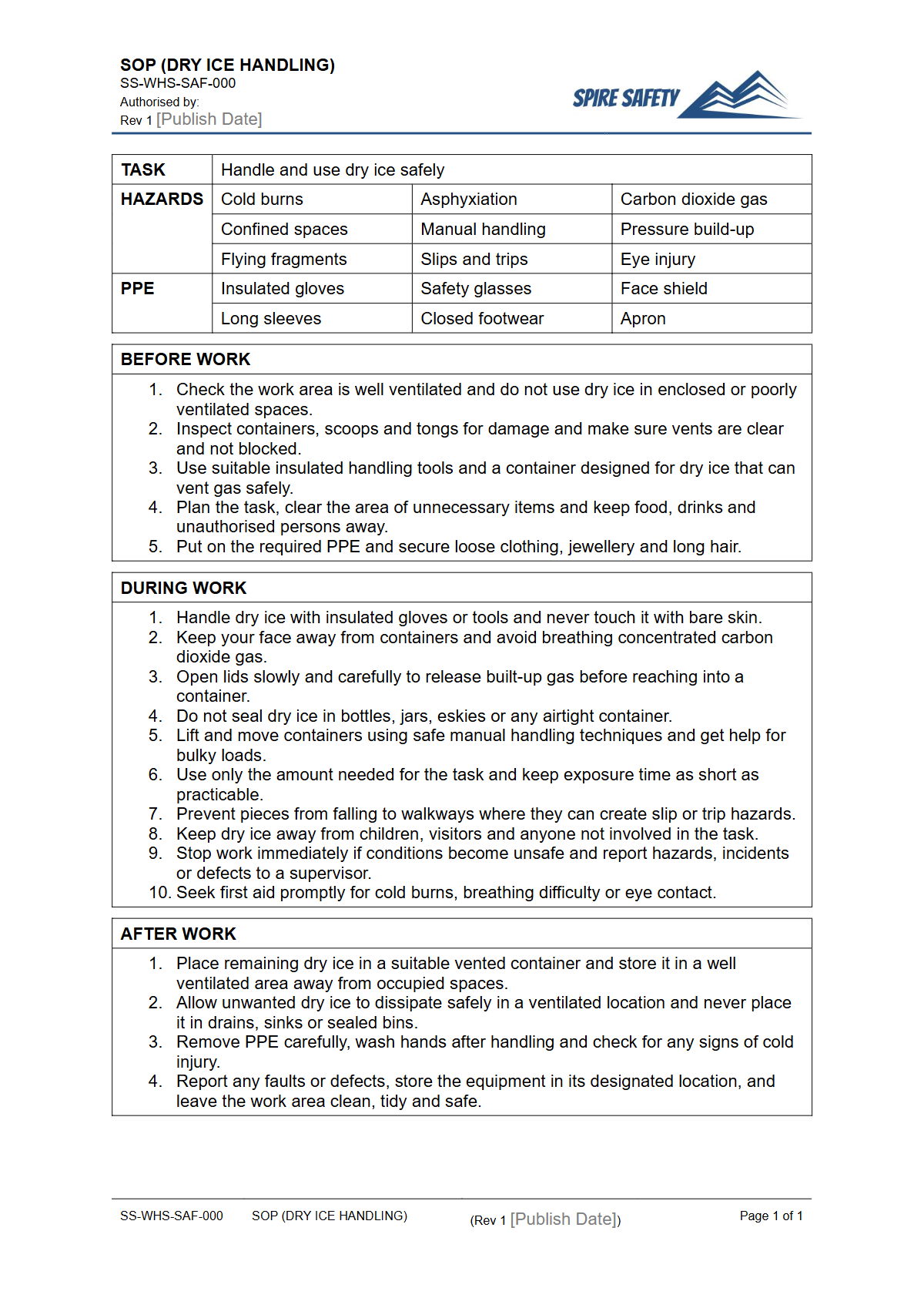
Download our free Safe Operating Procedure (SOP) for dry ice handling.
Free Safe Operating Procedure (Dry Ice Handling) Template
DOCX • 126 KB + PDF
Updated Oct 2026
No signup required
Purpose of the Free Safe Operating Procedure (Dry Ice Handling) Template
Dry ice, the solid form of carbon dioxide (CO₂), is a versatile substance used across many industries, from shipping and hospitality to medical and research applications. Despite its common use, it presents significant health and safety risks if not handled correctly.
This Free Safe Operating Procedure (Dry Ice Handling) Template provides a structured framework to help your organisation document and implement safe work practices.
The primary purpose of this SOP is to control the specific hazards associated with dry ice, including:
- Asphyxiation: As dry ice sublimates (turns from a solid directly into a gas), it releases large volumes of CO₂. In poorly ventilated areas, this gas can displace oxygen, creating a hazardous atmosphere that can lead to confusion, loss of consciousness, and death.
- Cold Burns (Frostbite): Dry ice has a surface temperature of -78.5°C. Brief contact with bare skin can cause severe cell damage, similar to a thermal burn.
- Explosion Hazard: When dry ice sublimates in a sealed, airtight container, the build-up of CO₂ gas can cause immense pressure, leading to a violent rupture or explosion.
Using a formal SOP helps ensure all workers understand these risks and follow standardised, safe methods for handling, storage, and disposal. It forms a critical component of your overall WHS management system, demonstrating a commitment to proactive risk management.
Video walkthrough
How to use the Free Safe Operating Procedure (Dry Ice Handling) Template
This template is provided in both DOCX and PDF formats for your convenience. The DOCX file is fully editable, allowing you to tailor the content to the unique circumstances of your workplace. We recommend a systematic approach to customisation:
First, review the template sections, which cover pre-operational checks, operational steps, emergency procedures, and disposal. Next, walk through the actual process of using dry ice in your facility.
Identify the specific containers, tools, ventilation systems, and personal protective equipment (PPE) available. Update the SOP to reflect these site-specific details.
Just as you would specify the model and safety features in an air compressor SOP, you must detail the exact context for handling dry ice at your site.
IMPORTANT: This document is a template and must be customised to your workplace. It provides a starting point aligned with Australian WHS principles but does not supports your compliance efforts on its own.
You must adapt the content to reflect the specific hazards, equipment, and control measures relevant to your operations. We are not liable for any incidents arising from the use of this unmodified template.
When to use it
A Safe Operating Procedure for dry ice should be developed and implemented before the substance is first brought into the workplace. It should be used consistently during any task involving dry ice, including receiving deliveries, transferring it between containers, using it in processes (e.g., for cooling or blast cleaning), and disposing of spent material.
This SOP serves as a primary training document for new employees and a crucial reference for experienced workers to ensure procedures are not forgotten.
This procedure should be stored in a location easily accessible to all relevant personnel. Consider it one of many essential documents in your safety system, which might include procedures for various tasks and equipment.
You can explore more examples in our free WHS resources library to build a comprehensive set of safety documentation.
Who should use it
This Safe Operating Procedure should be used by several groups within an organisation:
- Workers: Any employee or contractor who directly handles or works in the vicinity of dry ice must be trained on and follow the procedures outlined in the SOP.
- Supervisors and Managers: Team leaders are responsible for ensuring workers are trained, competent, and consistently adhering to the SOP. They also use it to conduct safety observations and provide feedback.
- WHS Personnel: Health and Safety Advisors or Managers will typically lead the development, review, and updates of the SOP. They may also create procedures for other high-risk tasks, like developing a plasma cutter SOP for a fabrication workshop.
Key Control Measures for Dry Ice
A robust SOP is built on the hierarchy of control. For dry ice, key controls include:
- Engineering Controls: The most effective control is ensuring adequate ventilation. This can be achieved through mechanical ventilation systems (e.g., exhaust fans) or by working in open, outdoor areas where gas cannot accumulate. Using CO₂ gas monitors with alarms in storage areas is another critical engineering control.
- Administrative Controls: This SOP is a primary administrative control. Others include clear warning signage on storage containers and at the entrance to storage areas, limiting the duration of exposure for workers, and providing comprehensive training. Documenting procedures for all types of workplace equipment, even for simple items as detailed in our FREE Step Ladder SOP Template, helps build a strong safety culture.
- Personal Protective Equipment (PPE): PPE is the last line of defence. Mandatory PPE for handling dry ice includes thermal or cryogenic gloves to prevent cold burns, safety glasses (or a face shield for splash risks), and non-absorbent, long-sleeved clothing.
Auditing and Reviewing Your SOP
An SOP is not a 'set and forget' document. To remain effective, it must be reviewed regularly—typically annually, or whenever there is a change in process, equipment, or after an incident or near-miss.
Regular reviews ensure the procedure remains relevant and effective. An external perspective from WHS compliance auditing can be invaluable for identifying any gaps between your documented procedure and what actually happens in practice.
If your organisation handles numerous hazardous substances or complex processes, implementing these systems can be challenging. For expert guidance in developing and embedding robust safety procedures, consider engaging with professional WHS consulting services.
Common mistakes
Common mistakes to avoid
- Storing dry ice in a sealed esky, fridge, freezer, or other airtight container.
- Handling dry ice with bare hands, leading to severe cold burns.
- Using or storing dry ice in unventilated rooms, walk-in coolers, or vehicles.
- Disposing of dry ice down a sink or toilet, which can damage plumbing due to the extreme cold and gas pressure.
Legal references
Legal considerations
The following legal requirements may be relevant to this type of work.
- Work Health and Safety Act (Harmonised) — Provides the primary duties for protecting workers and other people from work health and safety risks.
- Work Health and Safety Regulations (Harmonised) — Sets out requirements supporting the management of workplace hazards and risks.
The following codes may be relevant to this type of work.
- Managing WHS Risks Code of Practice — Provides practical guidance on identifying hazards, assessing risks and applying effective controls.
- Work Health and Safety Consultation, Cooperation and Coordination Code of Practice — Provides practical guidance on consulting workers and coordinating with other duty holders.
- Managing the Work Environment and Facilities Code of Practice — Provides practical guidance on safe work environments, workplace facilities and related controls.
Did you know
Extreme Cold
Dry ice has a surface temperature of approximately -78.5° Celsius. Direct contact with skin can cause severe frostbite within seconds.
Solid to Gas
Unlike regular water ice, dry ice does not melt into a liquid. It undergoes a process called sublimation, turning directly from a solid into carbon dioxide gas.
FAQ
Frequently asked questions
01What are the main hazards of handling dry ice?
02What PPE is required for handling dry ice?
03Can you transport dry ice in a car or van?
04Why can't you store dry ice in an airtight container?
Share this resource
Free Safe Operating Procedure (Dry Ice Handling) Template
Browse Categories
How To Use It
- 1Download and open in Word or PDF.
- 2Replace the placeholders with your business details.
- 3Get it reviewed by a WHS specialist before rollout.
Need it customised?
Our WHS consultants can adapt this template to your site, run a gap analysis, or audit what you already have in place.
Book a Free Consultation WHS consulting servicesor call 1300 156 382
Related templates
- Free Safe Operating Procedure (Dryer Lint Cleaning) Template
- Free Safe Operating Procedure (Drywall Lift) Template
- Free Safe Operating Procedure (Duct Access Cleaning) Template
- Free Safe Operating Procedure (Duct Crimper) Template
- Free Safe Operating Procedure (Duct Cutter) Template
- Free Safe Operating Procedure (Duct Grille Cleaning) Template