
Free Position Description (Truck Driver - Multi-Combination) Template
Download our Free Position Description for Multi-Combination (MC) Truck Drivers.
Free Position Description (Truck Driver - Multi-Combination) Template
DOCX • 136 KB + PDF
Updated Oct 2026
No signup required
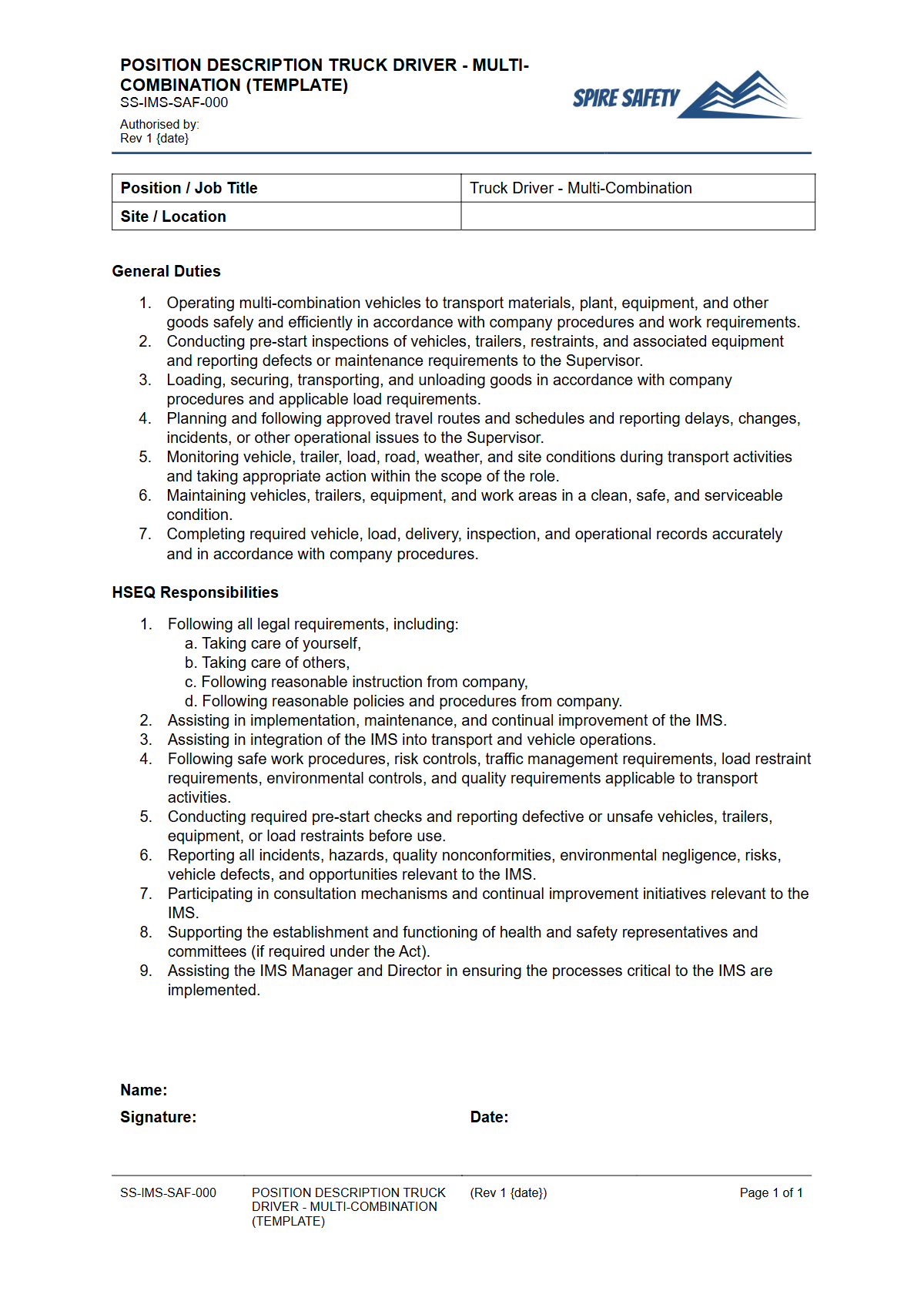
Purpose of the Free Position Description (Truck Driver - Multi-Combination) Template
Defining the role of a Multi-Combination (MC) Truck Driver is critical for safety, compliance, and operational efficiency in the transport and logistics sector. A well-drafted Position Description (PD) sets clear expectations from day one.
This Free Position Description (Truck Driver - Multi-Combination) Template provides a structured foundation for outlining the key responsibilities, qualifications, and safety obligations associated with the role. Using a formal PD helps integrate safety duties into the core functions of the job, ensuring drivers understand their part in maintaining a safe work environment for themselves and others on the road.
A clear PD is a fundamental component of effective WHS management systems, as it formally assigns safety responsibilities to specific roles within the organisation. It serves as a reference point for recruitment, induction, performance management, and training, helping to ensure that only competent and aware individuals operate your heavy vehicles.
How to use the Free Position Description (Truck Driver - Multi-Combination) Template
This template is provided in both DOCX and PDF formats for your convenience. The DOCX file is fully editable, allowing you to tailor the content to your specific operational needs and legal obligations. To use it effectively, follow these steps:
- Download the DOCX file.
- Review each section, including Key Responsibilities, Qualifications & Experience, and WHS Duties.
- Modify the content to accurately reflect the specific vehicle types, freight, routes, and company policies at your workplace.
- Incorporate details about your specific fatigue management, load restraint, and pre-start inspection procedures.
- Ensure the role's reporting lines and key internal/external relationships are correctly identified.
- Have the final document reviewed and approved by management before implementation.
IMPORTANT: This is a template only. We have designed it to be a strong starting point based on Australian WHS principles, but you must customise it to reflect the specific tasks, equipment, risks, and control measures relevant to your workplace and state/territory regulations.
For specific procedural guidance, you might develop documents like a FREE Body Truck SOP (Safe Operating Procedure) Template to complement the PD.
When to use it
A formal Position Description for an MC Truck Driver should be used throughout the employment lifecycle. It is most valuable during the recruitment and onboarding process to attract suitable candidates and set clear performance benchmarks.
It also serves as a critical tool for conducting performance reviews, identifying training needs, and clarifying duties to avoid misunderstandings. In the unfortunate event of a workplace incident, a comprehensive PD can help in investigations by demonstrating what was expected of the worker. The responsibilities outlined, such as daily checks, align with practical tools like a Free Pre-Start Checklist (Dump Truck) Template.
Who should use it
This template is designed for use by a range of personnel within a transport, logistics, construction, or mining organisation. Primary users include:
- Human Resources (HR) Managers: For creating consistent and compliant job advertisements and employment contracts.
- Transport or Fleet Managers: To ensure operational requirements and safety standards are accurately captured in the role.
- WHS/HSE Advisors and Managers: To formalise the safety responsibilities and duties of drivers.
- Business Owners and Directors: To establish clear lines of accountability and meet due diligence obligations under WHS law.
For businesses needing expert assistance in adapting this template or developing a suite of safety documentation, our WHS consulting services can provide tailored support.
Integrating with Other WHS Documents
A Position Description works best as part of a broader safety framework. The responsibilities listed in this PD should align with the practical steps outlined in your company's procedures and risk assessments.
For example, the duty to 'operate the vehicle in accordance with the safe work method statement' directly links the PD to task-specific documents like a Safe Work Method Statement (Tip Truck or Trailer Operation) Template. This creates a cohesive system where role expectations are connected to safe work practices on the ground. You can find more templates to build out your safety system in our free WHS resources library.
Common mistakes
Common mistakes to avoid
- Using the template without customising it to the specific trucks, freight, and routes.
- Being too generic about WHS duties, such as load restraint and fatigue management.
- Failing to review and update the Position Description when roles, equipment, or regulations change.
- Ignoring Chain of Responsibility (CoR) duties that apply to schedulers, loaders, and managers.
Legal references
Legal considerations
The following legal requirements may be relevant to this type of work.
- Work Health and Safety Act (Harmonised) — Provides the primary duties for protecting workers and other people from work health and safety risks.
- Work Health and Safety Regulations (Harmonised) — Sets out requirements supporting the management of workplace hazards and risks.
The following codes may be relevant to this type of work.
- Managing WHS Risks Code of Practice — Provides practical guidance on identifying hazards, assessing risks and applying effective controls.
- Work Health and Safety Consultation, Cooperation and Coordination Code of Practice — Provides practical guidance on consulting workers and coordinating with other duty holders.
- Managing the Work Environment and Facilities Code of Practice — Provides practical guidance on safe work environments, workplace facilities and related controls.
Did you know
Chain of Responsibility
Under the Heavy Vehicle National Law (HVNL), everyone in the supply chain, not just the driver, has a legal duty to ensure safety. This is known as the Chain of Responsibility (CoR).
Heavy Vehicle Fatalities
Crashes involving heavy trucks make up a significant portion of road fatalities in Australia, highlighting the critical importance of driver competency, vehicle maintenance, and safe work practices.
FAQ
Frequently asked questions
01What is a Multi-Combination (MC) vehicle licence?
02Does this Position Description template cover fatigue management?
03Is this Position Description suitable for all states in Australia?
04What other WHS documents are needed for a truck driver?
Share this resource
Free Position Description (Truck Driver - Multi-Combination) Template
Browse Categories
How To Use It
- 1Download and open in Word or PDF.
- 2Replace the placeholders with your business details.
- 3Get it reviewed by a WHS specialist before rollout.
Need it customised?
Our WHS consultants can adapt this template to your site, run a gap analysis, or audit what you already have in place.
Book a Free Consultation WHS consulting servicesor call 1300 156 382
Related templates
- Free Position Description (Warehouse Manager) Template
- Free Position Description (Welder or Fabricator) Template
- Free Position Description (WHS Adviser or Officer) Template
- Free Position Description (WHS Coordinator) Template
- Free Position Description (Work Health and Safety Manager) Template
- Free Position Description Template