
Free Position Description (Tiler) Template
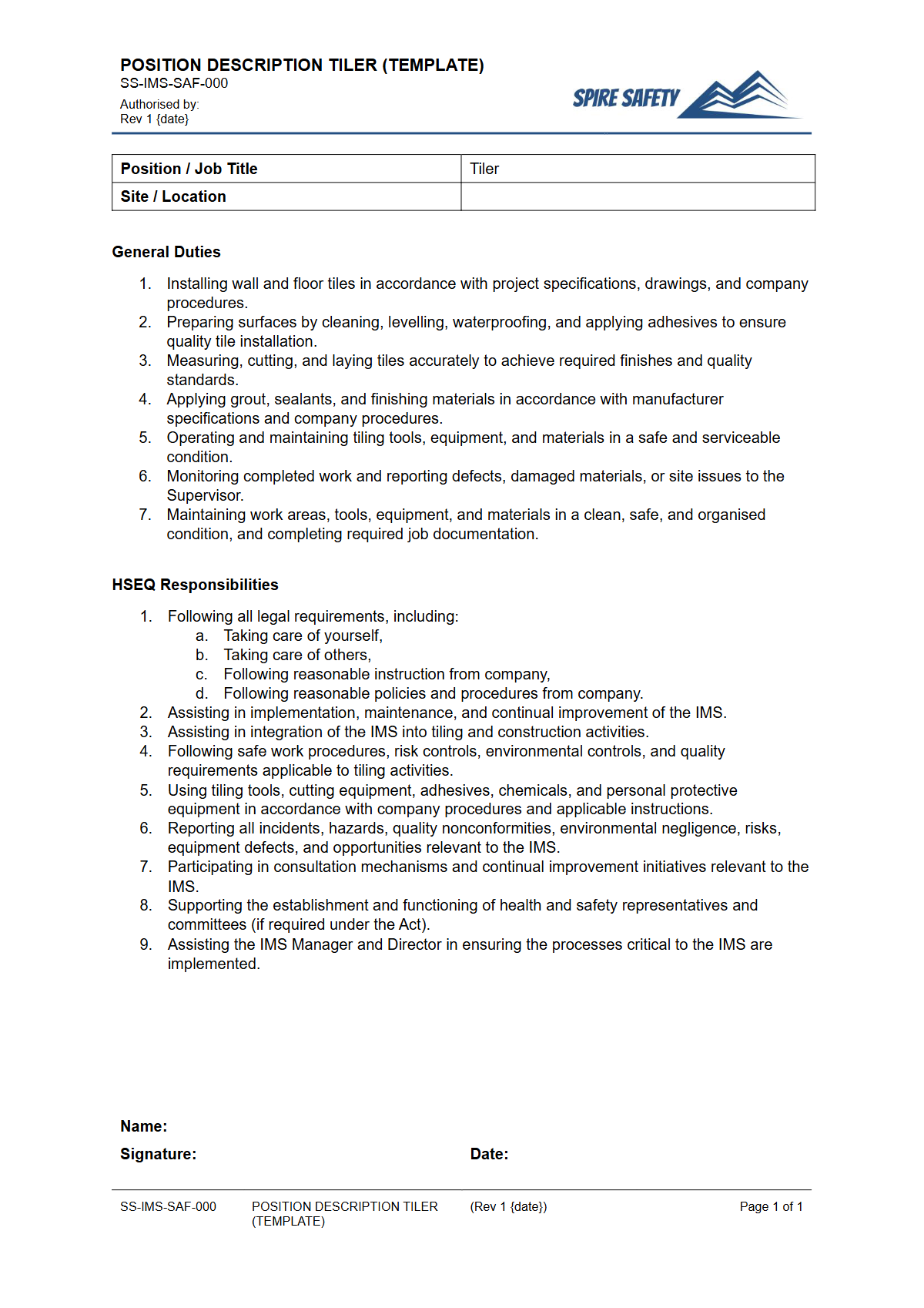
Download our free Position Description (Tiler) template. A structured DOCX and PDF resource to help you clearly define roles, responsibilities, and WHS duties.
Free Position Description (Tiler) Template
DOCX • 135 KB + PDF
Updated Oct 2026
No signup required
Purpose of the Free Position Description (Tiler) Template
A well-drafted position description is a foundational tool for managing your workforce and meeting your Work Health and Safety (WHS) obligations. This free Position Description (Tiler) template provides a structured starting point for defining the key duties, responsibilities, qualifications, and safety expectations for tilers in your organisation.
Using a clear PD helps formalise accountabilities, ensuring that both the worker and management understand the scope of the role, including critical WHS requirements related to manual tasks, hazardous substances, and dust control.
Clarifying these elements from the outset simplifies recruitment, induction, and performance management. It also serves as important documentation within your overall safety framework, demonstrating that you have defined and communicated safety-critical roles.
A comprehensive position description is a key component of effective WHS management systems, helping to embed safety into your organisational culture.
How to use the Free Position Description (Tiler) Template
This resource is available as a DOCX file for easy editing and a PDF for straightforward printing and distribution. To get the most value, you must tailor it to the specific context of your business and the projects your tilers will be working on.
Consider the types of tiles used (e.g., ceramic, porcelain, stone), the specific equipment provided, and the environments they will work in (e.g., new residential, commercial fit-outs, renovations).
Important: This is a template, not a finished document. We cannot know your specific workplace hazards, state-based regulations, or operational procedures.
You must customise this document to reflect the actual risks and requirements of your business to ensure it is fit for purpose.
Key areas to customise:
- Key Responsibilities: Add or remove duties to match the role precisely. Include tasks like surface preparation, waterproofing, cutting tiles (noting methods like wet cutting to control dust), mixing adhesives, and grouting.
- WHS Duties: Specify responsibilities such as adhering to Safe Work Method Statements (SWMS), using personal protective equipment (PPE), participating in toolbox talks, and reporting hazards.
- Qualifications & Experience: List the required licences, certifications (e.g., Certificate III in Wall and Floor Tiling), and level of experience necessary for the role.
- Physical Requirements: Detail the physical demands of the job, such as lifting, kneeling, and repetitive motions, which are critical for managing manual task risks.
When to use it
A Position Description is a versatile document used throughout the employment lifecycle. It is essential when you are recruiting for a new tiler to attract suitable candidates and provide clarity on the role.
It should be provided to new hires as part of their induction and onboarding process to formally establish expectations from day one.
The document should also be referenced during performance reviews to provide a basis for discussion and feedback. Furthermore, it should be reviewed and updated periodically, especially when a role's duties change, new equipment is introduced, or following a safety incident.
This ensures it remains a relevant and accurate reflection of the position, a practice often verified during a thorough WHS compliance auditing program.
Who should use it
This template is designed for use by anyone involved in hiring and managing construction tradespeople. This includes:
- Business Owners and Directors: Particularly in small to medium-sized construction or tiling businesses who need to formalise their HR and WHS processes.
- Hiring Managers and HR Professionals: To ensure consistency and clarity in the recruitment process.
- Site Supervisors and Foremen: To understand the defined scope and limitations of the roles they supervise and to assist in performance management.
- WHS Advisors: To ensure that safety responsibilities are clearly allocated and integrated into core job functions.
For organisations that require specialised assistance in developing role-specific documentation that aligns with their broader safety strategy, engaging external expertise can be highly beneficial. Spire Safety's WHS consulting services can provide tailored support to ensure your documentation is robust and practical for your needs.
We also have a wide range of other templates available in our free WHS resources library to support your operations.
Common mistakes
Common mistakes to avoid
- Using a generic template without customising it for specific site hazards and materials.
- Focusing only on technical tasks and omitting crucial WHS responsibilities and accountabilities.
- Failing to list essential qualifications, licences, and competencies required for the role.
- Treating the position description as a one-time document instead of a living document that is reviewed regularly.
Legal references
Legal considerations
The following legal requirements may be relevant to this type of work.
- Work Health and Safety Act (Harmonised) — Provides the primary duties for protecting workers and other people from work health and safety risks.
- Work Health and Safety Regulations (Harmonised) — Sets out requirements supporting the management of workplace hazards and risks.
The following codes may be relevant to this type of work.
- Managing WHS Risks Code of Practice — Provides practical guidance on identifying hazards, assessing risks and applying effective controls.
- Work Health and Safety Consultation, Cooperation and Coordination Code of Practice — Provides practical guidance on consulting workers and coordinating with other duty holders.
- Managing the Work Environment and Facilities Code of Practice — Provides practical guidance on safe work environments, workplace facilities and related controls.
Did you know
The Silica Dust Hazard
Cutting, grinding, or drilling ceramic or stone tiles can generate respirable crystalline silica dust. Inhaling this dust can lead to serious and irreversible lung diseases like silicosis.
Manual Task Risks
Tilers are at high risk of musculoskeletal disorders due to frequent lifting of heavy tile boxes, prolonged kneeling, and repetitive arm movements. These injuries account for a significant portion of all serious claims in the construction industry.
FAQ
Frequently asked questions
01What key WHS responsibilities should be included in a tiler's position description?
02Is a position description a legal requirement in Australia?
03How does a Position Description differ from a Safe Work Method Statement (SWMS)?
04Can I use this template for an apprentice tiler?
Share this resource
Free Position Description (Tiler) Template
Browse Categories
How To Use It
- 1Download and open in Word or PDF.
- 2Replace the placeholders with your business details.
- 3Get it reviewed by a WHS specialist before rollout.
Need it customised?
Our WHS consultants can adapt this template to your site, run a gap analysis, or audit what you already have in place.
Book a Free Consultation WHS consulting servicesor call 1300 156 382
Related templates
- Free Position Description (Training and Development Officer) Template
- Free Position Description (Truck Driver - Heavy Rigid) Template
- Free Position Description (Truck Driver - Multi-Combination) Template
- Free Position Description (Warehouse Manager) Template
- Free Position Description (Welder or Fabricator) Template
- Free Position Description (WHS Adviser or Officer) Template