
Free Position Description (Training and Development Officer) Template
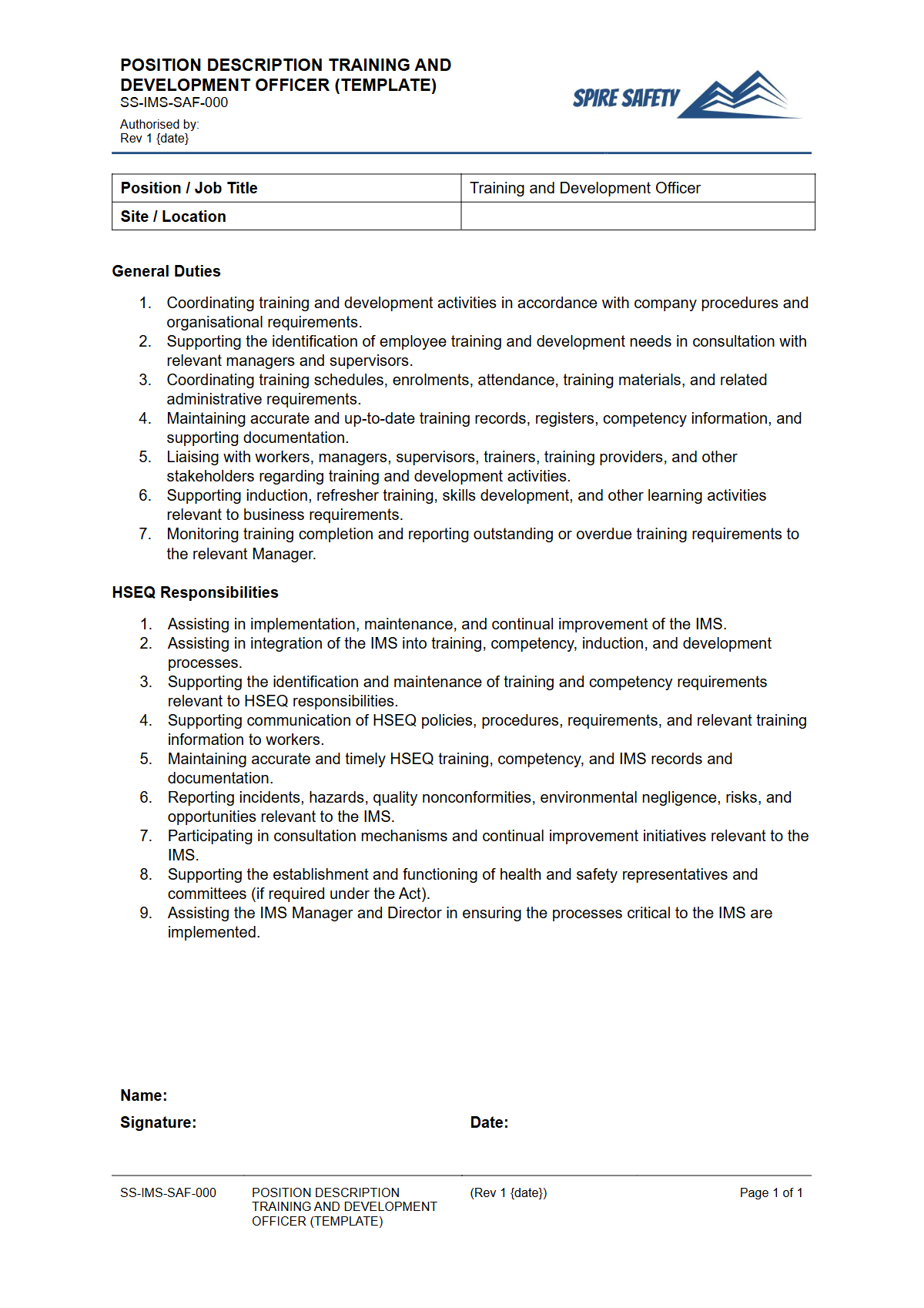
Define the key responsibilities and WHS duties of your Training and Development Officer with our structured position description.
Free Position Description (Training and Development Officer) Template
DOCX • 137 KB + PDF
Updated Oct 2026
No signup required
Purpose of the Free Position Description (Training and Development Officer) Template
Defining roles clearly is the foundation of a proactive safety culture and an efficient organisation. Our Free Position Description (Training and Development Officer) Template provides a structured starting point for outlining the responsibilities, qualifications, and performance expectations for this critical role.
A well-drafted position description ensures that your Training and Development Officer is empowered to identify training needs, develop effective programs, and maintain crucial competency records. This clarity helps align training initiatives with your organisation's strategic goals and safety objectives.
This role is pivotal in ensuring your workforce has the necessary skills and knowledge to perform their duties safely and effectively. The position description acts as a key tool not just for recruitment, but also for performance management, succession planning, and demonstrating due diligence.
It clarifies how the officer's duties contribute to the overall health of your WHS management systems by ensuring all personnel are competent and aware of their safety obligations.
How to use the Free Position Description (Training and Development Officer) Template
This template is designed for ease of use and customisation. Available in both DOCX and PDF formats, you can download the file and edit it to reflect the specific context of your business, industry, and operational risks.
It includes sections covering primary purpose, key responsibilities, reporting lines, qualifications, and WHS accountabilities. Replace the placeholder text with details relevant to your organisation, ensuring the language is clear and unambiguous.
Important: This is a template, not a finished document. We have drafted it to align with Australian WHS principles, but it is essential that you customise it.
You must adapt the content to suit your specific legal obligations, risk profile, organisational structure, and the unique hazards present in your workplace. A position description is only effective when it accurately reflects the real-world requirements of the role within your business.
When to use it
A formal Position Description for a Training and Development Officer should be used in several key business scenarios. The most common is during the recruitment process when advertising for a new hire or promoting an internal candidate.
It provides applicants with a clear understanding of the role's scope and expectations. It is also an invaluable tool for onboarding new employees into the position, forming the basis of their induction and initial performance goals.
Beyond recruitment, this document should be reviewed and updated regularly. Use it during annual performance reviews to measure achievements against stated responsibilities. It's also wise to review the position description when there is a significant change in business operations, technology, or legislation that impacts training requirements, which may be identified during routine WHS compliance auditing.
Who should use it
This resource is primarily intended for use by those responsible for human resources and work health and safety management. This includes:
- Human Resources (HR) Managers: For creating job advertisements, managing recruitment, and establishing performance management frameworks.
- WHS Managers and Safety Officers: To ensure that the role's WHS responsibilities are clearly defined and that training activities directly support the organisation's safety objectives.
- Operations Managers and Department Heads: To clarify how the Training and Development Officer will support their teams' competency and skill development needs.
- Business Owners and Directors of small to medium-sized enterprises (SMEs): For formalising roles and responsibilities as the organisation grows and its training needs become more complex.
The Training and Development Officer often plays a key role in implementing company-wide initiatives, such as programs focused on Mental Health First Aid in the workplace, making this PD a vital tool for various leaders across the business. If your organisation lacks internal expertise in structuring such roles, engaging external advisors through WHS consulting can provide valuable direction and ensure best practice. For more templates and guides, explore our complete free WHS resources library.
Common mistakes
Common mistakes to avoid
- Using the template without customising it to the specific workplace and industry.
- Failing to clearly link training responsibilities to the organisation's overall WHS and business objectives.
- Writing a simple task list instead of defining key responsibilities, outcomes, and accountabilities.
- Forgetting to consult with managers and team members who will interact with the role to ensure the PD is practical.
Legal references
Legal considerations
The following legal requirements may be relevant to this type of work.
- Work Health and Safety Act (Harmonised) — Provides the primary duties for protecting workers and other people from work health and safety risks.
- Work Health and Safety Regulations (Harmonised) — Sets out requirements supporting the management of workplace hazards and risks.
The following codes may be relevant to this type of work.
- Managing WHS Risks Code of Practice — Provides practical guidance on identifying hazards, assessing risks and applying effective controls.
- Work Health and Safety Consultation, Cooperation and Coordination Code of Practice — Provides practical guidance on consulting workers and coordinating with other duty holders.
- Managing the Work Environment and Facilities Code of Practice — Provides practical guidance on safe work environments, workplace facilities and related controls.
Did you know
Training as a Leading Indicator
Effective and consistent safety training is considered a 'leading indicator' of a positive safety culture. Organisations that invest in training often see a corresponding decrease in 'lagging indicators' like injury rates and incident reports.
The 70:20:10 Model
A popular learning and development model suggests that 70% of learning comes from on-the-job experience, 20% from social learning (mentoring, feedback), and only 10% from formal training. A good Training Officer designs programs that support all three areas.
FAQ
Frequently asked questions
01What is the difference between a Training Officer and a WHS Officer?
02Does this position description template cover all legal requirements?
03How often should a position description be reviewed?
04What qualifications should a Training and Development Officer have?
Share this resource
Free Position Description (Training and Development Officer) Template
Browse Categories
How To Use It
- 1Download and open in Word or PDF.
- 2Replace the placeholders with your business details.
- 3Get it reviewed by a WHS specialist before rollout.
Need it customised?
Our WHS consultants can adapt this template to your site, run a gap analysis, or audit what you already have in place.
Book a Free Consultation WHS consulting servicesor call 1300 156 382
Related templates
- Free Position Description (Truck Driver - Heavy Rigid) Template
- Free Position Description (Truck Driver - Multi-Combination) Template
- Free Position Description (Warehouse Manager) Template
- Free Position Description (Welder or Fabricator) Template
- Free Position Description (WHS Adviser or Officer) Template
- Free Position Description (WHS Coordinator) Template