
Free Position Description (Structural Engineer) Template
Download our free Position Description template for a Structural Engineer. Clearly define roles, WHS duties, and qualifications. Get your DOCX or PDF now.
Free Position Description (Structural Engineer) Template
DOCX • 135 KB + PDF
Updated Oct 2026
No signup required
Purpose of the Free Position Description (Structural Engineer) Template
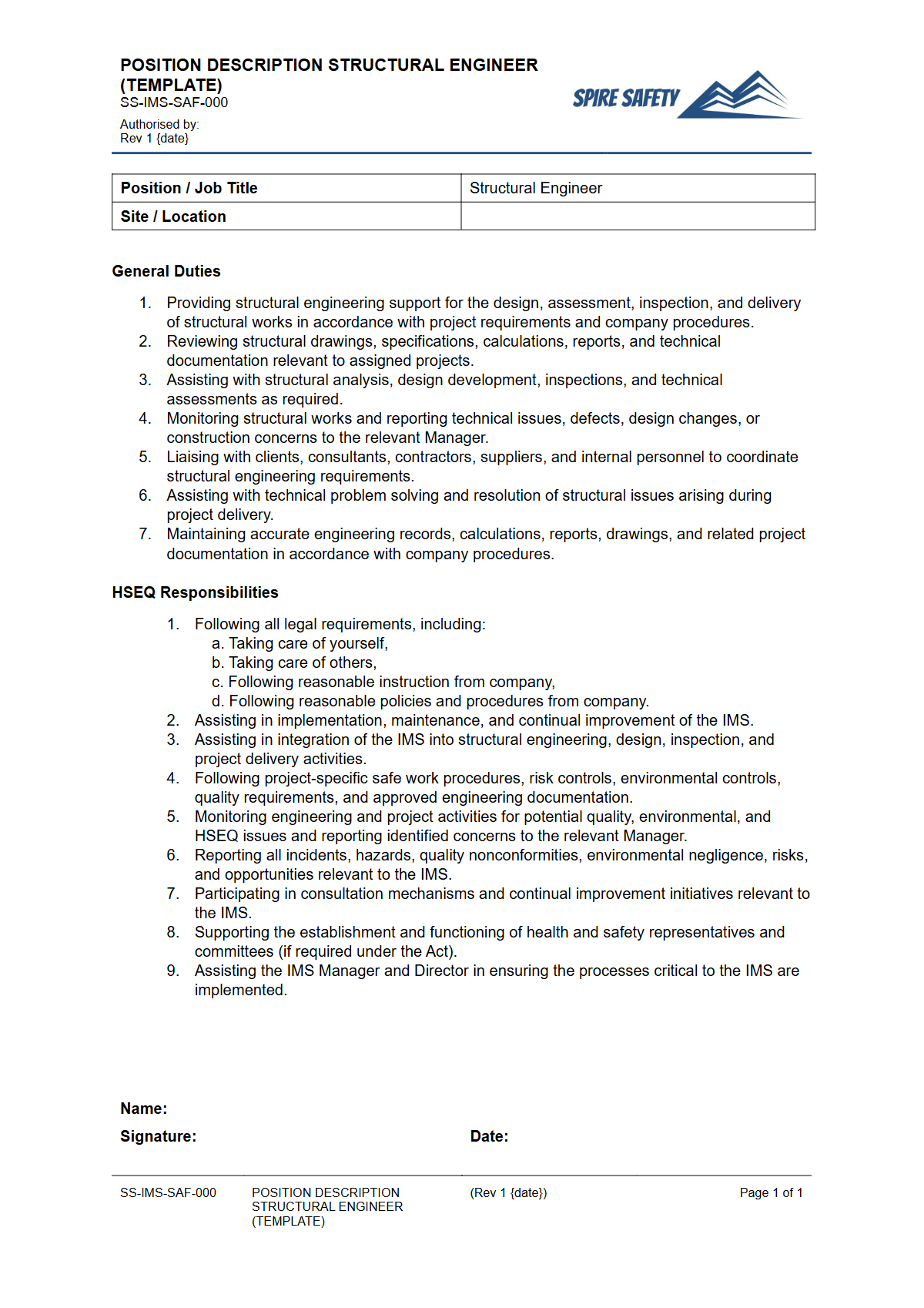
A well-drafted position description is the foundation for attracting, hiring, and managing qualified professionals. This free Position Description (Structural Engineer) template provides a structured starting point for Australian businesses in the construction, engineering, and design sectors.
It helps you clearly articulate the scope of the role, key responsibilities, required qualifications, and essential performance indicators. By defining these elements upfront, you can streamline your recruitment process, set clear expectations from day one, and ensure the candidate understands their critical role within your organisation's safety framework.
Defining roles and responsibilities is a cornerstone of effective safety management. This document helps integrate the structural engineer’s duties into your broader WHS management systems, ensuring that safety considerations, particularly the duties of a designer under WHS law, are formally recognised and assigned.
Key Components of the Position Description
Our template is organised into logical sections to ensure comprehensive coverage of the role. These include:
- Position Summary: A high-level overview of the role's purpose and its contribution to the organisation.
- Key Responsibilities: Detailed duties including structural analysis, design and documentation, project management, site inspections, and client liaison.
- WHS Responsibilities: A dedicated section outlining the engineer’s specific duties to ensure designs are safe and without risk, so far as is reasonably practicable, and to contribute to a positive safety culture. For expert help defining safety-critical roles, consider our WHS consulting services.
- Qualifications and Experience: Specifies necessary academic degrees, professional accreditations (like CPEng), software proficiency, and years of relevant experience.
- Key Performance Indicators (KPIs): Measurable goals to assess performance, such as design accuracy, project deadlines, and budget adherence.
How to use the Free Position Description (Structural Engineer) Template
This resource is available in both DOCX and PDF formats. We recommend downloading the DOCX version to easily edit and adapt the content to your specific business needs.
Review each section and modify the text to reflect your company's structure, culture, project types, and specific legislative requirements in your state or territory.
Important: This document is a template and is not a substitute for legal or professional advice. We have designed it to be a helpful starting point, but it must be customised to your specific workplace requirements, project needs, and organisational structure.
It is your responsibility to ensure the final document is fit for purpose and aligns with all applicable laws and standards. Engaging in regular WHS compliance auditing can help verify that your role definitions and safety procedures meet legal obligations.
When to use it
A formal position description for a structural engineer should be used in several key situations. The most common is during the recruitment and hiring process to attract suitable candidates and provide clarity during interviews.
It should also be used for onboarding new employees, forming the basis for their induction and training. Furthermore, it serves as an essential tool for performance reviews, helping to establish clear, measurable objectives.
Establishing clear roles and responsibilities is also a fundamental requirement for companies seeking certification against international standards, a process we can support with our ISO 45001 consulting services.
Who should use it
This template is designed for a range of personnel involved in recruitment, project management, and operational oversight within the built environment sector. This includes:
- HR Managers and Recruiters: To create accurate and appealing job advertisements.
- Hiring Managers and Team Leaders: To clearly define the role they are looking to fill and assess candidates against set criteria.
- Directors and Business Owners: To ensure governance and clarity across all roles within the organisation.
- Project Managers: To understand the specific accountabilities of the structural engineers on their team.
By using a standardised and thorough document, you can promote consistency and professionalism across your organisation. For more templates and checklists, feel free to browse our complete free WHS resources library.
Common mistakes
Common mistakes to avoid
- Using a generic template without customising it for specific project types (e.g., residential vs. high-rise vs. infrastructure).
- Failing to clearly articulate the specific WHS duties and responsibilities of a 'designer' under WHS legislation.
- Omitting key software proficiency requirements relevant to your organisation (e.g., AutoCAD, Revit, SPACE GASS, ETABS).
- Neglecting to specify state-based registration requirements, which are mandatory for professional engineers in several jurisdictions.
Legal references
Legal considerations
The following legal requirements may be relevant to this type of work.
- Work Health and Safety Act (Harmonised) — Provides the primary duties for protecting workers and other people from work health and safety risks.
- Work Health and Safety Regulations (Harmonised) — Sets out requirements supporting the management of workplace hazards and risks.
The following codes may be relevant to this type of work.
- Managing WHS Risks Code of Practice — Provides practical guidance on identifying hazards, assessing risks and applying effective controls.
- Work Health and Safety Consultation, Cooperation and Coordination Code of Practice — Provides practical guidance on consulting workers and coordinating with other duty holders.
- Managing the Work Environment and Facilities Code of Practice — Provides practical guidance on safe work environments, workplace facilities and related controls.
Did you know
Designer's Duty of Care
Under model WHS laws, designers like structural engineers have a specific duty to ensure, so far as is reasonably practicable, that the structures they design can be built, used, and maintained without risks to health and safety.
Chartered Status
In Australia, the 'Chartered Professional Engineer' (CPEng) designation from Engineers Australia is a key industry benchmark of competency, professionalism, and ethical conduct.
FAQ
Frequently asked questions
01What qualifications should a Structural Engineer in Australia have?
02Does this Position Description cover WHS responsibilities?
03Is a Position Description a legally binding document?
04How often should I review a Structural Engineer's Position Description?
Share this resource
Free Position Description (Structural Engineer) Template
Browse Categories
How To Use It
- 1Download and open in Word or PDF.
- 2Replace the placeholders with your business details.
- 3Get it reviewed by a WHS specialist before rollout.
Need it customised?
Our WHS consultants can adapt this template to your site, run a gap analysis, or audit what you already have in place.
Book a Free Consultation WHS consulting servicesor call 1300 156 382
Related templates
- Free Position Description (Tiler) Template
- Free Position Description (Training and Development Officer) Template
- Free Position Description (Truck Driver - Heavy Rigid) Template
- Free Position Description (Truck Driver - Multi-Combination) Template
- Free Position Description (Warehouse Manager) Template
- Free Position Description (Welder or Fabricator) Template