
Free Position Description (Scaffolder) Template
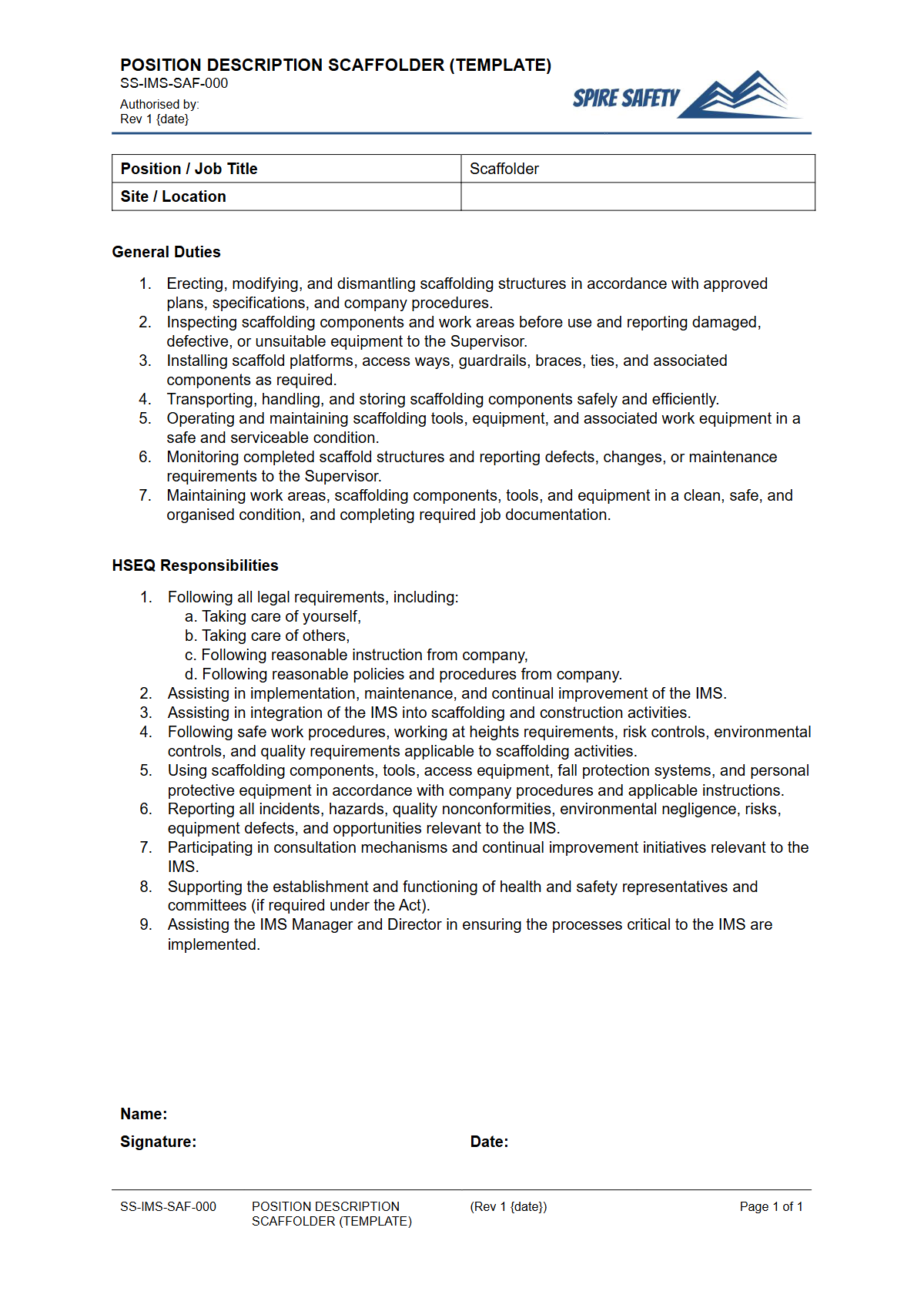
Download our free Position Description (Scaffolder) template.
Free Position Description (Scaffolder) Template
DOCX • 138 KB + PDF
Updated Oct 2026
No signup required
Purpose of the Free Position Description (Scaffolder) Template
A detailed Position Description is a critical tool for any organisation employing scaffolders. This Free Position Description (Scaffolder) Template provides a structured starting point for defining the role, responsibilities, skills, and qualifications necessary for safe and efficient scaffolding operations.
Using a clear PD helps set performance expectations, clarifies safety obligations, and ensures that candidates and employees fully understand the requirements of their position. It forms a foundational element of recruitment, onboarding, performance management, and competency verification.
Integrating well-defined roles into your safety framework is essential for building a strong safety culture. A comprehensive PD demonstrates a commitment to due diligence by ensuring that specific WHS duties are formally assigned and acknowledged.
This document is a key component within a robust WHS management system, helping to systematically manage risks associated with high-risk construction work.
Furthermore, clearly articulating roles and responsibilities is a core requirement for organisations seeking alignment with international standards. A thorough Position Description helps meet key clauses related to organisational roles, responsibilities, and authorities required for ISO 45001 certification.
How to use the Free Position Description (Scaffolder) Template
This template is designed for ease of use. Download the DOCX file to edit and tailor it to your specific operational needs, or use the PDF as a reference.
It is structured to cover key areas including the primary purpose of the role, key responsibilities, WHS duties, required skills, qualifications, and experience.
Important: This document is a template and must be customised to suit the specific requirements of your organisation, state or territory legislation, and the types of scaffolding work performed (e.g., modular, tube and coupler, suspended). We recommend a thorough review by a competent person within your business before implementation.
For assistance in adapting this template to your unique workplace needs, consider engaging expert WHS consulting services.
When to use it
A Position Description for a Scaffolder should be used at multiple stages of the employment lifecycle. It is essential during the recruitment and hiring process to attract suitable candidates and as a benchmark for interviews.
It should be provided to new employees during their induction and onboarding to formally outline their role and responsibilities from day one.
The document also serves as an important tool for ongoing performance management, providing a clear basis for reviews and discussions about professional development. It should be reviewed and updated whenever the role changes, new types of scaffolding are introduced, or in response to incidents or changes in legislation. It is also a key piece of evidence reviewed during internal and external WHS compliance audits.
Who should use it
This template is designed for a range of personnel responsible for workforce management and safety in the construction, industrial, and maintenance sectors. This includes:
- HR Managers and Recruitment Specialists: To create accurate job advertisements and guide the selection process.
- Project Managers and Site Supervisors: To manage daily work, allocate tasks, and ensure scaffolders on their team are competent and aware of their duties.
- WHS Managers and Advisors: To ensure that safety responsibilities are clearly defined and integrated into operational roles.
- Business Owners and Directors of SMEs: To establish formal employment structures and meet their due diligence obligations under WHS law.
By using a standardised template, organisations can ensure consistency in how roles are defined across different projects and sites. You can find more useful documents by exploring our complete free WHS resources library for other templates and guides.
Common mistakes
Common mistakes to avoid
- Using a generic PD that doesn't reflect the specific types of scaffolding used on site.
- Forgetting to list mandatory high-risk work licence and other critical competency requirements.
- Failing to clearly define WHS responsibilities, such as conducting pre-start checks or participating in risk assessments.
- Not reviewing and updating the Position Description when site conditions or job roles change.
Legal references
Legal considerations
The following legal requirements may be relevant to this type of work.
- Work Health and Safety Act (Harmonised) — Provides the primary duties for protecting workers and other people from work health and safety risks.
- Work Health and Safety Regulations (Harmonised) — Sets out requirements supporting the management of workplace hazards and risks.
The following codes may be relevant to this type of work.
- Managing WHS Risks Code of Practice — Provides practical guidance on identifying hazards, assessing risks and applying effective controls.
- Work Health and Safety Consultation, Cooperation and Coordination Code of Practice — Provides practical guidance on consulting workers and coordinating with other duty holders.
- Managing the Work Environment and Facilities Code of Practice — Provides practical guidance on safe work environments, workplace facilities and related controls.
Did you know
Competency is Key
Under model WHS laws, a "competent person" has acquired knowledge and skills through training, qualification, or experience. A well-drafted Position Description is the first step in verifying this competency before work begins.
FAQ
Frequently asked questions
01What key information should be in a Scaffolder Position Description?
02Is a high-risk work licence for scaffolding required in every Australian state?
03How does this Position Description template support WHS compliance?
04Can I use this template for both an employee and a subcontractor scaffolder?
Share this resource
Free Position Description (Scaffolder) Template
Browse Categories
How To Use It
- 1Download and open in Word or PDF.
- 2Replace the placeholders with your business details.
- 3Get it reviewed by a WHS specialist before rollout.
Need it customised?
Our WHS consultants can adapt this template to your site, run a gap analysis, or audit what you already have in place.
Book a Free Consultation WHS consulting servicesor call 1300 156 382
Related templates
- Free Position Description (Scheduler or Planner) Template
- Free Position Description (School Groundskeeper) Template
- Free Position Description (Security Officer) Template
- Free Position Description (Site Manager) Template
- Free Position Description (Site Supervisor) Template
- Free Position Description (Structural Engineer) Template