
Free Position Description (Return to Work Coordinator) Template
Define the critical role of your Return to Work Coordinator with our structured template.
Free Position Description (Return to Work Coordinator) Template
DOCX • 138 KB + PDF
Updated Oct 2026
No signup required
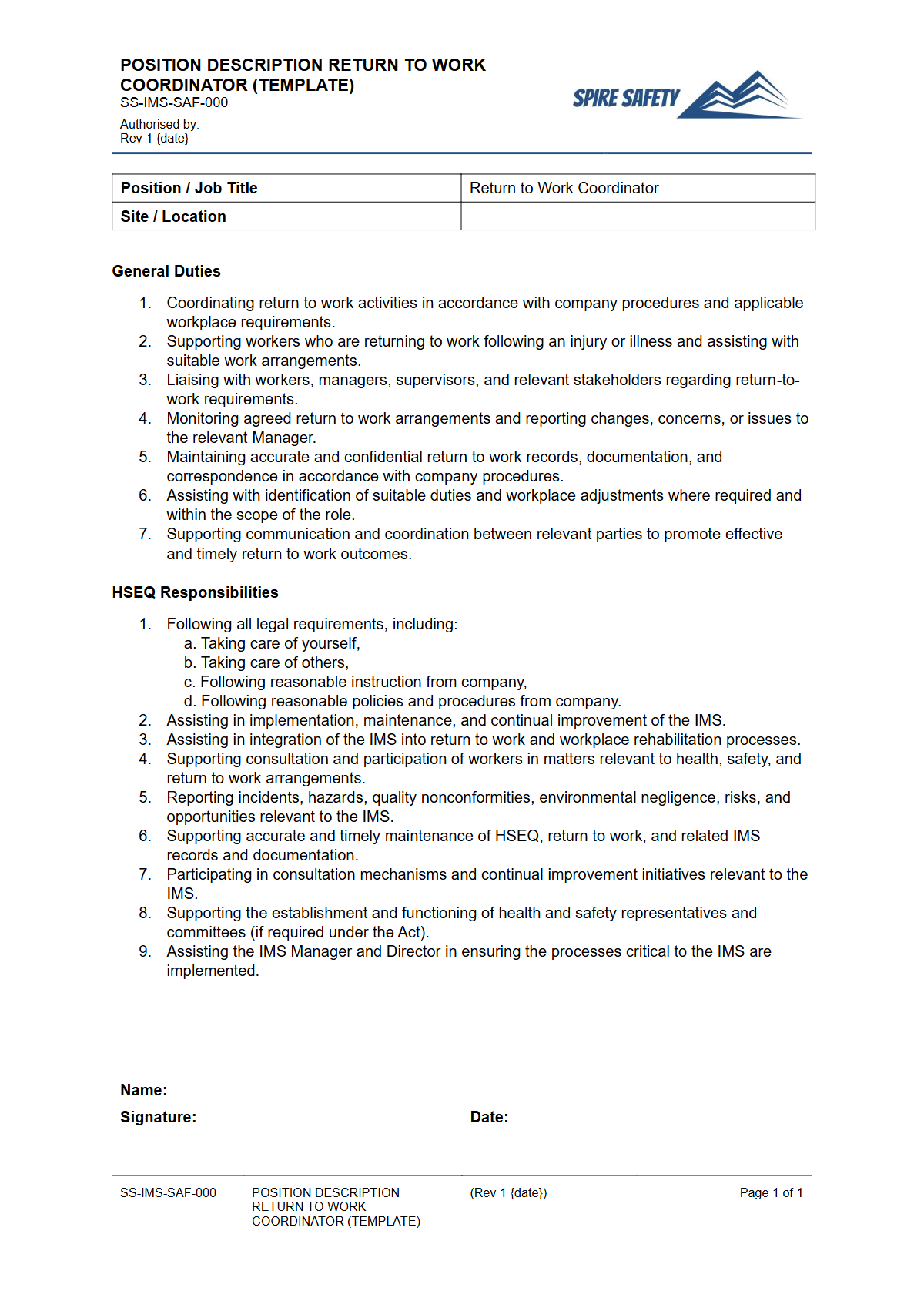
Purpose of the Free Position Description (Return to Work Coordinator) Template
A designated Return to Work (RTW) Coordinator is a pivotal role in managing workplace injuries and facilitating a safe, timely, and durable return to work for injured employees. This Free Position Description (Return to Work Coordinator) Template provides a structured foundation for defining the scope, responsibilities, and authority of this position within your organisation.
A clear and comprehensive position description ensures that the appointed individual understands their duties, reporting lines, and the expectations of the role. It clarifies their function in liaising between the injured worker, management, medical practitioners, and insurers.
Establishing this role formally is a key step in demonstrating your organisation's commitment to worker welfare and legislative duties. It helps integrate injury management and rehabilitation processes directly into your organisation's broader WHS management systems, moving from a reactive to a proactive approach.
Using a well-drafted PD ensures consistency, sets performance benchmarks, and provides a clear point of contact for all parties involved in the return-to-work journey. This clarity is essential for a process that is often complex and sensitive.
How to use the Free Position Description (Return to Work Coordinator) Template
This template is designed as a comprehensive starting point, aligned with Australian workplace health and safety practices. It outlines the typical duties, skills, and qualifications required for a Return to Work Coordinator.
To make it effective for your business, you must adapt it to your specific operational context, industry, and legal obligations in your state or territory. Pay close attention to sections covering key responsibilities, reporting structures, and essential criteria, and edit them to match your company’s unique needs and terminology.
Customisation is critical. You should review and insert details specific to your organisation, such as the direct manager for the role, any required internal software competencies, and specific Key Performance Indicators (KPIs).
For businesses needing expert guidance on integrating this role or refining their injury management procedures, engaging professional WHS consulting can provide valuable insight and support.
Please note: This is a template document. We strongly advise that you customise it to reflect the specific requirements, structure, and operational context of your organisation.
When to Use This Position Description
This position description should be used in several key situations. The most common application is during the recruitment and hiring process to attract and vet suitable candidates for a new or vacant Return to Work Coordinator role.
It provides applicants with a clear understanding of the job's demands and expectations from the outset. Internally, it can be used to formalise the responsibilities of an existing employee who is taking on these duties, ensuring there is no ambiguity about their function.
It is also a valuable tool for performance reviews, professional development planning, and succession planning within your WHS and HR teams.
Who Should Use This Resource
This template is designed for use by a range of personnel responsible for health, safety, and human resources management. This includes:
- Human Resources (HR) Managers: For recruiting, onboarding, and managing the performance of the RTW Coordinator.
- WHS/OHS Managers: To ensure the role is correctly defined and integrated within the overall safety framework and strategy.
- Small Business Owners: For organisations large enough to require a dedicated coordinator (as mandated by state or territory legislation), this template helps establish the role correctly from the start.
- Senior Management: To understand the scope and importance of the role and ensure it is adequately resourced and supported.
Having clearly defined roles and responsibilities is a foundational element that is often scrutinised during a WHS compliance auditing process, demonstrating a systematic approach to injury management. Properly defining the RTW Coordinator role also supports the principles of worker consultation and support central to frameworks like ISO 45001.
If your organisation is pursuing certification, leveraging expert ISO 45001 consulting can help align your processes with international best practice. For additional guides and checklists, you can explore our complete free WHS resources library.
Common mistakes
Common mistakes to avoid
- Using the generic template without customising it for the organisation's specific structure, industry, and risks.
- Assigning the role to an employee without providing them with adequate training, time, or authority to perform their duties effectively.
- Failing to clearly define reporting lines, leading to confusion and delays in the return-to-work process.
- Neglecting the critical communication and confidentiality aspects of the role, potentially breaching privacy and damaging trust with the injured worker.
Legal references
Legal considerations
The following legal requirements may be relevant to this type of work.
- Work Health and Safety Act (Harmonised) — Provides the primary duties for protecting workers and other people from work health and safety risks.
- Work Health and Safety Regulations (Harmonised) — Sets out requirements supporting the management of workplace hazards and risks.
The following codes may be relevant to this type of work.
- Managing WHS Risks Code of Practice — Provides practical guidance on identifying hazards, assessing risks and applying effective controls.
- Work Health and Safety Consultation, Cooperation and Coordination Code of Practice — Provides practical guidance on consulting workers and coordinating with other duty holders.
- Managing the Work Environment and Facilities Code of Practice — Provides practical guidance on safe work environments, workplace facilities and related controls.
Did you know
The Value of Early Intervention
Research consistently shows that the sooner an employer connects with an injured worker and begins planning for their return, the higher the likelihood of a successful and lasting outcome. A dedicated coordinator is key to facilitating this early support.
State-Specific Training
In some Australian states and territories, Return to Work Coordinators are required to complete a specific training course approved by the local workers' compensation authority to be formally recognised in the role.
FAQ
Frequently asked questions
01What are the key responsibilities of a Return to Work Coordinator in Australia?
02Is a Return to Work Coordinator mandatory in every Australian workplace?
03Who can be a Return to Work Coordinator?
04How does this position description help with workers' compensation claims?
Share this resource
Free Position Description (Return to Work Coordinator) Template
Browse Categories
How To Use It
- 1Download and open in Word or PDF.
- 2Replace the placeholders with your business details.
- 3Get it reviewed by a WHS specialist before rollout.
Need it customised?
Our WHS consultants can adapt this template to your site, run a gap analysis, or audit what you already have in place.
Book a Free Consultation WHS consulting servicesor call 1300 156 382
Related templates
- Free Position Description (Rigger or Dogman) Template
- Free Position Description (Roofer) Template
- Free Position Description (Safety Officer - Site) Template
- Free Position Description (Scaffolder) Template
- Free Position Description (Scheduler or Planner) Template
- Free Position Description (School Groundskeeper) Template