
Free Verification of Competency (Laser Level) Template
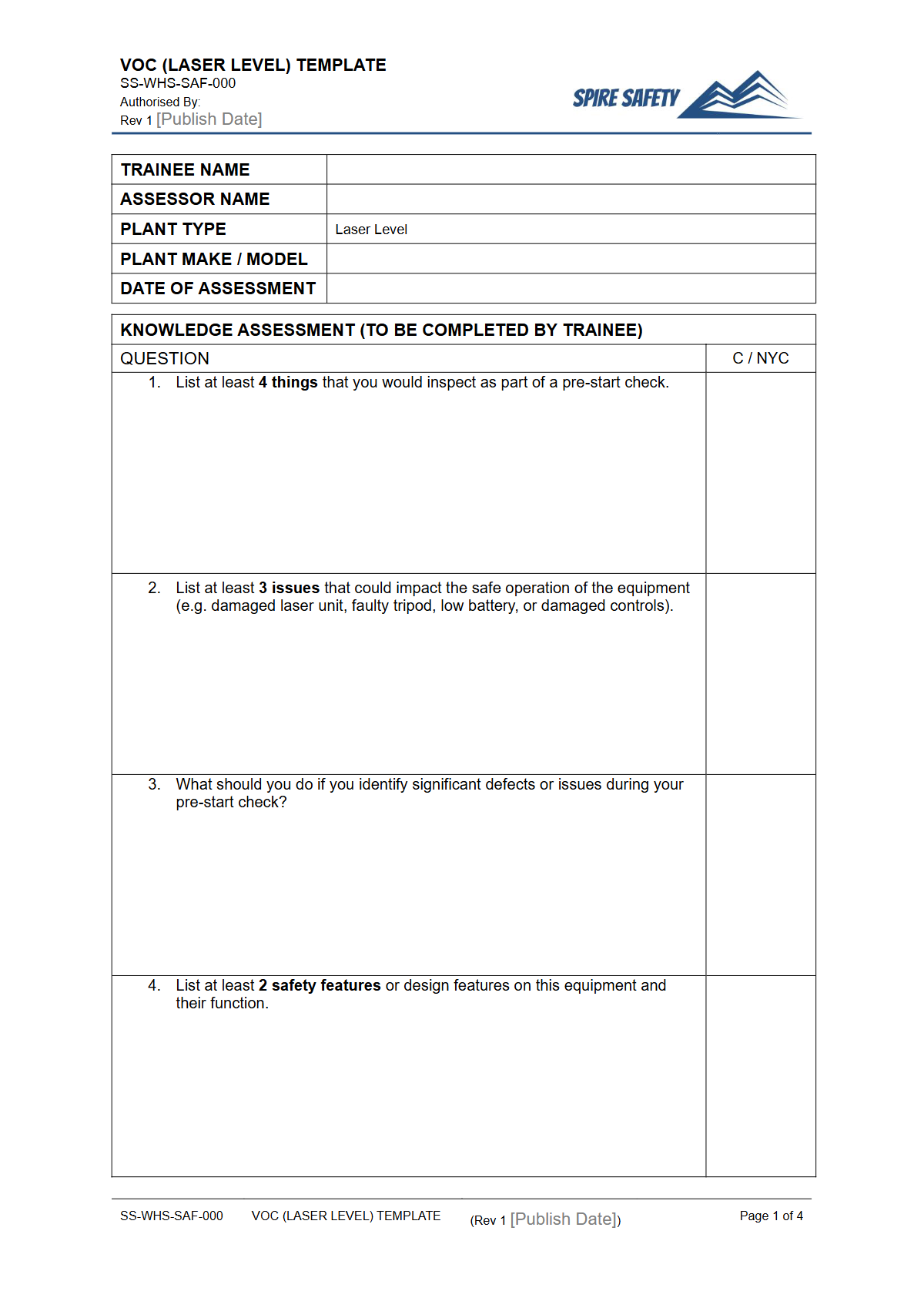
Download our free Verification of Competency (Laser Level) Template. This structured resource helps you assess operator skills and safety knowledge.
Free Verification of Competency (Laser Level) Template
DOCX • 138 KB + PDF
Updated Oct 2026
No signup required
Purpose of the Free Verification of Competency (Laser Level) Template
Operating a laser level safely and accurately is crucial on any worksite. While it may seem like a simple tool, misuse can lead to eye injuries, inaccurate measurements, and costly project rework.
This Free Verification of Competency (Laser Level) Template provides a structured framework for a Person Conducting a Business or Undertaking (PCBU) to confirm that their workers have the necessary skills and knowledge to use this equipment safely and effectively. It helps demonstrate that you are meeting your primary duty of care under WHS legislation to provide adequate training, instruction, and supervision.
A formal verification process ensures that competency is assessed consistently across your organisation. Using this template helps standardise the assessment criteria, covering everything from pre-use checks and correct setup to safe operation and shutdown procedures.
It forms a critical component of your overall safety framework, integrating with broader WHS management systems to minimise risk and promote a culture of safety.
Video walkthrough
How to use the Free Verification of Competency (Laser Level) Template
This downloadable document provides a comprehensive starting point for assessing your workers. The process is straightforward: download the DOCX or PDF, adapt it to your specific needs, and use it to conduct the assessment.
A competent person, such as a supervisor or experienced operator, should observe the worker performing the tasks and ask relevant theoretical questions to gauge their understanding.
Important: This is a template, not a finished document. You must customise it to reflect the specific make and model of laser level used in your workplace, your site-specific procedures, and the unique hazards present in your operational environment.
We have not accounted for every possible scenario or piece of equipment, so adding, removing, or modifying sections is essential for it to be effective.
For tasks involving more complex equipment on site, you may find our Verification of Competency (Mini Excavator) Template a useful resource for maintaining a consistent assessment approach across different plant types.
When to use it
A Verification of Competency (VOC) is not a one-off event. It should be conducted at several key points during a worker's employment to ensure their skills remain current. Consider using this laser level VOC template in the following situations:
- Pre-employment: To verify the claims of a potential new hire.
- Post-training: After a worker has completed initial training on the equipment.
- Introduction of new equipment: When a new type or model of laser level is introduced to the workplace.
- Post-incident: Following an incident or near-miss involving a laser level to identify any competency gaps.
- Periodic reassessment: As part of a regular schedule (e.g., every 1-2 years) to ensure skills have not diminished over time.
Regular assessments are a key part of a proactive safety culture and can be incorporated into your schedule of WHS compliance auditing to ensure ongoing adherence to safety standards.
Who should use it
This template is designed for use by any person responsible for workplace safety and worker competency. This typically includes:
- Supervisors and Team Leaders: Who are responsible for the day-to-day safety and performance of their teams.
- WHS/HSE Managers and Officers: Who oversee the organisation's safety management systems and compliance obligations.
- Project Managers: To ensure that all personnel on their project, including subcontractors, are competent to perform their assigned tasks safely.
- Competent Assessors: An individual designated by the PCBU who possesses the necessary knowledge, skills, and experience to conduct the assessment fairly and accurately.
The principles of competency verification apply to a wide range of tools and machinery. Whether assessing the use of hand tools or larger plant, the process is similar.
For example, the same structured approach can be applied when using our Free Drill Press VOC (Verification of Competency) Template for workshop equipment.
Similarly, for groundwork activities where laser levels are frequently used, ensuring competency on associated machinery is vital. You can apply the same verification principles using tools like our Verification of Competency (Trencher) template to build a comprehensive skills matrix for your team.
This document is one of many resources designed to support Australian businesses in managing their WHS obligations. You can explore our complete free WHS resources library for more templates, checklists, and guides.
Common mistakes
Common mistakes to avoid
- Assuming a worker's previous experience is sufficient without formal verification.
- Using a generic VOC checklist without customising it for the specific laser level model and workplace tasks.
- Failing to properly document the VOC outcome, observations, and any required corrective actions.
- Treating the VOC as a simple pass/fail exercise rather than an opportunity for refresher training and development.
Legal references
Legal considerations
The following legal requirements may be relevant to this type of work.
- Work Health and Safety Act (Harmonised) — Provides the primary duties for protecting workers and other people from work health and safety risks.
- Work Health and Safety Regulations (Harmonised) — Sets out requirements supporting the management of workplace hazards and risks.
The following codes may be relevant to this type of work.
- Managing WHS Risks Code of Practice — Provides practical guidance on identifying hazards, assessing risks and applying effective controls.
- Work Health and Safety Consultation, Cooperation and Coordination Code of Practice — Provides practical guidance on consulting workers and coordinating with other duty holders.
- Managing the Work Environment and Facilities Code of Practice — Provides practical guidance on safe work environments, workplace facilities and related controls.
Did you know
Laser Classification
Lasers are classified from Class 1 (safest) to Class 4 (most hazardous) based on their potential to cause eye and skin damage. Most construction lasers are Class 2 or 3R, which require specific safety controls.
Accuracy Is Key
Even a minor error in setting up a laser level can be magnified over distance, leading to significant structural errors, costly rework, and potential safety hazards on a construction project.
FAQ
Frequently asked questions
01Is a Verification of Competency the same as a licence?
02How often should I conduct a VOC for a laser level?
03Who is a 'competent person' to conduct the assessment?
04Does this template cover all types of laser levels?
Share this resource
Free Verification of Competency (Laser Level) Template
Browse Categories
How To Use It
- 1Download and open in Word or PDF.
- 2Replace the placeholders with your business details.
- 3Get it reviewed by a WHS specialist before rollout.
Need it customised?
Our WHS consultants can adapt this template to your site, run a gap analysis, or audit what you already have in place.
Book a Free Consultation WHS consulting servicesor call 1300 156 382
Related templates
- Free Verification of Competency (Laser Screed) Template
- Free Verification of Competency (Lighting Tower) Template
- Free Verification of Competency (Log Splitter) Template
- Free Verification of Competency (Manual Pallet Jack) Template
- Free Verification of Competency (Material Hoist) Template
- Free Verification of Competency (Mobile Crane) Template