
Free Position Description (Bricklayer) Template
Download our free, editable Position Description for bricklayers. This template helps you define key roles, responsibilities, and WHS duties. Get your DOCX now.
Free Position Description (Bricklayer) Template
DOCX • 135 KB + PDF
Updated Oct 2026
No signup required
Purpose of the Free Position Description (Bricklayer) Template
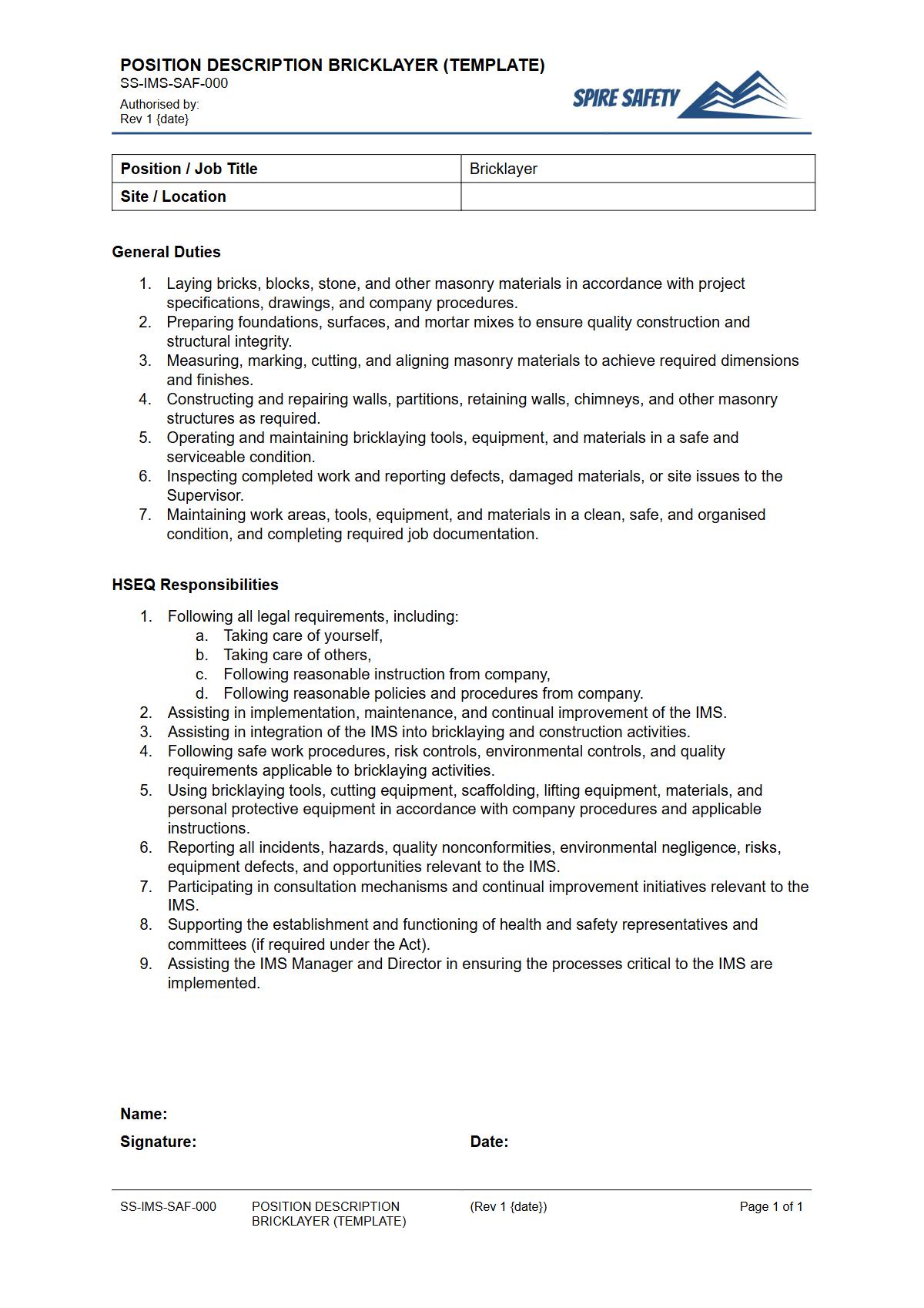
Defining roles and responsibilities clearly is fundamental to a safe and efficient construction site. This free Position Description (Bricklayer) template serves as a structured starting point for articulating the duties, qualifications, and safety accountabilities for bricklaying roles within your organisation.
A well-drafted PD goes beyond a simple task list; it establishes clear expectations for performance, behaviour, and, most importantly, workplace health and safety. It acts as a key document for recruitment, onboarding, and performance management, helping to ensure that every team member understands their specific contribution to site safety.
Furthermore, a detailed position description is an integral component of effective WHS management systems. It helps demonstrate that your business has systematically considered the requirements of each role and communicated the associated WHS duties to the worker, forming part of your evidence for due diligence.
How to use the Free Position Description (Bricklayer) Template
To get started, download the template in your preferred format (DOCX for editing or PDF for reference). The document is structured to cover the core areas of a comprehensive position description, but it requires careful customisation to be effective for your business.
Note: This document is a template only. It is essential that you customise it to reflect the specific tasks, equipment, hazards (e.g., silica dust, manual handling, noise), and control measures unique to your workplace and projects.
We are not responsible for the implementation or compliance of the final document you create.
Key Sections to Customise:
- Position Summary: Briefly describe the main purpose of the role.
- Key Responsibilities: Detail the primary tasks, such as preparing work areas, mixing mortar, laying bricks and blocks, and using tools and equipment. Be specific to the types of projects your business undertakes.
- WHS Duties: This is a critical section. List explicit safety responsibilities, such as adhering to Safe Work Method Statements (SWMS), correctly using personal protective equipment (PPE), reporting hazards and incidents, and participating in toolbox talks.
- Qualifications and Experience: Specify required trade qualifications (e.g., Certificate III in Bricklaying/Blocklaying), licences (e.g., white card), and the level of industry experience needed.
- Skills and Attributes: Outline necessary skills like physical fitness, attention to detail, teamwork, and communication abilities.
Once customised, the document should be reviewed to ensure it aligns with your legal and operational requirements. Engaging in a process of WHS compliance auditing can help confirm that your documented roles and responsibilities meet the standards set by Australian WHS legislation.
When to use it
A position description for a bricklayer is a dynamic document used throughout the employment lifecycle. It is most commonly used during the recruitment and selection process to attract and screen suitable candidates.
Following this, it becomes a vital tool for onboarding new employees, setting clear expectations from day one. It also provides a framework for ongoing performance reviews and identifying training needs.
In the unfortunate event of a workplace incident, the PD can be reviewed as part of the investigation to assess whether role duties were clearly defined and understood.
Who should use it
This template is designed for use by Human Resources (HR) managers, recruitment officers, site supervisors, and business owners in the construction industry. To ensure the position description is practical and accurately reflects the demands of the job, it is crucial to consult with experienced bricklayers or senior site personnel during the drafting process.
Their firsthand knowledge of the tasks, risks, and required skills is invaluable. For organisations needing expert assistance to ensure their PDs and other WHS documents are robust and fit for purpose, engaging external WHS consulting services can provide valuable insight and assurance.
By investing the time to properly define each role, you build a stronger foundation for safety culture and operational excellence. Explore our free WHS resources library for more templates and guides to support your safety management efforts.
Common mistakes
Common mistakes to avoid
- Using a generic template without customising it for site-specific hazards and tasks.
- Focusing only on operational duties and forgetting to include critical WHS responsibilities.
- Failing to consult with experienced workers or supervisors when drafting the document.
- Not reviewing or updating the position description after an incident or a change in work practices.
Legal references
Legal considerations
The following legal requirements may be relevant to this type of work.
- Work Health and Safety Act (Harmonised) — Provides the primary duties for protecting workers and other people from work health and safety risks.
- Work Health and Safety Regulations (Harmonised) — Sets out requirements supporting the management of workplace hazards and risks.
The following codes may be relevant to this type of work.
- Managing WHS Risks Code of Practice — Provides practical guidance on identifying hazards, assessing risks and applying effective controls.
- Work Health and Safety Consultation, Cooperation and Coordination Code of Practice — Provides practical guidance on consulting workers and coordinating with other duty holders.
- Managing the Work Environment and Facilities Code of Practice — Provides practical guidance on safe work environments, workplace facilities and related controls.
Did you know
Silica Dust Risk
Bricklaying activities like cutting bricks can generate respirable crystalline silica, a hazardous dust that can cause serious lung diseases. Engineering controls, such as on-tool dust extraction, are critical.
Manual Handling Load
A single brick can weigh between 2 to 4 kg. An average bricklayer can lift over 1,000 kg in a single day, making hazardous manual tasks one of the biggest injury risks in the trade.
FAQ
Frequently asked questions
01What WHS duties should be included in a bricklayer's position description?
02Is a position description a legally required document in Australia?
03How often should a bricklayer's position description be reviewed?
04Can this template be used for a bricklaying apprentice?
Share this resource
Free Position Description (Bricklayer) Template
Browse Categories
How To Use It
- 1Download and open in Word or PDF.
- 2Replace the placeholders with your business details.
- 3Get it reviewed by a WHS specialist before rollout.
Need it customised?
Our WHS consultants can adapt this template to your site, run a gap analysis, or audit what you already have in place.
Book a Free Consultation WHS consulting servicesor call 1300 156 382